
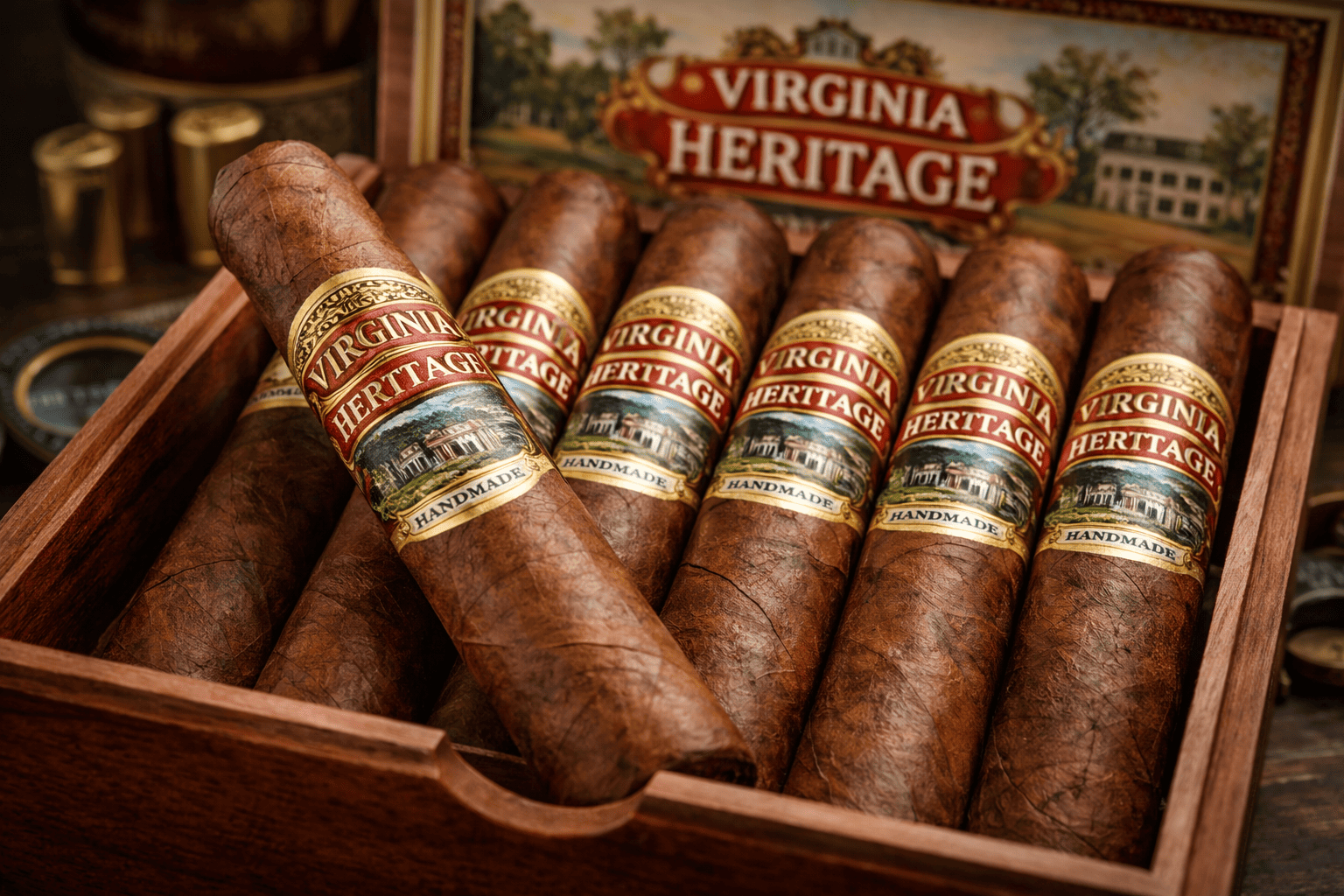
Virginia occupies a singular place in the history of tobacco. Long before cigar factories rose in Havana or Santiago, the soil along the James River was already shaping the global perception of fine leaf. Virginia Heritage cigars emerge from that lineage, not as nostalgic artifacts, but as contemporary expressions of an American agricultural legacy refined through modern curing, blending, and restraint. They represent a deliberate return to origin, filtered through technical discipline rather than romantic abstraction.
John Rolfe’s introduction of Nicotiana tabacum to Virginia in 1612 altered the economic trajectory of the English colonies. As historian Alan Taylor notes, “By the mid-seventeenth century, tobacco had become the economic lifeblood of colonial Virginia.”
Source: https://www.mountvernon.org/library/digitalhistory/digital-encyclopedia/article/tobacco/
That foundation still informs Virginia Heritage cigars. They are not attempts to imitate Caribbean profiles. Instead, they translate regional agronomy into cigars that privilege aroma, combustion integrity, and layered sweetness, shaped by flue-curing traditions and temperate climate variability.
Virginia Tobacco And Its Agricultural Identity
Virginia tobacco differs structurally from equatorial leaf. The state’s latitude produces longer daylight variation, cooler nights, and slower maturation. These conditions yield thinner leaves with higher natural sugar content and lower nicotine concentration.
According to the University of Kentucky College of Agriculture, “Flue-cured tobacco is characterized by high sugar content and mild flavor, making it distinct from air-cured or fire-cured types.”
Source: https://www2.ca.uky.edu/agcomm/pubs/id/id160/id160.pdf
Virginia Heritage cigars often rely on flue-cured Virginia leaf as a component rather than a dominant wrapper. Its combustibility and sweetness influence the blend architecture, contributing brightness and aromatic lift rather than weight.
Key agronomic traits include:
- Elevated natural sugars
- Reduced alkaloid concentration
- Thin cell walls promoting even burn
- Pronounced hay, citrus peel, and bread-like aromas
These traits demand careful fermentation control. Excess heat risks caramelization that can flatten nuance.
Fermentation And Processing Discipline
Virginia Heritage cigars require fermentation strategies distinct from those used for Nicaraguan or Honduran leaf. Flue-cured tobacco enters fermentation with higher sugar content, increasing the risk of overheating.
Producers often employ:
- Lower pile heights
- Extended fermentation cycles
- Frequent rotation to manage internal temperature
- Post-fermentation aging exceeding 18 months
These steps stabilize sugars and prevent acrid byproducts. The result is a leaf that burns evenly and retains aromatic clarity rather than developing charred bitterness.
Construction Philosophy And Craft
Virginia Heritage cigars emphasize balance and combustion predictability. Construction avoids dense bunching. Draw resistance remains moderate, encouraging slow cadence.
Observed physical characteristics include:
- Elastic wrappers with fine venation
- Uniform cylindrical symmetry
- Cool-burning combustion temperature
- Ash that forms in layered segments rather than dense stacks
These attributes improve reliability during packing cigars for travel, especially when cigars encounter moderate humidity fluctuation during transit.
Sensory Architecture And Flavor Evolution
Virginia Heritage cigars present a progression shaped by sweetness and structure rather than intensity. Their development favors aromatic layering over abrupt shifts.
Opening Phase
The initial light introduces:
- Fresh hay
- Toasted white bread
- Light honey
- Subtle citrus zest through retrohale
Smoke texture appears airy yet cohesive. Pepper presence remains minimal, allowing sweetness to define the opening impression.
Middle Phase
As combustion stabilizes, flavors deepen:
- Baked apple
- Almond flour
- Warm cedar
- Soft dairy notes reminiscent of cream
Sweetness integrates with mild tannic dryness, creating balance rather than contrast.
Final Phase
The closing segment narrows in focus:
- Toasted grain
- Light espresso crema
- Dry earth
- Faint leather
Strength increases marginally, though nicotine impact remains restrained. Combustion remains even without bitterness when smoked patiently.
Blending Strategies And Leaf Integration
Virginia Heritage cigars rarely rely on single-origin purity. Instead, they often integrate:
- Virginia flue-cured filler for sweetness
- Dominican binder for elasticity
- Ecuadorian shade wrapper for structural integrity
This approach stabilizes burn rate and broadens flavor spectrum without overpowering the Virginia component.
Such blends reward attentive smokers and perform reliably under TSA cigar restrictions screening and standard airport handling.
Aging Behavior And Cellaring
Virginia-forward cigars age differently from mineral-heavy Nicaraguan blends. Their sugars integrate quickly, making early aging impactful.
After 12–24 months at 65–67 percent relative humidity:
- Sweetness becomes more cohesive
- Grain notes gain depth
- Citrus sharpness softens
- Smoke texture thickens slightly
Extended aging beyond five years often leads to aromatic fade. These cigars favor moderation over long-term hoarding.
Understanding customs rules for cigars becomes relevant when transporting aged stock internationally, as declaration thresholds differ widely.
Travel, Regulation, And Practical Ownership
Virginia Heritage cigars often accompany enthusiasts who value subtlety over force. Their mild-to-medium profile suits varied climates and social contexts.
Air Travel Considerations
Most airlines permit cigars in carry-on and checked baggage. Carry-on transport remains preferred to avoid temperature variation in cargo holds. Knowledge of how to carry humidor on plane includes selecting rigid cases and humidity packs calibrated below 70 percent.
Customs And Import Limits
Cigar laws by country vary considerably. Many jurisdictions impose quantity limits or require declaration beyond specified thresholds. Failure to comply risks confiscation or duty assessment.
Virginia Heritage cigars, being American-made, avoid embargo-related complications but remain subject to import limits abroad.
International Shipping
Shipping cigars internationally introduces temperature and handling risk. Virginia leaf’s thinner structure makes prolonged shipping without climate control less advisable than personal transport.
Duty-Free Acquisition
Duty-free cigar buying tips apply when Virginia Heritage cigars appear in select airport retailers. Retaining receipts and verifying destination allowances protects against customs issues.
Cultural Context And Smoking Environments
Virginia Heritage cigars align with reflective smoking environments. Their profile favors conversation, reading, and contemplative pacing.
Cigar-friendly travel destinations often provide private lounges or hotel cigar rooms where such cigars can be enjoyed without conflict. Local smoking regulations abroad increasingly restrict public smoking regardless of tobacco type, making private venues essential.
Respect for local norms remains integral to enjoying these cigars responsibly.
Comparison With Other American Tobacco Traditions
Virginia Heritage cigars differ from other U.S. tobacco expressions:
- Compared to Kentucky fire-cured products: less smoke density, greater sweetness
- Compared to Pennsylvania broadleaf cigars: lighter body, higher aromatic lift
- Compared to Connecticut shade cigars: more grain-driven sweetness, less cream
These distinctions define Virginia Heritage cigars as structurally delicate yet sensorially articulate.
Who Virginia Heritage Cigars Serve Best
These cigars suit smokers who prioritize:
- Aromatic clarity
- Sweetness without heaviness
- Combustion consistency
- Lower nicotine impact
They appeal to those interested in American agricultural continuity translated into refined smoking instruments.
Final Considerations
Virginia Heritage cigars embody restraint guided by history and agronomy. They do not pursue dominance through strength or visual theatrics. Their value lies in how they convert flue-cured sweetness, careful fermentation, and disciplined construction into measured sensory progression.
For enthusiasts managing global travel, regulatory frameworks, and evolving smoking environments, these cigars offer reliability and quiet distinction. Whether stored thoughtfully, transported across borders in compliance with airline and customs protocols, or enjoyed in settings shaped by local smoking regulations abroad, Virginia Heritage cigars reward patience and attention.
Their significance rests not in novelty, but in how consistently they translate American tobacco heritage into balanced, contemporary expression—one deliberate draw at a time.