
The enduring cultural gravity of The Sopranos rests not only on its narrative architecture or psychological acuity, but on a dense fabric of visual and social cues that shaped how authority, leisure, and masculinity appeared on screen at the turn of the millennium. Among those cues, cigars occupied a steady, carefully placed role. They functioned as tools of posture and pacing, marking shifts in power, mood, and hierarchy. In this environment, the cigar was neither ornament nor indulgence alone. It became an object through which character, ritual, and status were communicated with economy.
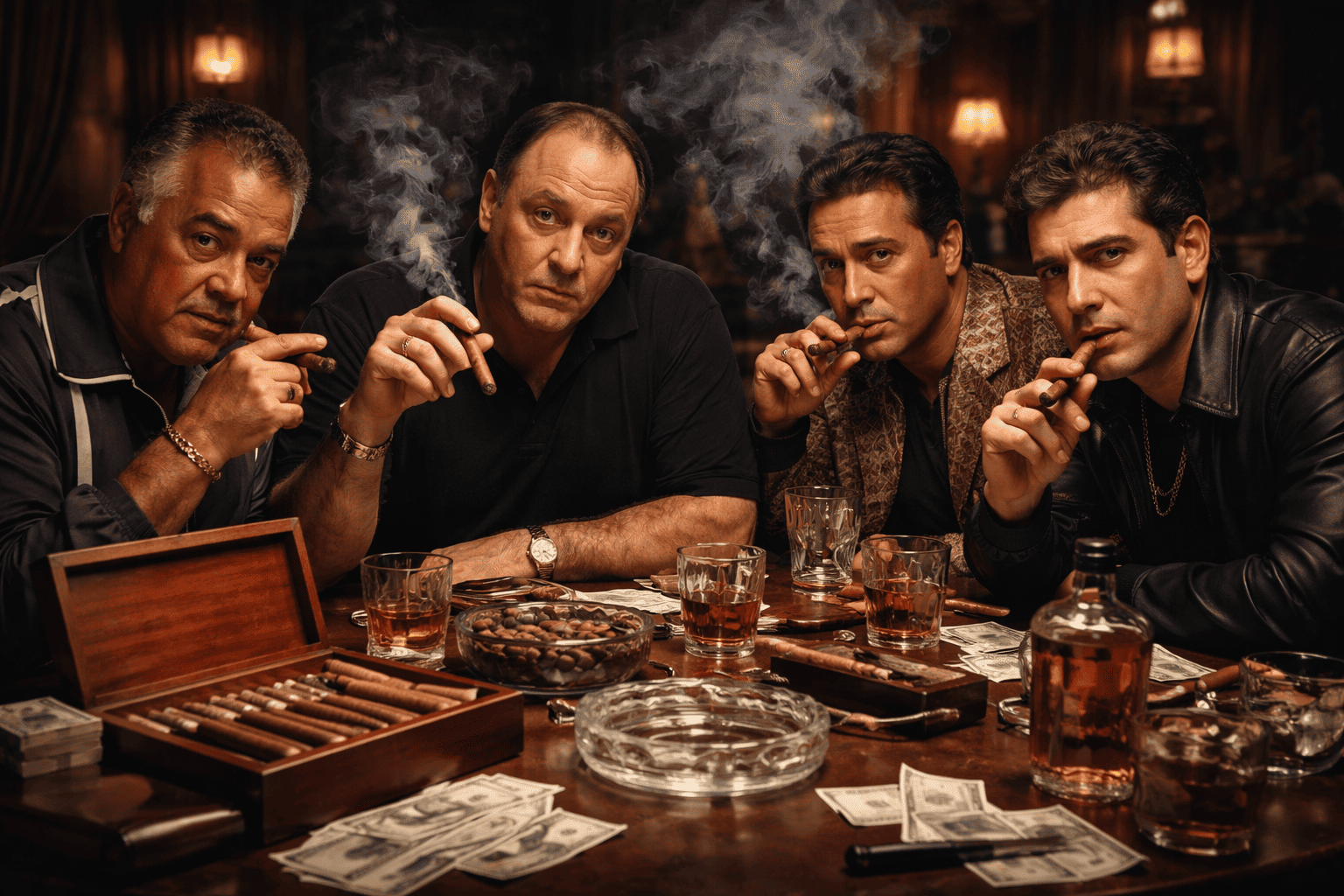
The presence of cigars in the series aligned with a broader pattern in American visual culture. Cigars in movies and TV had long been associated with figures of command, from industrial magnates to crime bosses. What distinguished The Sopranos lay in its restraint. Cigars appeared in moments of reflection, negotiation, or quiet dominance rather than constant display. This selective placement allowed the object to retain symbolic weight, avoiding caricature while remaining legible to the audience.
Cultural Context: Cigars and Late-20th-Century American Masculinity
By the late 1990s, cigars had re-entered American popular consciousness. Industry data from the Cigar Association of America shows that U.S. cigar consumption rose from roughly 2.1 billion units in 1993 to over 4.3 billion by 1998, a surge often attributed to lifestyle media, celebrity visibility, and the framing of cigars as markers of success rather than vice. This period coincided with the development and airing of The Sopranos, situating the series within a real-world cigar revival rather than an invented aesthetic.
Cigars and luxury lifestyle imagery merged during this phase. Magazines, lounges, and private clubs framed cigar smoking as a contemplative practice tied to affluence and discernment. The series reflected that atmosphere with precision. Cigars appeared in back rooms, patios, and offices rather than public streets, reinforcing their association with controlled environments and selective access.
Tony Soprano and the Semiotics of the Cigar
The character of Tony Soprano, portrayed by James Gandolfini, rarely engaged in ostentatious ritual. When cigars entered his hands, they did so with purpose. Often uncut until moments before lighting, frequently paired with silence rather than dialogue, the cigar served as an extension of decision-making rather than leisure alone.
From a construction perspective, the cigars shown on screen typically resembled large ring gauge, dark-wrapped profiles common in the American market at the time. While specific brands were not foregrounded, the visual language aligned with maduros and broadleaf wrappers, styles associated with deeper combustion aromas and heavier mouthfeel. This visual choice reinforced Tony’s grounded, weighty presence. Lighter wrappers or slender formats would have conveyed a different temperament altogether.
The cigar’s burn rhythm mirrored the character’s internal pacing. Slow draws accompanied moments of contemplation. Faster puffs appeared during agitation or confrontation. This choreography echoed observations from cigar historians such as Richard Carleton Hacker, who wrote in The Ultimate Cigar Book: “A cigar is not merely smoked; it is paced, and that pace becomes part of its meaning.” The series applied this principle without exposition.
Ritual Spaces: Back Rooms, Patios, and Power Geometry
Cigars in The Sopranos were rarely smoked in isolation. They appeared in shared spaces that carried implicit rules. The back room of the Bada Bing, private home patios, and informal outdoor gatherings acted as modern equivalents of the cigar lounge. These settings echoed real-world famous cigar lounges, where hierarchy often reveals itself through seating, lighting, and silence rather than speech.
In such scenes, the cigar became a stabilizing object. Hands occupied by tobacco were less likely to gesture wildly. Conversations slowed. Decisions gained gravity. This mirrored sociological research on ritual objects. Anthropologist Mary Douglas observed that shared rituals reduce ambiguity within groups by establishing predictable patterns of behavior. The cigar fulfilled that role with efficiency.
Sopranos Cigars as Licensed Culture
During the early 2000s, the popularity of the series led to licensed merchandise, including cigar-related products marketed under The Sopranos name. These items entered a marketplace already receptive to celebrity cigar endorsements and celebrity cigar brands. While the long-term commercial footprint of such products remained limited, their existence signaled the strength of the association between the series and cigar culture.
Collectible celebrity cigars tied to film and television often function less as daily smoking options and more as cultural artifacts. Packaging, band design, and naming conventions frequently reference specific scenes or character archetypes rather than blend composition. In this sense, Sopranos-branded cigars occupied a space closer to memorabilia than connoisseur staples, yet they reinforced the idea that the cigar was central to the show’s identity.
Famous Cigar-Smoking Celebrities and Screen Influence
The Sopranos joined a lineage of productions that shaped how cigars functioned within popular imagination. Famous cigar-smoking celebrities such as Winston Churchill, Jack Nicholson, and Arnold Schwarzenegger had already cemented the cigar as a visual shorthand for authority and independence. The series updated that shorthand for a contemporary setting, stripping away glamour and replacing it with domestic tension and moral ambiguity.
Pop culture cigar moments within the show avoided spectacle. There were no slow-motion lighting scenes or celebratory toasts framed around tobacco. This restraint aligned with critical commentary from media scholars. David Chase, the series creator, noted in a 2007 interview with The New York Times that he aimed to depict “the banality of power,” allowing everyday objects to carry weight without fanfare. The cigar fit that philosophy.
Sensory Reading: What the Screen Suggests About Flavor
While the series did not engage in explicit tasting language, the visual cues allow informed inference. Dark wrappers, substantial smoke output, and relaxed draw patterns suggest cigars leaning toward medium-to-full body. One would expect flavor profiles dominated by earth, roasted coffee, leather, and subdued sweetness rather than sharp spice. Such profiles align with blends popular in the U.S. market during the show’s production years, particularly those produced in Nicaragua and Honduras for American consumption.
The absence of ash-focused close-ups or commentary on construction indicates that technical perfection was secondary to symbolic function. The cigars burned well enough to avoid distraction. That sufficed. In a narrative sense, flawless construction would have drawn unnecessary attention. Slight irregularities, visible relights, and uneven ash contributed to realism rather than detracted from it.
Cigars as Social Currency
Within the series, cigars functioned as gifts, peace offerings, and markers of respect. Offering a cigar signaled inclusion within a circle, even if temporarily. Refusing or ignoring such an offer carried meaning. This dynamic mirrors real-world practices documented in studies of informal economies. Sociologist Diego Gambetta has written extensively on how symbolic goods facilitate trust in environments where formal contracts hold little sway. The cigar served that function with minimal dialogue.
This practice resonates with how cigars shaped celebrity image beyond the screen. Public figures photographed with cigars often leveraged the image to project autonomy or defiance. In The Sopranos, that projection was internalized within the narrative rather than marketed outward.
The Broader Legacy in Cigars and Television
The influence of The Sopranos extended into later productions that adopted similar visual language. Series such as Mad Men and Boardwalk Empire also employed cigars as narrative instruments rather than background props. In each case, the object retained its association with contemplation and authority, even as cultural attitudes toward smoking shifted.
Data from the Centers for Disease Control and Prevention indicates that cigarette smoking declined steadily in the U.S. after 2000, while cigar use remained comparatively stable among certain demographics. This divergence reinforced the cigar’s positioning as a deliberate choice rather than a habitual one. Television portrayals that emphasized ritual over frequency supported that distinction.
Final Considerations
Sopranos cigars occupy a distinctive position at the intersection of narrative economy, cultural symbolism, and material ritual. Their presence within the series reflected real-world trends without amplifying them beyond credibility. The cigars neither redeemed nor condemned their users. They observed.
For readers interested in cigars and pop culture, the series offers a study in restraint. It demonstrates how an object associated with indulgence can function as a narrative stabilizer, grounding scenes in silence and measured time. The legacy persists in how cigars continue to appear across media, not as spectacle, yet as quiet indicators of power, reflection, and negotiated space.
In that sense, Sopranos cigars remain less about smoke and more about what surrounds it: pauses, glances, unspoken agreements. That context, carefully sustained, keeps their cultural resonance intact.