
Odyssey Sweet Tip cigars represent a distinct, value-oriented expression within General Cigar’s portfolio. They are built to present an accessible, mildly sweet aromatic profile while preserving the construction and combustion characteristics expected of a hand-rolled Nicaraguan-made stick. The treatment below addresses provenance, blend architecture, a phase-based sensory evaluation, practical storage and pairing guidance, and measured commentary on the product’s place in the flavored/infused marketplace. Where manufacturer and retail descriptions exist, verbatim industry text is used with source links for verification.
Brand Context and Market Position
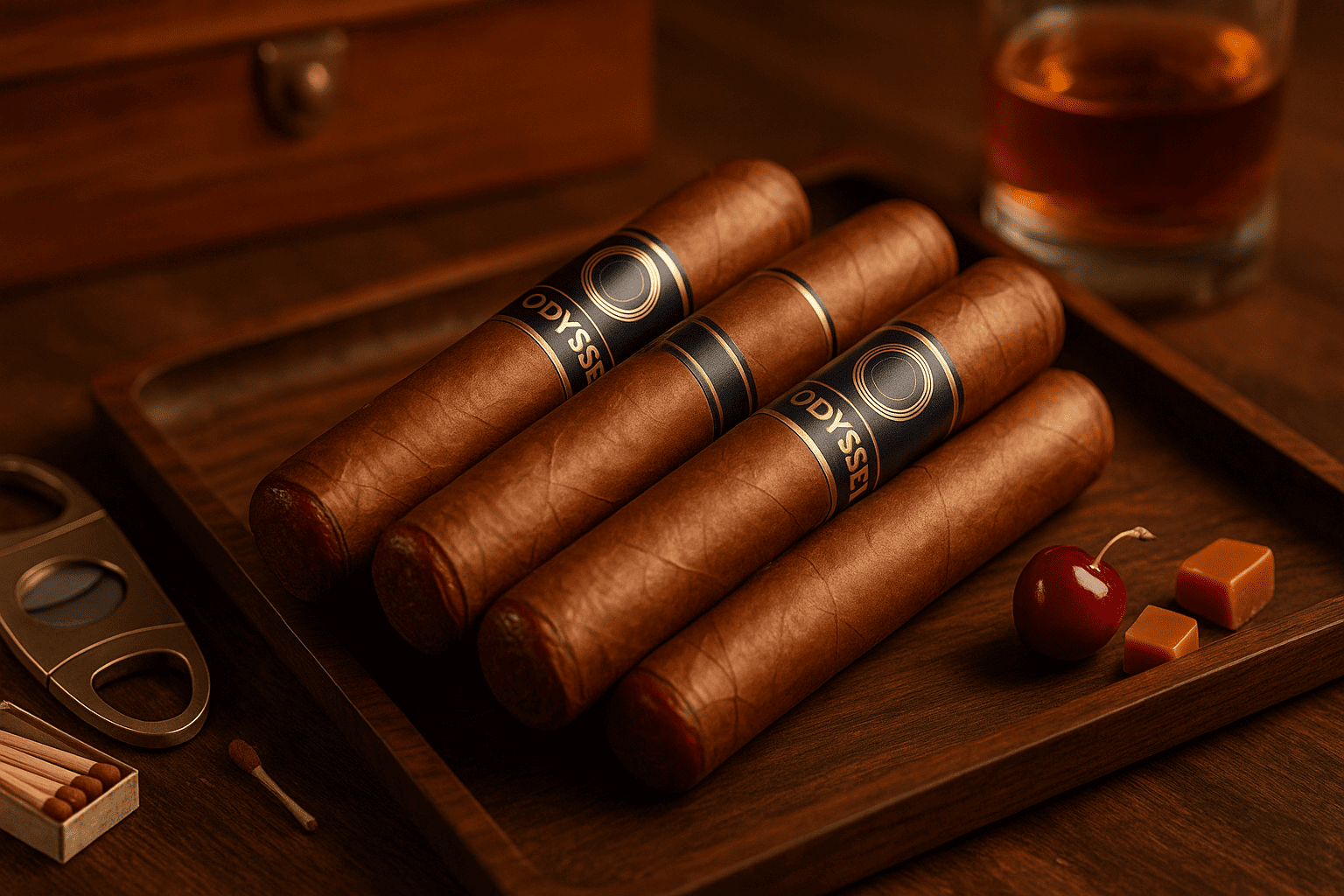
Odyssey is produced under the General Cigar / STG umbrella and is positioned as a budget-friendly, everyday brand assembled from Cuban-seed tobaccos grown in Nicaragua and Honduras. Retail specification pages consistently identify a Nicaraguan Habano wrapper, Honduran binder, and a filler mix of Nicaraguan and Honduran leaves. Neptune Cigar describes the line as: “The Odyssey Sweet Tip is a value-priced, mild-strength stogie that is handmade in Nicaragua.” NeptuneCigar. Retailers emphasize affordability and an uncomplicated flavor direction intended to broaden appeal. Cigars International summarizes the consumer proposition bluntly: “The flavors are rich, creamy, and sweet, and the construction is top-notch for pennies on the dollar!” Cigars International.
Market-scale data is relevant when situating product strategy: the global cigar and cigarillos market was estimated at USD 54.79 billion in 2024, a figure that helps explain manufacturers’ investments in accessible, flavored-cap styles and other diversification strategies. Grand View Research
Construction and Blend Architecture
Odyssey Sweet Tip blends follow predictable engineering choices intended to optimize draw, burn stability, and a gentle aromatic lift from the cap:
- Wrapper: Nicaraguan Habano—selected for structural integrity, moderate oil, and natural sweetness that will not mask a sweetened cap.
- Binder: Honduran—chosen to add body and a steady combustion rate.
- Filler: Nicaraguan and Honduran Cuban-seed long-fillers—long filler improves ash cohesion and supports a longer, more even burn in mid-sized vitolas.
Retailers and product pages repeatedly note the presence of a sweetened cap rather than a fully flavored wrapper or homogenized flavored leaf. JR Cigars describes the formulation with a precise product claim: “Thanks to its sweetened tip, the flavors are rich, creamy, and naturally sweet, and the fragrant vanilla-like aroma will be enticing for both you and those nearby.” JR Cigars.
This construction strategy yields a cigar that reads, technically, as a conventional premium stick with an applied cap treatment rather than a wholly flavored or infused product.
Terminology Clarification: Infused vs. Flavored
Clarity of terms assists both evaluation and storage choices. Sources that explain the processes distinguish two primary approaches:
- what are infused cigars: commonly used to describe premium cigars that have been aged or conditioned in aromatic environments so flavor constituents penetrate leaf structure over time. Cigar.com overview.
- how cigars are flavored: describes a suite of methods—direct topical application (sprays or dips), flavored homogenized leaf wrappers, or vapor/steeping infusion—each yielding different perceptual and storage properties. MontesCigarShop.
A careful reader will note infused vs flavored differences in intent and outcome: infusion aims for persistence and integration; flavored application tends to deliver immediate and sometimes ephemeral surface sweetness. Cigar.com
Sensory Method and Phase-Based Tasting
A reproducible sensory report divides the smoke into three measurable phases: opening (pre-light and first third), development (middle third), and finish (final third). The Odyssey Sweet Tip produces a characteristic arc; quantified metrics and qualitative descriptors are recorded below.
Opening (pre-light and first third)
Pre-light aroma: noticeable vanilla/cream notes concentrated around the sweetened cap; the wrapper contributes a muted grain and hay aroma.
First draws: candied vanilla and soft caramel appear immediately, supported by a mild tobacco sweetness. Draw resistance typically falls in the light-to-moderate band (numerical scale 1–5: commonly 2–3). Burn starts even when the sample is structurally sound.
Perceptual weight: mild–medium, leaning toward mild; the cap treatment is clearly the dominant aromatic.
Development (middle third)
Integration: the filler tobaccos begin to assert cedar, light earth, and a subtle pepper note; vanilla becomes less saccharine and acts as a smoothing background.
Technical markers: ash cohesion and burn line indicate long-filler construction is performing as intended; a steady pale-gray ash and narrow burn scarf are positive signs.
Flavor balance: the tobacco frame gains presence and the cap treatment transitions from overt sweetness to supportive cream.
Finish (final third)
Concentration: toasted sugar and light leather appear; if the cap flavoring was restrained, the cigar closes with warm, bakery-like vanilla lingering on the retrohale.
Risk factors: over-rapid puffing or elevated heat can cause the sweet cap to scorch, producing acrid or chemical notes—moderate pacing (approx. 20–30 seconds between puffs) minimizes that risk.
Product Advantages and Limitations
A balanced appraisal must list flavored cigar pros and cons in pragmatic terms:
- Advantages: accessible aromatic lift for newcomers, reliable construction at a modest price point, and a product concept that pairs well with dessert-style beverages.
- Limitations: some smokers will perceive the sweetened cap as a surface treatment that fades; long-term aging is not typically recommended for sugar-laden caps; regulatory attention to flavored products can affect availability in some markets. Retail reviews reveal variability—some report pronounced vanilla and cream, others note a subdued cap—so sampling before bulk purchase is advisable. JR Cigars, Cigars International.
Are Flavored Cigars Natural?
The question are flavored cigars natural is not binary. Some flavored and infused products explicitly reference natural extracts—for instance, CAO’s Bella Vanilla labels may reference vanilla extract—while other offerings use synthesized flavorants or non-disclosed flavor compounds. Readers requiring natural-source verification should consult manufacturers’ product pages and packaging declarations. CAO Bella Vanilla reference.
Vanilla Examples and Comparative Notes
A brief vanilla infused cigars review of widely available market references shows two pathways:
- Signature infused lines (e.g., Drew Estate ACID Blondie, CAO Bella Vanilla) emphasize integrated aromatics and, for many reviewers, retain vanilla through the midsection. Drew Estate ACID, CAO Bella Vanilla review.
- Budget sweet-cap products such as Odyssey Sweet Tip behave somewhat differently: the cap provides an immediate aromatic invitation, then the core tobacco occupies the mid and final thirds. Retail tasting notes reflect this pattern.
Storage and Use Recommendations
Practical guidance for flavored or cap-treated cigars is straightforward: flavored cigar storage tips emphasize separation and moderate humidity control.
- Maintain a humidor at standard conditions (approx. 65–70% RH) for short-term storage.
- Store sweet-cap or infused cigars in dedicated drawers or sealed tins to avoid cross-flavoring.
- Avoid prolonged cellaring of sugar-treated caps; higher humidity combined with sugars increases risk of mold or wrapper tackiness.
- Rotate samples and smoke within months rather than years for best aromatic fidelity. Cigar.com storage guide.
How Cigars Are Flavored: Methods and Implications
How cigars are flavored spans techniques from steeping and vapor infusion to topical application:
- Steeping/infusion: Leaves are exposed to aroma-rich environments allowing permeation; this method yields integrated aroma.
- Topical application / spray: Flavorings applied externally create a strong pre-light scent but may fade quickly under combustion.
- Homogenized leaf wrappers: Flavored homogenized leaf (HCL) wrappers with incorporated flavorings offer another route; they can be very consistent but are often associated with lower price points.
The methodology impacts the longevity of flavor, the product’s compatibility with humidor storage, and the way aromatics interact with tobacco’s natural oils.
How to Pair Flavored Cigars and Cocktail Pairings for Flavored Cigars
How to pair flavored cigars requires proportional matching between cigar intensity and beverage body:
- Vanilla/caramel notes: Bourbon Old Fashioned (bourbon, sugar, bitters) or a cream-forward after-dinner drink.
- Cherry/fruit-forward caps: Cherry Manhattan or cognac with a fruit-forward finish.
- Coffee/roast-infused sticks: Espresso martini or an aged rum with coffee notes.
A short list of cocktail pairings for flavored cigars: vanilla Old Fashioned (bourbon, vanilla syrup), espresso martini (for chocolate/coffee-infused sticks), and cherry Manhattan (rye, cherry liqueur) for cherry-accented cigars. When pairing, keep volume moderate and avoid mixing multiple intense flavors; the goal is complementarity rather than competition.
Brand Selection and Comparative Brands
When considering best infused cigar brands, established companies such as Drew Estate (ACID, Tabak Especial) and CAO (Flavours series) appear frequently on curated lists due to consistent infusion techniques, transparency in product descriptions, and broad distribution. These larger houses invest in process control that increases the likelihood of integrated aromatics, which is informative when comparing a sweet-cap product like Odyssey to dedicated infused offerings. Drew Estate, CAO.
Purchasing Advice and Use Cases
- Buy single sticks or small bundles to confirm the cap’s intensity and the overall burn before committing to larger quantities.
- Use Odyssey Sweet Tip as an informal, social smoke—its mild profile and accessible aromatics suit casual outdoor sessions and situations where a lighter, more aromatic smoke is preferred.
- Retailers frequently market these sizes in bundle formats for value-oriented consumers. Famous Smoke product page.
Final Considerations
Odyssey Sweet Tip cigars function as an engineered compromise: they retain long-filler construction and hand-rolled technique while adding a surface-level aromatic accent that broadens appeal. For consumers seeking a mild, vanilla-leaning profile with reliable burn and an approachable price, Odyssey’s sweet-tip formulation is a reasonable entry point. For those focused on integration of flavor at a structural level, dedicated infused lines from specialist houses offer an alternative approach. In practice, the best path to satisfaction is controlled sampling—documented draw, timed pacing, and matched beverage pairing—so that the buyer can translate marketing claims into reproducible sensory outcomes. Retail and industry references cited above provide verifiable product descriptions and practical guidance for storage, pairing, and further comparative evaluation.