
Few public figures have embodied physical dominance and volatility as completely as Mike Tyson. During his ascent in the mid-1980s, Tyson’s image was forged through speed, force, and an almost ritualistic intensity that extended beyond the boxing ring. In later decades, as his public identity evolved from feared heavyweight champion to reflective cultural figure, cigars emerged as a recurring companion. They appeared not as symbols of conquest, but as markers of control, patience, and recalibration. Within that arc, Mike Tyson cigars reveal how tobacco can mirror personal transformation while remaining anchored in broader traditions of cigars and luxury lifestyle culture.
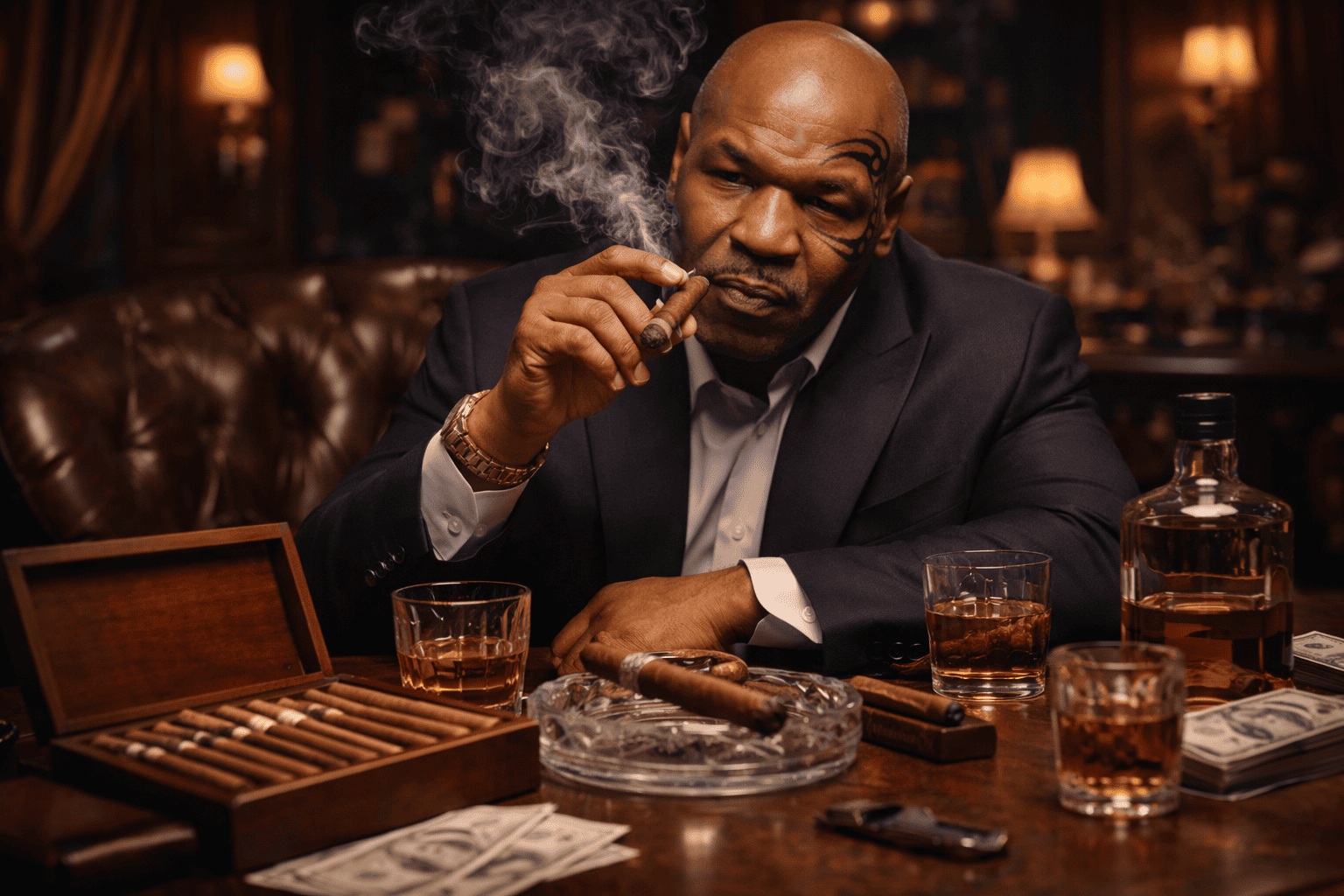
Tyson’s association with cigars belongs to a lineage shaped by famous cigar-smoking celebrities whose public rituals reframed tobacco as deliberate rather than impulsive. In this context, the cigar operates as a counterpoint to chaos. Smoke slows time. Combustion introduces structure. For Tyson, whose career unfolded at extremes of speed and pressure, the cigar became a studied pause.
Historical Context: Boxing, Status, and Cigar Culture
The connection between championship boxing and cigars predates Tyson by generations. Heavyweight champions from Jack Johnson to Joe Louis were photographed with cigars as visual shorthand for arrival. These images circulated in newspapers and later television, reinforcing cigars as emblems of earned status. Cultural historian David Wondrich observed that cigars historically signaled “arrival into a class that controls its own time,” a notion closely aligned with prizefighting success.
By the 1980s, when Tyson rose to prominence, cigars occupied a renewed place in American culture. According to the Cigar Association of America, U.S. cigar consumption increased steadily during the late 1980s and accelerated in the 1990s, reaching over 4 billion units annually by the decade’s end. This revival coincided with expanded media coverage and the emergence of celebrity cigar endorsements that framed cigars as curated lifestyle choices rather than habitual consumption.
Source: https://www.cigarassociation.org/industry-statistics/
Tyson’s public cigar use entered this environment already primed to read tobacco as a symbol of wealth, contemplation, and controlled indulgence.
Early Imagery: Cigars and Post-Fight Ritual
During Tyson’s championship years, cigars appeared intermittently in post-fight settings, private gatherings, and media photographs. These moments differed sharply from celebratory champagne imagery common in other sports. The cigar suggested a quieter form of acknowledgment. No spectacle. No rush.
From a sensory perspective, cigars favored by elite athletes during this period typically leaned toward full-bodied profiles. Large ring gauges and dark wrappers were prevalent in the U.S. market, reflecting consumer preference for depth and persistence. Such cigars, often produced in Nicaragua or Honduras, delivered dense smoke with aromas of earth, charred wood, and roasted coffee. These characteristics aligned with the gravitas expected of heavyweight champions.
The cigar’s slow burn contrasted with Tyson’s explosive fighting style. That contrast amplified its meaning. Smoke replaced movement. Stillness replaced violence.
Transformation and Reflection: Cigars as Discipline
After Tyson’s incarceration and subsequent return to public life, his relationship with cigars shifted in tone. Appearances in interviews, documentaries, and later cigars in movies and TV presented tobacco not as a victory marker, but as a stabilizing ritual. Cigars accompanied conversation rather than celebration.
This change aligned with broader sociological interpretations of ritual consumption. Anthropologist Mary Douglas argued that ritual objects help individuals impose order on environments marked by uncertainty. The cigar’s structure—cut, light, draw, ash—offers predictability. For Tyson, whose later years involved public introspection, the cigar functioned as a tactile anchor.
Mike Tyson and Pop Culture Cigar Moments
Tyson’s presence in pop culture extended well beyond boxing. Appearances in films such as The Hangover series and frequent podcast interviews positioned him within a new media ecosystem. In several of these settings, cigars appeared as part of relaxed, conversational spaces rather than performative displays. These pop culture cigar moments reinforced a recalibrated image: reflective, composed, grounded.
Unlike iconic cigar scenes built around triumph or menace, Tyson’s cigar moments emphasized neutrality. The cigar did not dominate the frame. It shared space with dialogue. This subtlety aligned with evolving norms around how cigars shaped celebrity image in the 21st century, favoring authenticity over theatricality.
The Emergence of Tyson 2.0 Cigars
In 2022, Tyson formalized his relationship with tobacco through the launch of Tyson 2.0 Cigars, produced in collaboration with Plasencia Cigars, one of the most established families in premium cigar manufacturing. The announcement marked Tyson’s entry into the category of celebrity cigar brands, a space that blends personal narrative with agricultural craft.
Plasencia’s involvement carried technical significance. Founded in 1865, the Plasencia family controls extensive tobacco farms in Nicaragua and Honduras and supplies leaf to numerous high-end brands. Their participation signaled an emphasis on tobacco quality rather than novelty branding.
Source: https://www.plasenciacigars.com/about/
The Tyson 2.0 cigar line featured blends designed to emphasize strength and balance rather than novelty. Public statements emphasized Nicaraguan-grown tobacco and traditional construction methods. This positioning aligned the brand with experienced smokers rather than casual collectors alone.
Construction and Blend Philosophy
Available information indicates that Tyson 2.0 cigars utilize Nicaraguan fillers and wrappers selected for body and combustion stability. Nicaraguan tobacco, particularly from regions such as Estelí and Jalapa, is known for producing cigars with pronounced structure, mineral depth, and steady burn characteristics.
From a construction standpoint, such cigars typically exhibit:
- Firm bunching for consistent draw
- Thick wrappers capable of slower combustion
- Ash structure that favors stacked integrity over flakiness
These attributes support extended smoking sessions and gradual flavor development, aligning with the contemplative pacing often associated with cigars and luxury lifestyle rituals.
Sensory Profile: Interpreting the Intended Experience
While individual tasting notes vary, the design philosophy suggests a flavor progression rooted in intensity and control.
Opening Phase
Initial draws likely emphasize dark cocoa, toasted cedar, and black coffee. Smoke texture appears dense, coating the palate without sharpness. Early combustion favors warmth over spice.
Mid-Section
As the cigar settles, mineral notes and roasted nut elements emerge. Nicaraguan ligero typically introduces increased nicotine presence at this stage, paired with leather and faint sweetness derived from extended fermentation.
Final Stretch
Later stages tend toward earth-forward intensity. Charred wood, espresso bitterness, and lingering mineral finish dominate. Draw cadence shortens naturally as strength accumulates, reinforcing deliberate pacing.
This progression reflects a profile designed for experienced smokers accustomed to managing strength through rhythm rather than avoidance.
Celebrity Cigars and Market Positioning
The premium cigar market has seen numerous celebrity cigar endorsements with mixed longevity. Brands tied to athletes and entertainers often succeed or fail based on tobacco integrity rather than name recognition alone. Industry analyst Charlie Minato of Halfwheel has consistently emphasized that “celebrity involvement may draw initial attention, but blend consistency determines survival.”
Source: https://halfwheel.com/
Tyson 2.0’s collaboration with an established producer addressed this concern directly. By grounding the product in established agricultural expertise, the brand positioned itself beyond novelty, appealing to smokers interested in collectible celebrity cigars that remain functional rather than decorative.
Cigars, Masculinity, and Reframed Power
Tyson’s cigar narrative illustrates a broader evolution in how cigars intersect with masculinity. Earlier imagery equated cigars with dominance. Later representations favor control and reflection. This shift parallels broader cultural changes in how strength is defined publicly.
Within famous cigar lounges and private settings, cigars often serve as equalizers. Titles recede. Conversation slows. For Tyson, whose life unfolded under relentless scrutiny, such spaces offered neutrality.
Legacy and Influence
Mike Tyson’s cigar presence contributes to ongoing discussions around cigars in movies and TV, celebrity branding, and ritualized consumption. His transition from feared champion to reflective public figure parallels a recalibration of cigar symbolism itself. Tobacco no longer signals conquest alone. It signals pause.
This influence extends into how newer generations interpret celebrity cigar brands. Authenticity, agricultural transparency, and blend integrity now carry greater weight than spectacle. Tyson’s approach reflects that recalibration.
Final Considerations
Mike Tyson cigars occupy a space shaped by history, discipline, and recalibrated identity. From early post-fight rituals to formalized brand collaboration, cigars mirrored his shifting relationship with control and time. They served not as trophies, yet as instruments of pacing.
For readers examining famous cigar-smoking celebrities and the evolving role of tobacco within public life, Tyson offers a case study rooted in transformation. His cigars speak quietly. They burn steadily. Their meaning resides less in smoke than in the measured intervals between draws, where force yields to reflection.