
Cigar leaf is a living, hygroscopic material whose aromatic and structural integrity depends on a narrow environmental balance. When stored outside of a humidor, that balance shifts quickly: oils oxidize, wrappers lose elasticity, draw resistance changes, burn behavior becomes erratic, and, under the wrong conditions, biological hazards such as mold or tobacco-beetle infestation appear. This article offers an evidence-based timeline for how long cigars remain usable without a humidor, explains the mechanisms that produce degradation, compares realistic storage scenarios, and provides actionable protocols to extend cigar life when a dedicated humidor is unavailable. The analysis combines manufacturer guidance, extension-level entomology data, retail practice, and practical preservation measures so the reader can make informed choices in real time.
Executive summary of expected lifespans (quick reference)
- Unwrapped, exposed at room conditions (no humidity source): perceptible drying and flavor loss in 48–72 hours; structural brittleness within several days. Retailers commonly cite 2–3 days for meaningful deterioration. CDC — Cigar Use in the United States.
- Sealed factory box left unopened (original packaging intact): stability for several weeks; some authoritative sellers estimate up to about six weeks in a sealed box before the need for active humidification.
- Ziplock bag / airtight container with a two-way humidity pack (e.g., Boveda): measured preservation for weeks to many months depending on pack size and seal quality; two-way packs actively buffer RH and can maintain ideal microclimates. See manufacturer guidance such as Boveda.
- Tupperdor (airtight plastic humidor substitute) with cedar and two-way packs: reliable multi-month storage; many collectors use this method as a durable, low-maintenance alternative.
- Long-term cellaring without a humidor: not recommended; for multi-year aging, a properly seasoned cedar humidor or electric cabinet is preferable to minimize risk of beetle infestation and flavor loss.
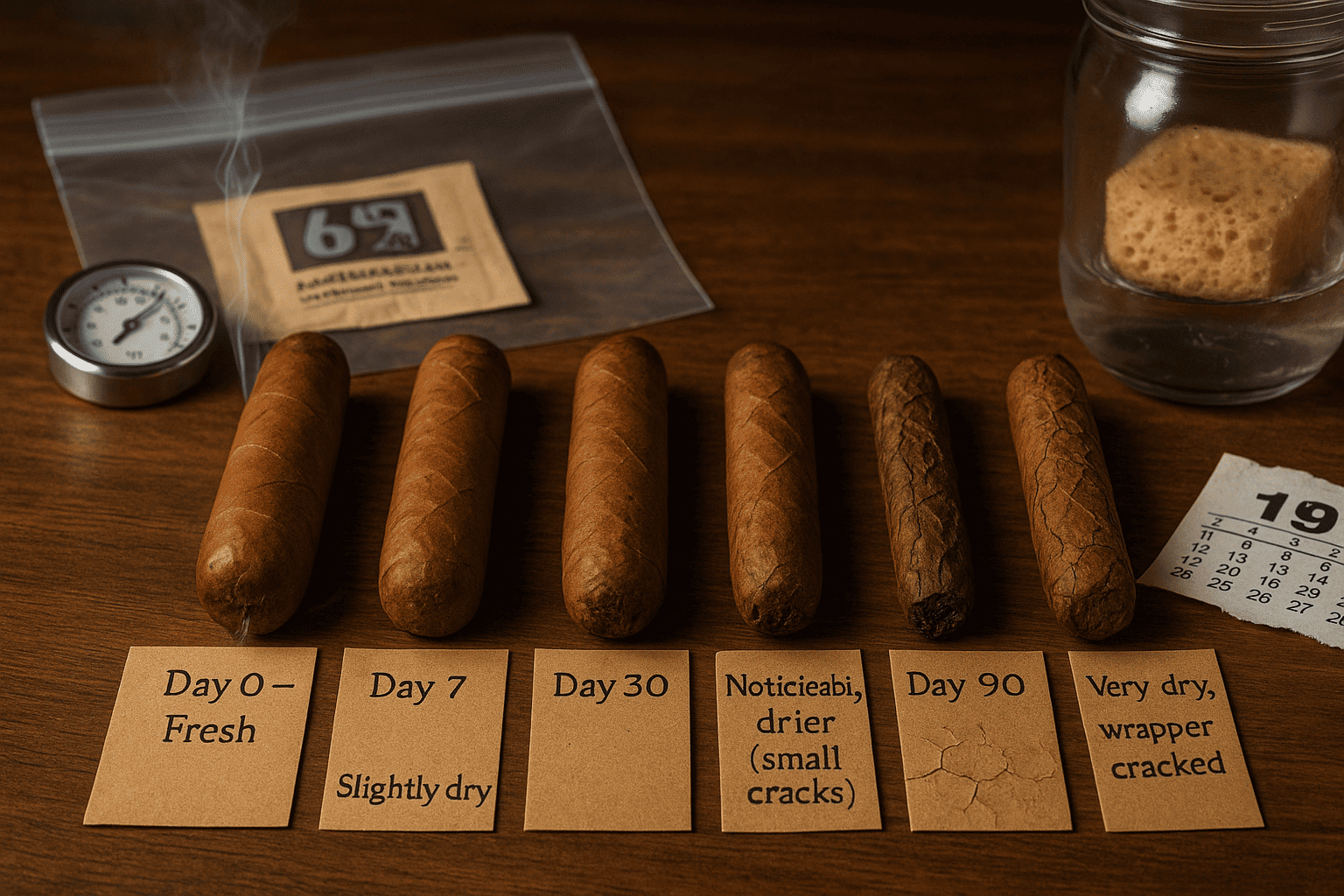
The sections that follow explain how those time ranges arise, present step-by-step mitigations, and provide operational routines that produce repeatable results.
Why time-to-failure varies: physical, chemical, and biological drivers
Any estimate of “how long a cigar lasts” without a humidor must tie to three distinct processes:
- Moisture diffusion and mechanical failure. Wrapper leaf and binder have a finite capacity to hold moisture. In dry ambient air the wrapper loses plasticizing oils and moisture; this produces toothy wrappers, a tight or flaky cold draw, and ultimately wrapper splits when humidity loss is rapid. The first 48–72 hours are the period of fastest moisture change for a freshly unwrapped cigar.
- Oxidation and aromatic loss. Volatile aroma compounds and delicate oils oxidize or evaporate when the leaf is not held at stable RH and temperature. Even absent major moisture loss, aroma concentration and perceived sweetness can decline gradually over weeks when not buffered.
- Microbial and entomological risk. Elevated temperature combined with high RH favors mold growth and increases the chance of tobacco-beetle activity. Entomological literature shows that the tobacco/cigarette beetle (Lasioderma serricorne) has development profiles that are sensitive to temperature and humidity; consignments stored warm and humid are at materially higher risk.
These processes operate on different time scales. Moisture loss and mechanical deterioration typically appear first (days). Aromatic decline occurs on a scale of weeks to months. Insect and mold risk is conditional on ambient warmth and humidity and becomes the dominant hazard in warm, humid storage over weeks to months.
Realistic scenarios and timelines (detailed)
The following breakdown presents common consumer situations and how long a cigar will typically remain acceptable under each.
1. Open, unprotected at room temperature (no humidification)
Expected outcome: perceptible drying within 48–72 hours; noticeable loss of flavor and wrapper pliability; increased chance of wrapper fracture if handled.
Why: air at typical household RH (30–50% in many climates) will draw moisture from the leaf until equilibrium is reached. The first 48 hours include the steepest moisture flux. Retail guides and hobbyist surveys consistently report that cigars left unprotected begin to decline after two to three days.
2. Unopened factory box, sealed
Expected outcome: relative stability for weeks; some vendors and advisors state that an unopened box can remain fresh for up to approximately six weeks without active humidification. This assumes the box seal remains intact and ambient conditions are not extreme.
3. Zip-top bag or resealable plastic with a plain damp sponge or water (improvised humidification)
Expected outcome: temporary improvement if done carefully; high risk of over-humidification or uneven moisture distribution; not recommended unless using distilled water and careful placement.
Why: open water sources or wet sponges may produce local condensation or mold if not controlled; mineral buildup from tap water is also a hazard. Two-way packs are safer for non-humidors. Practical forums and experienced retailers caution against simple sponge methods because they are easy to overdo.
4. Zip-top bag with two-way pack (Boveda or equivalent)
Expected outcome: preservation measured in weeks to months; two-way humidity control maintains a set RH and will both release and absorb moisture as needed. With a high-quality freezer-grade bag and appropriately sized pack, a cigar can retain usable moisture and flavor for an extended period.
5. Airtight plastic container (tupperdor) with cedar sheet and two-way packs
Expected outcome: stable storage for months when maintained; widely used as a robust, low-maintenance alternative to wooden desktop humidors. Two-way packs sized to the container volume provide predictable RH control.
6. Mason jar with a small two-way pack
Expected outcome: excellent microclimate for single sticks or small sets; glass is non-porous and avoids off-gassing issues. Well suited for short to medium term storage.
7. Travel humidor (soft case) with gel humidifier or Boveda
Expected outcome: reliable short-term protection for transit and a few days to weeks depending on ambient conditions; not intended for long-term cellaring.
8. Long-term aging without a humidor
Expected outcome: unmanaged long-term storage significantly increases the risk of flavor deterioration and biological hazards. Collectors seeking multi-year maturation are advised to use a properly seasoned cedar humidor or a small electric humidor; improvised methods lack the stability required for multi-year aging.
Mechanisms, risk thresholds, and the tobacco-beetle issue
Warm, humid, and poorly ventilated conditions are the environment in which the tobacco/cigarette beetle thrives. Entomological research documents temperature and humidity conditions that materially affect beetle life cycles. For practical storage, avoid sustained storage above the low-to-mid 70s RH in warm conditions, and keep temperature moderate to reduce hatch risk. Extension guidance on the tobacco beetle is available from sources such as the University of Florida Entomology — Tobacco Beetle.
How to extend life without a humidor: practical, step-by-step measures
The following procedures are pragmatic and repeatable. They are organized by increasing effectiveness and resource intensity.
Emergency triage for a dry cigar
- Do not dunk or soak. Rapid rehydration causes wrapper splitting.
- Place the cigar in an airtight bag or jar with a two-way pack at 65–69% RH. Monitor after 24 hours and again at 48–72 hours; soften slowly until pliable. Two-way packs buffer exchange safely and gradually.
- Avoid heat. Warmth increases rate of oil extraction and can encourage the wrapper to split during rehydration.
Emergency triage for an over-humidified cigar
- Move cigars to a dry, stable ambient room. Lay them loosely on a dry plate and allow slow evaporation.
- If a sealed container is available, add a small desiccant (preferably kiln-dried cedar rather than silica) in a separate compartment of the container to draw excess moisture gradually. Monitor daily.
Best short-term preservation protocol (budget-friendly)
- Use a freezer-grade resealable bag or an airtight plastic container.
- Place an appropriately sized two-way humidity pack inside (Boveda sizing charts are available online).
- Remove excess air, seal, and store in a cool, dark place. Check after 24–48 hours and periodically thereafter.
Best medium-term method (practical and robust)
- Use a quality airtight plastic box (a “tupperdor”).
- Line with a thin cedar sheet or place cedar separators if possible to add buffering.
- Use two-way packs sized to the container; replace per manufacturer schedule.
- Keep the container in a temperature-stable room and inspect monthly.
Conditioning and preparatory steps: how to season a humidor step-by-step (concise reference)
“Place the 84% Boveda seasoning pack(s) inside your empty wooden humidor. Close the lid and don’t open the humidor for 14 days—no matter what your hygrometer readings are.”
Key points from that instruction:
- Use manufacturer-recommended 84% seasoning packs for cedar surfaces.
- Allow a full 14 days sealed; don’t rely on short sponge-based seasoning which often under-conditions the wood.
- Replace with maintenance packs (69% or 72%) for ongoing control once seasoning completes.
This “how to season a humidor step-by-step” instruction is repeatable and supported by pack manufacturers such as Boveda — Season Wood Humidor.
Sensory consequences over time — the tasting perspective
A cigar’s sensory arc shifts as moisture, oils, and volatile compounds change:
- 0–72 hours unprotected: initial sweetness and aromatic top notes diminish; wrapper becomes drier and toothier. Cold draw tightens. Smokes from such sticks often produce thinner smoke and a harsher mouthfeel.
- Weeks in poor storage: aromatic headspace is reduced; subtler tertiary notes are lost and the perceived body of the smoke flattens. Burn irregularities may start to appear.
- Months in inadequate storage: oxidation of oils regularly produces dullness and potential off-notes. If mold appears due to excessive RH, musty, sour flavors develop and cigars should be discarded.
- Properly buffered, airtight storage (with two-way packs): aromas and oils hold; the cigar can be stable and ready to smoke for weeks to months with preserved structural integrity.
These sensory changes are not only technical; they are often the ultimate test of preservation strategy.
Practical measurement and monitoring without a humidor
A simple hygrometer/thermometer plus disciplined observation makes improvised storage safe.
- Place an inexpensive digital hygrometer inside the sealed container for the first 24–72 hours to verify stability. Calibrate if possible (salt test) and replace packs accordingly.
- Perform visual and tactile checks: wrapper elasticity, cold draw, and foot aroma are quick daily checks if no instrument is present.
- Record and label: log dates when packs were inserted and when containers were sealed. A small maintenance cadence prevents surprises.
The keyword how to monitor humidor temp applies here: even in improvised setups, measure and record temperature and humidity to avoid slow degradation or insect risk.
Best humidor setup tips that inform non-humidor strategies
- Use distilled water for any active humidifier; never tap water. Mineral content can support growth and leave deposits.
- Calibrate instruments before relying on them. The salt-test method is a simple standard.
- Avoid overpacking containers; allow modest circulation to prevent localized hot pockets and mold risk.
- Segment flavored and neutral cigars to prevent aroma transfer.
- Maintain a modest maintenance schedule (inspect weekly initially, then monthly) — this mirrors a standard humidor maintenance schedule adapted to improvised containers.
Common humidor mistakes that apply to non-humidor storage
- Rapid rehydration attempts (dunking, heavy misting) that cause wrapper splitting.
- Using tap water in reservoirs or sponges; always use distilled water.
- Relying on inexpensive, thin bags that permit moisture diffusion; opt for freezer-grade bags or sealed containers.
- Ignoring ambient temperature; warm storage increases insect risk and accelerates oxidative change.
- Failing to calibrate hygrometers before trusting readings.
When a humidor becomes necessary: storing cigars long term
For true long-term cellaring (many months to years), a dedicated environment is the prudent choice. The reasons are practical: cedar’s buffering properties, validated long-term RH control, and reduced opening frequency produce more predictable aging outcomes. For collectors contemplating multi-year maturation, investment in a properly seasoned cedar humidor, a controlled electric humidor, or a professional cellar reduces risk of beetle infestation and flavor drift. The trade-offs of travel humidors vs desktop humidors and cedar-lined humidor benefits are central to that decision: travel cases are for transit, desktop humidors for daily rotation, and cedar-lined or electric cabinets for cellaring and aging.
Evidence and authoritative guidance used in this article
- The U.S. Centers for Disease Control and Prevention: “In 2021, an estimated 8.6 million adults aged 18 and older currently smoked cigars.” See the CDC summary: CDC — Cigar Use in the United States.
- Boveda’s manufacturer guidance on seasoning and two-way pack use: “Place the 84% Boveda seasoning pack(s) inside your empty wooden humidor. Close the lid and don’t open the humidor for 14 days—no matter what your hygrometer readings are.” See Boveda — Season Wood Humidor.
- Retail guidance and practical experience from cigar vendors indicate that unprotected cigars can begin to deteriorate in as few as two to three days and that sealed factory boxes can provide limited protection for several weeks.
- Entomology and extension literature on Lasioderma serricorne (tobacco/cigarette beetle) demonstrates the species’ sensitivity to temperature and humidity and underpins the practical guidance to avoid prolonged warmth combined with high RH. See UF Entomology — Tobacco Beetle.
Decision matrix: what to do in common purchase/use situations
- Bought a single cigar at a convenience store and will smoke it within 48 hours: leave it in the tube or paper and store in a cool pocket; check feel before lighting.
- Bought several cigars and plan to smoke weekly over the next month: use a freezer-grade resealable bag or a small airtight container with an appropriately sized two-way pack.
- Bought a box and no humidor yet: keep the factory box sealed if possible; place the sealed box in an airtight outer container or tupperdor with maintenance packs as soon as available. Some vendors note sealed boxes remain fresh up to about six weeks under reasonable ambient conditions.
- Intend to cellar for more than a year: allocate budget for a seasoned cedar humidor or a small electric humidor; long-term aging in improvised conditions is unsupported by controlled evidence and increases risk.
Final Considerations
Cigar longevity without a humidor is a function of environment, container integrity, and the user’s willingness to apply disciplined mitigation. Unprotected cigars begin to lose structural and aromatic quality within 48–72 hours in typical room air. A sealed factory box will extend usable life for several weeks; airtight bags, jars, and tupperdors paired with two-way humidity control will properly preserve cigars for weeks to many months depending on seal quality and pack sizing. For multi-year cellaring, a properly seasoned cedar humidor or a controlled electric unit is the safer, more predictable option.