
Hammer and Sickle Cigars occupy a distinctive niche within the modern cigar market, where branding, political symbolism, and traditional cigar craftsmanship intersect. The name alone evokes immediate historical association, drawing from the iconography of the former Soviet Union, yet the cigars themselves are products of contemporary premium cigar production rather than relics of Cold War industry. Understanding Hammer and Sickle Cigars requires attention to their origin story, blending philosophy, construction methods, sensory profile, and the broader context in which they are smoked and discussed.
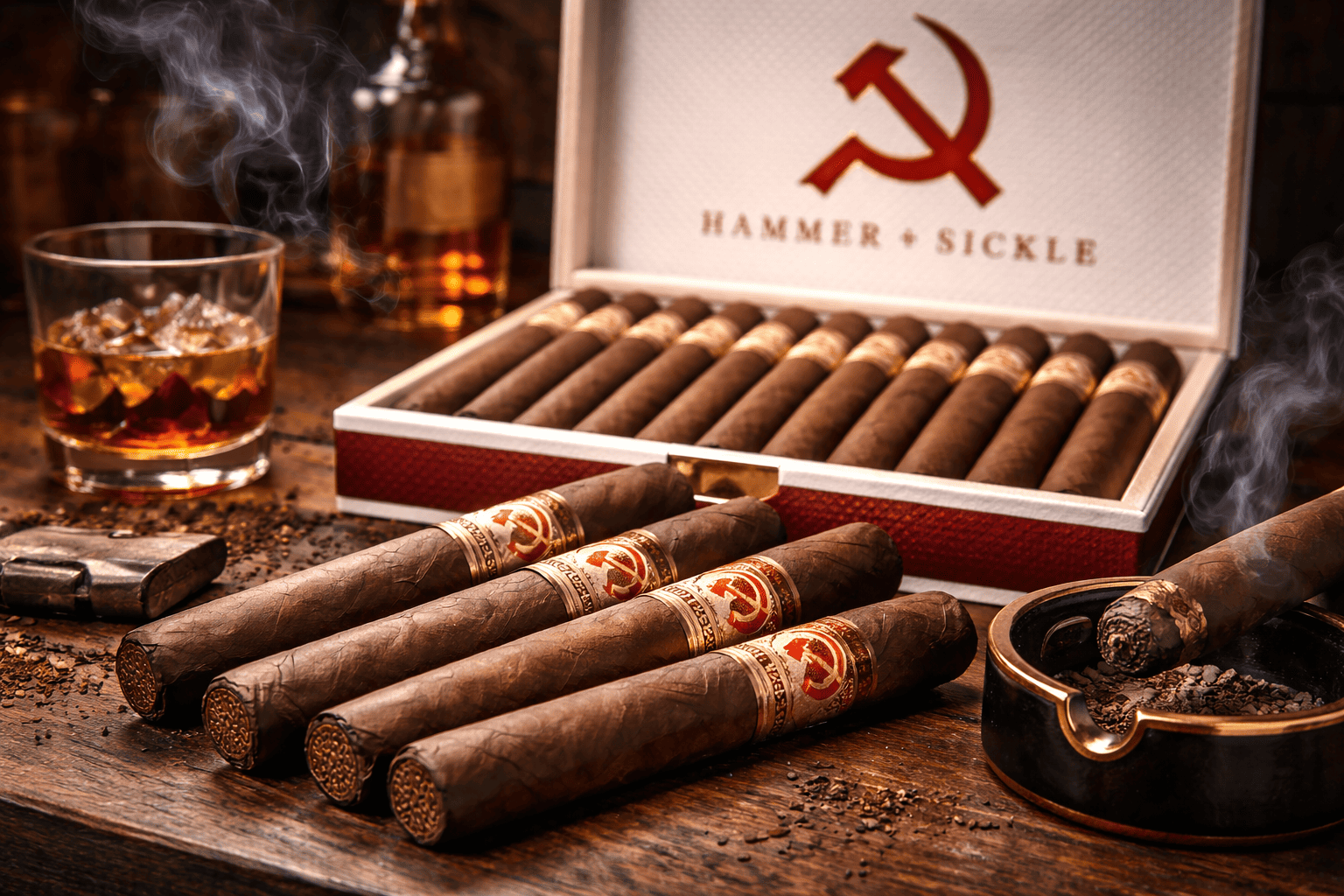
The brand’s identity leans heavily on contrast. Industrial symbolism meets artisanal tobacco, austere imagery meets aromatic complexity, and provocative naming meets a slow, contemplative ritual. This duality has shaped both its reception and its enduring presence in humidors since its introduction in the 1990s.
Origins And Brand Context
Hammer and Sickle Cigars were introduced in the mid-1990s by General Cigar Company, one of the largest premium cigar manufacturers in the United States. The line was conceived during a period of renewed experimentation in cigar branding, when political themes, heritage narratives, and bold visual language gained traction among manufacturers seeking distinction in a crowded market.
General Cigar, founded in 1910, has historically balanced large-scale production with premium positioning. Hammer and Sickle emerged as part of that portfolio, positioned not as novelty but as a full-bodied, serious cigar with a thematic wrapper rather than a gimmick. According to General Cigar’s corporate history, the company’s portfolio expansion during the 1990s coincided with the cigar boom, a time when U.S. cigar consumption rose sharply. Data from the U.S. Department of Agriculture shows cigar consumption increasing from roughly 2.1 billion units in 1990 to over 4.5 billion by 1997.
Tobacco Composition And Construction Philosophy
Hammer and Sickle Cigars are traditionally produced in the Dominican Republic, using a blend of long-filler tobaccos sourced from multiple regions. The core blend typically incorporates Dominican and Honduran fillers, bound with Indonesian tobacco, and finished with a Connecticut Broadleaf or dark Ecuadorian wrapper, depending on the specific release.
Construction reflects established premium standards:
- Long-filler tobacco throughout the bunch
- Hand-rolled production methods
- Substantial ring gauges designed for extended smoking time
The choice of wrapper plays a defining role. Broadleaf wrappers are air-cured, thicker, and naturally higher in sugar content. This contributes to a heavier mouthfeel and slower burn rate. Broadleaf’s combustion characteristics allow for a dense, creamy smoke output, which shapes both aroma and tactile sensation.
Draw resistance in Hammer and Sickle cigars tends toward the moderate range, encouraging measured puffing rather than rapid cadence. This aligns with the brand’s intended pacing and mitigates overheating, which can compromise flavor balance.
The Sensory Journey: Aroma, Flavor, And Texture
The sensory arc of Hammer and Sickle Cigars unfolds gradually, reflecting their full-bodied blend and deliberate construction. Pre-light inspection reveals aromas of aged wood, leather, and dark cocoa, often accompanied by subtle earthiness from the wrapper.
First Third
Upon ignition, the opening profile presents structured, grounded flavors. Toasted cedar, roasted coffee bean, and dry mineral notes dominate. Smoke texture is dense yet controlled, coating the palate without sharpness. Nicotine delivery at this stage remains moderate, setting a steady foundation.
The initial combustion phase emphasizes balance rather than intensity. This stage often reveals the quality of fermentation in the filler tobacco, with minimal harshness and stable burn characteristics.
Second Third
As the cigar enters its midpoint, oils migrate toward the head, enriching flavor concentration. Dark chocolate, black pepper, and leather notes deepen. Subtle sweetness emerges, often perceived as molasses or brown sugar, a signature trait of Broadleaf-wrapped blends.
Nicotine accumulation becomes more apparent during this phase. The physiological response aligns with documented short-term effects of cigars, including mild alertness and warmth.
Final Third
The final third intensifies in both flavor density and strength. Earth, charred oak, and pepper-forward notes dominate. Smoke output thickens, and combustion temperature rises if cadence is not adjusted. Experienced smokers often slow their pace here, preserving balance and avoiding bitterness.
This progression reflects intentional blending, designed to reward attention and restraint rather than rapid consumption.
Nicotine In Cigars Explained Within The Blend
Nicotine in cigars explained cannot be separated from tobacco priming. Hammer and Sickle blends often rely on higher-priming leaves, particularly ligero, which contain elevated nicotine concentrations. According to the Centers for Disease Control and Prevention, large cigars can contain between 5 and 20 grams of tobacco.
That quantity influences both strength perception and physiological response. Absorption occurs primarily through the oral mucosa when smoke is not inhaled, leading to gradual systemic uptake. Blood nicotine levels rise steadily rather than abruptly, producing sensations that some describe as a nicotine buzz.
This effect remains distinct from intoxication. Cognitive function stays intact, and sensory awareness often sharpens rather than dulls.
Cultural Symbolism And Reception
The Hammer and Sickle name carries unavoidable historical weight. For some smokers, it represents defiance or irony; for others, it is purely aesthetic. The cigar itself does not originate from Eastern Europe, nor does it claim ideological alignment. Its symbolism functions as branding shorthand rather than political statement.
Cigar culture has long incorporated imagery drawn from history, revolution, and counterculture. The reception of Hammer and Sickle Cigars reflects that tradition, provoking discussion while maintaining a core focus on smoking experience.
In lounges and private settings, the cigar often becomes a conversation catalyst, its band as much a topic as its blend.
Health Risks Of Cigar Smoking
Any discussion of premium cigars requires acknowledgment of health risks of cigar smoking. Combustion of tobacco produces carcinogenic compounds, including polycyclic aromatic hydrocarbons and tobacco-specific nitrosamines.
The National Cancer Institute states that cigar smoking is associated with cancers of the oral cavity, larynx, esophagus, and lung.
Oral Health And Cigars
Oral health and cigars share a direct relationship. The American Dental Association reports increased incidence of gum disease, tooth loss, and oral cancer among cigar smokers.
Does Cigar Smoke Affect Non-Smokers
Does cigar smoke affect non-smokers remains a key public health concern. Secondhand cigar smoke facts mirror those associated with cigarettes, containing thousands of chemicals harmful to cardiovascular and respiratory health.
The CDC reports that secondhand smoke causes heart disease and lung cancer in adults who have never smoked.
Cigars Vs Cigarettes Health Perspective
Cigars vs cigarettes health comparisons highlight differences in use patterns rather than risk elimination. Cigarettes deliver nicotine rapidly through inhalation, increasing addiction potential. Cigars deliver nicotine more slowly but in larger total quantities per unit.
Both forms elevate cardiovascular disease risk. Cigarettes show higher association with chronic lung disease, while cigars show stronger association with oral and upper aerodigestive tract cancers.
How Often To Smoke Cigars Safely
How often to smoke cigars safely invites a clear response: no frequency eliminates risk. Public health authorities consistently state that any tobacco exposure increases disease probability. Occasional smoking reduces cumulative exposure relative to daily use, yet measurable risk persists.
Quitting Cigars Resources And Dependency Awareness
Nicotine dependence applies to cigars alongside other tobacco products. Some Hammer and Sickle smokers maintain occasional use; others progress toward regular consumption.
- Behavioral counseling
- Nicotine replacement therapy
- Medical guidance and quitlines
Final Considerations
Hammer and Sickle Cigars represent a deliberate blend of provocative branding and traditional premium cigar construction. Their sensory profile rewards patience, delivering layered flavors and a gradual nicotine response that shapes perception without inducing intoxication.
Understanding nicotine in cigars explained clarifies why sensations emerge and fade, grounded in physiology rather than myth. At the same time, health risks of cigar smoking, cigar smoking and cancer risk, and secondhand cigar smoke facts remain inseparable from any honest appraisal.
Oral health and cigars, cigars vs cigarettes health distinctions, and the question of how often to smoke cigars safely all reinforce the importance of informed choice. For those reassessing their habits, quitting cigars resources provide structured pathways grounded in evidence.
Hammer and Sickle Cigars endure not for symbolism alone, but for their capacity to engage the senses, provoke conversation, and invite reflection within the measured ritual of the smoke.