
The phrase Free Cuba cigars carries layered meaning. It does not describe counterfeit products, nor does it refer to cigars distributed at no cost. Instead, it identifies cigars produced outside the island of Cuba that draw on Cuban seed genetics, Cuban-trained craftsmanship, or pre-embargo blending philosophy, yet exist independently of the Cuban state tobacco monopoly. These cigars are “free” in the political, agricultural, and economic sense: cultivated beyond Cuban borders, shaped by open-market experimentation, and subject to international trade without embargo constraints.
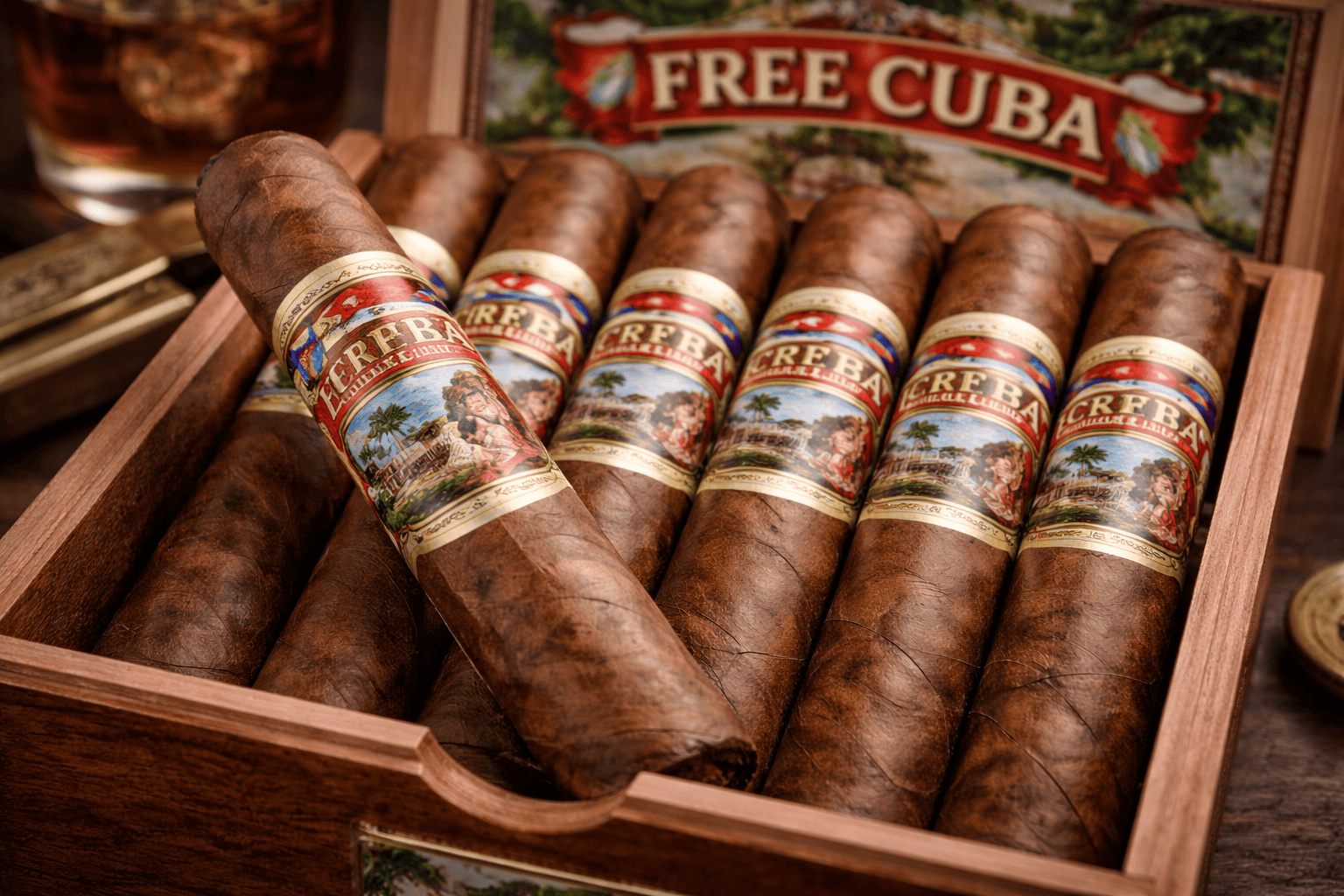
Free Cuba cigars occupy a complex intersection of history, migration, agronomy, and sensory memory. They exist as a response to limitation, shaped by exile and adaptation, refined through decades of trial in soils far from Vuelta Abajo. This article examines Free Cuba cigars as a category defined by intention rather than geography, tracing their origins, evaluating their construction and flavor evolution, and situating them within modern cigar culture, trade, and travel.
Historical Foundations: From Embargo To Dispersion
The Cuban Revolution of 1959 and subsequent nationalization of private industry initiated one of the most consequential migrations in cigar history. Master blenders, growers, and rollers left Cuba for Nicaragua, the Dominican Republic, Honduras, Mexico, and the Canary Islands. They carried with them seed varietals such as Criollo and Corojo, fermentation knowledge, and blending frameworks developed over generations.
The U.S. trade embargo against Cuba, formalized in 1962, accelerated this dispersion. According to the U.S. Department of State, “The embargo was imposed in response to the Cuban government’s nationalization of U.S.-owned properties without compensation.”
Source: https://history.state.gov/milestones/1961-1968/cuban-missile-crisis
This moment fractured Cuban cigar identity into two paths: one state-controlled and geographically fixed, the other mobile and adaptive. Free Cuba cigars belong to the latter.
What Defines A Free Cuba Cigar
Free Cuba cigars are not defined by a single country or brand. Their defining characteristics rest on three pillars:
- Use of Cuban seed or Cuban-derived hybrid seed
- Blending philosophy inspired by pre-revolution Cuban profiles
- Production outside Cuban state control
These cigars reject imitation as an endpoint. Instead, they interpret Cuban tradition through new terroirs and technical frameworks.
Common production regions include:
- Nicaragua (Estelí, Jalapa, Condega)
- Dominican Republic (Cibao Valley)
- Honduras (Jamastran Valley)
- Ecuador (wrapper cultivation)
Each region reshapes Cuban seed expression through soil chemistry, climate, and fermentation practice.
Cuban Seed Outside Cuba: Agronomic Adaptation
Cuban seed planted beyond the island undergoes measurable transformation. Soil mineral content, rainfall patterns, and daylight variation alter leaf thickness, oil concentration, and combustion behavior.
Research published by the FAO notes that “Tobacco grown under different climatic and soil conditions exhibits significant variation in chemical composition, including nicotine and sugar content.”
Source: https://www.fao.org/3/y4997e/y4997e00.htm
In Nicaragua, Cuban-seed Corojo develops darker pigmentation and higher mineral intensity. In the Dominican Republic, the same seed yields lighter, more aromatic leaf. Ecuador’s cloud cover produces elastic, low-vein wrappers prized for structural reliability.
Free Cuba cigars embrace these differences rather than suppress them.
Fermentation Philosophy And Technical Control
Pre-embargo Cuban cigars relied on extended fermentation and aging cycles, often exceeding three years. Free Cuba producers replicate this discipline with added precision.
Modern fermentation practices include:
- Temperature monitoring within pilones
- Controlled humidity chambers
- Extended post-fermentation aging
- Lot separation by priming position
These methods reduce ammonia presence and stabilize sugars. The result is cleaner combustion and more predictable flavor development.
Such control enhances resilience during packing cigars for travel and reduces volatility during shipping cigars internationally.
Sensory Architecture: Flavor Without Replication
Free Cuba cigars do not aim to reproduce a singular Cuban flavor. They aim to recreate a structure: balance, progression, and aromatic coherence.
Opening Phase
The initial light often presents:
- Dry cedar
- Toasted grain
- Soft white pepper
- Subtle floral notes through retrohale
Combustion tends to start cool, reflecting well-rested leaf and proper moisture balance.
Middle Phase
As the cigar settles, flavors broaden:
- Almond skin
- Baked apple
- Cocoa powder
- Earthy mineral tones
Sweetness integrates with mild tannic dryness, avoiding abrupt shifts.
Final Phase
The closing segment narrows focus:
- Espresso crema
- Leather
- Dark cedar
- Mineral salt
Strength increases moderately, rarely crossing into harshness when smoked with measured cadence.
This progression reflects Cuban tradition filtered through non-Cuban terroir.
Construction Standards And Physical Performance
Free Cuba cigars often exceed Cuban production in construction consistency. Open-market competition incentivizes quality control.
Observed construction traits include:
- Uniform draw resistance
- Straight burn line with minimal correction
- Elastic wrappers tolerant of climate variation
- Ash that holds without excessive density
These features matter when navigating traveling with cigars airline rules and variable cabin environments.
Legal And Trade Realities
Free Cuba cigars benefit from fewer trade restrictions than Cuban-made products.
United States Context
Cigars produced outside Cuba are legal for sale and import in the United States, provided they comply with FDA regulations. Cuban cigars remain subject to evolving restrictions, though personal import allowances have shifted over time.
According to U.S. Customs and Border Protection, “Persons subject to U.S. jurisdiction may import Cuban-origin alcohol and tobacco products for personal consumption, subject to applicable limitations.”
Source: https://www.cbp.gov/trade/basic-import-export/cuban-assets-control-regulations
Free Cuba cigars bypass these complexities entirely.
Travel Considerations And Regulatory Awareness
Air Travel
Most airlines permit cigars in carry-on and checked luggage. TSA cigar restrictions allow cigars but regulate accessories such as torch lighters and cutters. Cabin transport remains preferred to reduce exposure to temperature fluctuation.
Understanding how to carry humidor on plane includes selecting rigid cases and humidity packs calibrated below 70 percent.
Customs And Import Limits
Customs rules for cigars vary widely. Quantity thresholds differ by jurisdiction, and declaration requirements apply beyond certain limits. Awareness of cigar laws by country prevents confiscation or duty assessment.
Free Cuba cigars face no embargo-related scrutiny but remain subject to local import caps.
Duty-Free Purchases
Duty-free cigar buying tips apply equally to Free Cuba cigars. Retaining receipts and verifying destination allowances supports smooth customs clearance.
International Shipping
Shipping cigars internationally introduces risks related to climate control and handling. Free Cuba cigars with thicker wrappers tolerate transit better than delicate Cuban production, though personal transport remains preferable.
Cultural Position And Smoking Environments
Free Cuba cigars align with a globalized cigar culture. They appear in lounges from Madrid to Miami, Panama City to Zurich.
Cigar-friendly travel destinations often provide licensed lounges, hotel cigar rooms, and private clubs. Local smoking regulations abroad increasingly restrict public smoking, elevating the role of private venues.
Respect for regional norms remains central to responsible enjoyment.
Comparison With Cuban Production
Free Cuba cigars differ from Cuban-made cigars in several measurable respects:
- Greater construction consistency
- Broader range of strength and flavor profiles
- Wider availability
- More predictable aging behavior
Cuban cigars retain historical prestige and unique terroir. Free Cuba cigars offer adaptability, reliability, and innovation unconstrained by state monopoly.
Who Free Cuba Cigars Serve Best
Free Cuba cigars suit smokers who value:
- Cuban-inspired flavor architecture
- Construction reliability
- Legal accessibility across markets
- Transparency in production and sourcing
They appeal to those who view cigars as agricultural and cultural products rather than symbols.
Final Considerations
Free Cuba cigars represent continuity without confinement. They preserve Cuban seed genetics, blending philosophy, and sensory structure while operating within open markets shaped by innovation and accountability. Their existence reflects migration, adaptation, and technical refinement rather than imitation.
For enthusiasts managing international travel, regulatory complexity, and varied smoking environments, Free Cuba cigars provide clarity and consistency. Whether stored at home, transported across borders in compliance with airline and customs protocols, or enjoyed in settings shaped by local smoking regulations abroad, they reward attention and patience.
Their significance lies in freedom of expression: Cuban tradition interpreted without restriction, one deliberate draw at a time.