
This guide approaches flavored and infused cigars from a technical, sensory, and regulatory standpoint. It addresses product types, manufacturing techniques, sensory expectations and testing protocols, storage and pairing, market context, public health commentary, and practical guidance for consumers and retailers.
Defining Terms: Flavored Versus Infused
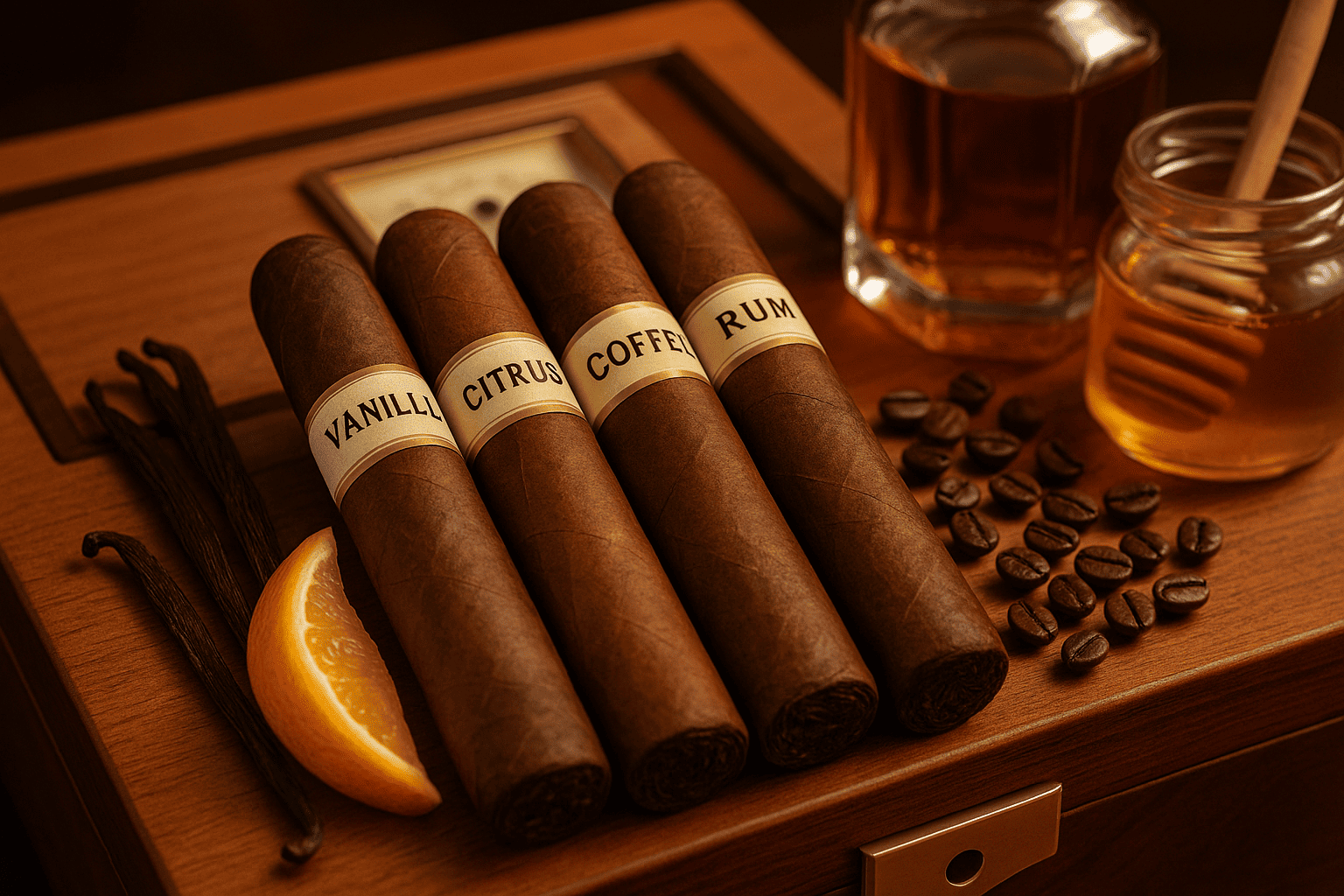
A practical taxonomy clarifies what is being discussed:
- Flavored cigars — cigars for which flavoring agents have been added at some point in the production process such that a characterizing flavor (fruit, candy, menthol, alcohol, spice, etc.) is perceptible in the smoke or aroma. This category covers mass-market tipped little cigars, machine-made cigarillos, and some handmade products that have received added flavorings.
- Infused cigars — cigars that have been exposed to an aromatic environment or treated with a solvent or carrier that allows the tobacco leaf to absorb volatile compounds. Barrel aging in spirits, room infusion with natural materials, and controlled exposure to essential oils are typical approaches found in premium lines.
- Casing and topping — process steps during leaf preparation and blending where a liquid preparation is applied to binder or filler leaves prior to final rolling, or a light coating is applied to the finished wrapper. These changes are part of the product’s recipe and affect burn, mouthfeel, and perceived sweetness.
Careful use of these terms assists quality control, sensory evaluation, and regulatory compliance.
Market Size and Public Health Context
Two data points frame commercial context and public health concern:
- The U.S. Centers for Disease Control and Prevention reports: “In 2021, an estimated 8.6 million adults aged 18 and older currently smoked cigars.” (CDC — Cigar Use in the United States).
- The American Heart Association’s fact sheet states: “Flavored cigars now make up a little more than 53% of the cigar marketplace.” (American Heart Association — Flavored Cigars Fact Sheet (PDF)).
Regulatory efforts reflect these dynamics. The U.S. Food and Drug Administration published a press announcement proposing product standards “to prohibit menthol as a characterizing flavor in cigarettes and prohibit all characterizing flavors (other than tobacco) in cigars.” The agency framed those proposed standards as measures intended to reduce youth initiation and to reduce tobacco-related disease and death. (FDA — Press Announcement on Proposed Rules).
These points are not rhetorical. They reflect measurable shifts in sales and consumption patterns, which influence manufacturing strategies, retail assortment, and policy. The presence of flavored offerings in convenience channels, the variety of flavor types and pack sizes, and the marketing tactics used in some markets are all empirical elements that shape an operational response from makers and retailers.
Why Flavor a Cigar? Organoleptic Rationale
Flavoring influences perception in two domains:
- Olfactory modulation — volatile compounds from flavoring agents reach the olfactory epithelium retronasally and orthonasally, modifying perceived sweetness, spice, and aromatic complexity.
- Gustatory and tactile modulation — certain casings alter the perceived mouthfeel and sweetness on the tongue, which can soften bitter or astringent elements in the base tobacco.
From a product-design point of view, flavoring is used to expand appeal, to create distinct brand signatures, and to target specific segments (new smokers or those seeking novelty). From a sensory-connoisseur point of view, the objective is measured: retain structural integrity of the tobacco while adding an ancillary aromatic layer. The interplay of base tobacco chemistry and added volatiles determines whether the final product reads as balanced, overflavored, or discordant.
Principal Methods of Flavoring and Infusion
Manufacturing practice groups the methods into several categories. Each method produces a different sensory intensity and durability of effect.
Infusion in Aromatic Environments (Room or Barrel Aging)
This method exposes cigars to the vapors of a natural material or spirit for an extended interval. Barrel-aging is common: cigars are placed in barrels that previously held whiskey, rum, or cognac so the wood-saturated volatiles diffuse into the wrapper and filler. The approach relies on slow absorption and equilibration and typically results in subtle, integrated aromatics that persist across the smoke.
A trade summary gives the technical outline: “Infusion is one of the most sophisticated methods for flavoring cigars. This process involves placing the cigars in an environment where they are exposed to natural flavors, allowing the tobacco to slowly absorb them over time.” (Montes Cigar Shop — How Cigars Are Flavored).
Spraying, Dipping and Topping
This set of processes applies a flavored liquid to leaves or finished cigars. Spraying the leaf or lightly coating the wrapper produces an immediate sensory effect. The intensity is a function of concentration and the time allowed for absorption and drying. Spraying may be used in mass-market production for reproducible, bold flavor profiles.
Casing During Leaf Preparation
A casing is an aqueous or solvent-based solution applied to binder or filler leaves prior to rolling. It can be a blend of humectants, extracts, or sugar-based agents that change the leaf’s surface chemistry. Casing is subtle, often designed to encourage mouthfeel harmony rather than overt flavor.
Direct Immersion and Vapor Exposure
Direct immersion of cigars in flavored liquids is a practice found in hobbyist circles and in some commercial lines that aim for a strong, immediate flavor. An alternative is controlled vapor exposure in sealed chambers where the cigars sit in an atmosphere enriched with volatile compounds. These methods differ in the gradient they create: immersion gives a saturated outer layer that can be intense, while vapor exposure produces gentler integration.
Summary statements from retail and manufacturing guides emphasize that infusion and spraying are the two most common techniques used by contemporary producers. (Montes Cigar Shop — How Cigars Are Flavored).
Manufacturing Constraints and Quality Control
Successful flavoring requires control at three stages:
- Leaf selection and preconditioning. Mild, neutral wrappers are often chosen when an explicit flavor is desired so the added aroma stands forward without bluntly masking leaf character. Long-fillers of neutral body serve as carriers.
- Concentration and solvent selection. Flavoring agents must be food-grade and compatible with tobacco matrices. Ethanol or glycols are commonly employed as carriers; concentrations are validated empirically to avoid wet pockets that hinder combustion.
- Aging and equilibration. After flavor application, the product typically rests for a period to allow volatiles to distribute and for surface solvents to volatilize; insufficient relaxation time yields volatile peaks and poor burn behavior.
Quality-control metrics include uniformity of draw, consistent burn line, ash cohesion, and analytical chemistry checks (headspace GC–MS when available) that quantify volatile profiles. Good manufacturing practice prescribes validation runs and retention sampling for each flavor and packaging configuration.
Sensory Expectations: How Flavoring Changes a Smoke
From a tasting perspective, flavored or infused cigars change the temporal sequence of perceived notes.
- Initial phase (first third). The wrapper and cap deliver the opening impression. A flavored cap creates immediate top notes that may read as sweet, spicy, or boozy. With barrel-aged cigars, aromatic wood and spirit traces can be prominent.
- Middle phase (second third). The blend begins to balance after initial combustion. If the infusion is integrated, tertiary and secondary tobacco notes interact with added volatiles to produce layered sensations, such as roasted grain supporting vanilla, or toasted almond underpinning coffee-chocolate tonality.
- Final phase (last third). The structural backbone of the blend is tested. Too much external flavoring can overshadow filler character late in the smoke and cause a flattening of complexity. Properly blended infused cigars will have the added flavor evolve rather than dominate.
Tasting protocol for comparative evaluation should standardize cut style, lighting technique, and puff cadence. A measured cadence of 45–60 seconds per draw stabilizes combustion temperature and assists reproducible evaluation in the three-phase structure. (CDC guidance and data context).
Analytical Perspective: Chemistry and Fermentation Interaction
Tobacco processing produces intrinsic volatile and non-volatile matrices that interact with applied flavorants. Fermentation transforms carbohydrate and protein substrates into Maillard-derived aroma precursors and reduces green notes. Recent microbial studies show that fermentation alters leaf microbiomes and associated metabolic potential, which in turn shape precursor availability for aroma formation. An academic summary reports that “the microbial community structure significantly changed in cigar tobacco leaves after artificial fermentation.” That observation explains why fermentation state matters when planning infusion strategy: heavily fermented leaves present a different chemical baseline for added volatiles to bind or to mask. (PMC — Microbial community and metabolic function).
This fact has operational implications. Infusion applied to a lightly fermented leaf can yield different sensory persistence than infusion applied to a heavily fermented leaf. Barrel aging frequently leverages the fermented chemistry of mature leaves, resulting in smoother integration of wood-derived or spirit-derived volatiles.
Sensory Taxonomy: Common Flavors and Perceptual Profiles
The market includes a range of flavor families. Each has an expected sensory footprint.
- Vanilla and sweet cream. Perceived as soft, sweet top-notes. They blend well with smooth Connecticut-style wrappers.
- Coffee, chocolate, roasted nut. These are often paired with medium-bodied fillers and darker wrappers; they read as roasting, cocoa, and roasted nuttiness in the mid-palate.
- Citrus and fruit. Bright top-notes that emphasize freshness; they can be sharp if overapplied and may clash with oxidized, aged tobaccos.
- Menthol and mint. Cooling sensations that reduce perceived harshness; these substances have been the focus of regulatory attention for their appeal to younger smokers. (FDA — Proposed Standards), (AHA — Flavored Cigars Fact Sheet).
- Alcoholic-beverage character (rum, bourbon, cognac). Barrel-aging and spirit-infused signatures create woody, caramel, and toasted sugar notes that often persist as retronasal echoes.
The American Heart Association and public health research indicate that certain flavor families—fruit and candy, alcohol—figure prominently in youth-preferred products and have been associated with higher market shares in convenience channels. This is a relevant factor for ethical retailing and policy compliance. (AHA — Flavored Cigars Fact Sheet).
Regulatory and Ethical Considerations
Regulation is an immediate constraint in many jurisdictions. The FDA’s proposed product standards to ban menthol in cigarettes and flavors in cigars frames a regulatory horizon and an enforcement focus on manufacturers and retailers. The agency described these proposals as measures intended to prevent youth initiation and to reduce tobacco-related disease and death. (FDA — Press Announcement on Proposed Rules).
From an ethical retailing standpoint, the following principles apply:
- Age-restricted access must be enforced.
- Marketing that targets minors through imagery, placement near schools, or price skimming should be avoided. Evidence indicates flavored products are disproportionately attractive to younger people and have higher retail penetration in convenience stores frequented by youth. (AHA — Flavored Cigars Fact Sheet), (CDC — Cigar Use Data).
Retailers that choose to sell flavored and infused products are advised to track compliance updates and to adopt internal policies consistent with local ordinances and national regulation.
Evaluating Quality: Sensory and Physical Signals
Quality assessment combines structural inspection and tasting.
Structural checks:
- Uniformity of wrapper color and absence of large veins.
- Firmness along the stick; no soft spots or overly dense regions.
- Clean cap work and a consistent roll that yields a steady draw.
Combustion checks:
- Even burn line with slow self-correcting tendencies.
- Firm, flaky ash with light gray coloration.
- Stable draw resistance; excessive looseness can produce cool, diluted smoke while excessive tightness causes overheating and harshness.
Aromatic checks:
- Integration of flavoring with tobacco base; the addition should not render the base indistinct.
- Persistence of flavor that evolves over the three-phase tasting sequence.
- Clean finish with low acridity.
If sensory evaluation reveals top-heavy flavor that masks leaf character, then either the infusion concentration was excessive or the underlying leaf selected was too neutral, lacking structural counterpoint.
Pairing and Contextual Use
Flavored and infused cigars can be matched with beverage choices to reinforce or contrast template notes.
- Sweet or vanilla-cased cigars pair harmoniously with dark roast coffee, espresso, or dessert cocktails that have oak or caramel notes.
- Barrel-aged rum or bourbon-infused cigars find complement in the same spirit families, but dry palate-clearing beverages (mineral water, unadorned coffee) reset the palate between puffs.
- Mint or mentholated offerings are frequently experienced as palate cleansers with citrus-driven cocktails; caution is advised with other mint products due to the cooling overlay.
Pairing is a matter of preference. The analytical task is to examine whether the beverage’s volatile profile competes with or supports the cigar’s aromatic envelope.
Storage and Humidor Considerations for Flavored Products
The presence of added volatiles changes storage considerations.
- Flavored cigars should be stored separately in a humidor compartment or box to avoid cross-flavoring of neutral sticks.
- Standard humidor targets for flavored sticks are comparable to unflavored products; many practitioners standardize at 65–70% relative humidity and 68–70°F. Volatile retention varies with humidity and temperature; lower humidity accelerates loss of lighter volatiles, while higher humidity may encourage migration between sticks. For controlled sampling, stores typically hold flavored inventory in dedicated trays or sealed containers until sale. (Montes Cigar Shop — Infusion Methods).
Retailers should note that some infused products are intentionally aged in packaging to maintain a parfum-like headspace; retailers should follow supplier instructions for shelf-life and display.
Consumer Guidance: How to Choose a Flavored or Infused Cigar
A disciplined purchase strategy reduces buyer’s regret.
- Inspect product provenance. Prefer manufacturers with transparent process descriptions and aging statements.
- Sample before purchase. If single-stick purchase is permitted, select a stick for trial rather than committing to a multi-pack.
- Check for integration. Avoid products that present a one-dimensional candy note without supporting tobacco structure.
- Mind session length. Infused or flavored sticks can be available in formats that suit short or long sessions; match size to time budget.
- Ageing potential. Some infused cigars are designed as ephemeral novelty items; others gain complexity with months of quiet rest in sealed conditions. Supplier literature should clarify intended shelf-life.
Empirically, major retail patterns show flavored products are heavy in low-count packs and convenience channels. The AHA documents that a majority of sales occur in channels that attract impulse purchase behavior. (AHA — Flavored Cigars Fact Sheet).
Comparative Testing Protocol — A Practical Laboratory for Flavor Assessment
A simple, repeatable test allows an empirical mapping of infusion effect.
- Select three sticks: one unflavored baseline from the same brand and two flavored variants of the same vitola or similar format.
- Standardize storage: 14 days at 68–70°F, 65–70% RH.
- Prepare the sample: use the same cutter, same torch type, identical toasting technique.
- Maintain a measured cadence: 45–60 seconds per puff. Record start and end times for each phase. (CDC context).
- Record objective metrics: draw resistance, ash length, burn-line correction intervals.
- Record subjective metrics using a fixed scale for aroma intensity, sweetness, bitterness, mouthfeel, and aftertaste. Use a three-phase tasting sheet aligned with first, second and final thirds.
- Compare results across sticks and tabulate differences arising from infusion method and concentration.
This procedure converts sensory impressions into data that can be used to guide purchasing, blending decisions, and inventory rotation.
DIY Infusion Notes: Safety and Practical Restraints
Small-scale infusion experiments are found among hobbyists. Safety and legal compliance are paramount:
- Use food-grade carriers and flavoring agents. Solvent residues matter for combustion safety and inhalation toxicity.
- Avoid unknown or industrial-grade solvents. Perfume-grade essential oils are not intended for inhalation and may be hazardous.
- Avoid making claims about medical or therapeutic benefits. Tobacco products are regulated in many markets and making health claims can trigger enforcement.
- For any immersion or vapor infusion, ensure a well-ventilated workspace and avoid open flames near solvents.
A number of specialized retailers publish hobbyist instructions that range from chamber vaporization of organic aromatics to barrel-aged approaches. Those materials are practical references, not prescriptions; they show paths that producers or serious hobbyists might test under controlled, safety-conscious conditions. (Montes Cigar Shop — Infusion Methods).
Health Signals and Scientific Findings
Scientific literature and public health bodies emphasize parity in toxicant constituents between flavored and unflavored cigar smoke. Studies indicate that flavored cigar smoke contains many of the same toxic and carcinogenic constituents that are present in cigarette smoke. The American Heart Association fact sheet summarizes that flavored cigar sales rose steeply over the 2009–2020 decade and that certain flavor types (fruit, candy, alcohol) are associated with higher cytotoxic responses in laboratory studies. Those findings underlie regulatory initiatives and public health advocacy. (AHA — Flavored Cigars Fact Sheet).
For practitioners the clear implication is measured risk assessment: flavored cigars are not benign and must be treated with the same respect assigned to other combusted tobacco products.
Retail and Portfolio Strategy
For retailers assembling an assortment, four pragmatic rules help align commercial goals and consumer safety:
- Keep flavored and unflavored inventories separated physically in the humidor.
- Maintain supplier documentation on flavoring agents and shelf-life.
- Price to reflect production cost and storage overhead; barrel-aged or slow-infused premium lines carry higher cost-per-stick and require different margin handling. Market reports document growth in premium and flavored segments. (Grand View Research — Market Report).
- Monitor local and federal regulatory environments; proposed product standards and changes in enforcement can shift acceptable product assortments rapidly. (FDA — Proposed Standards).
Case Studies: Product Archetypes
- Barrel-Aged Premium Series. These are generally premium-priced, limited-run cigars aged in spirit barrels; the wrapper and filler tend to be well-fermented to allow integration of spirit-derived vanillins and lactones. Sensory profile: woody caramel, toasted sugar, subtle spirit character.
- Sprayed Machine-Made Lines. Larger production-volume offerings that are sprayed with flavored liquids and packaged for mass-market sale. Sensory profile: immediate, bold top-notes with short persistence.
- Capped Flavored Tipped Cigars. These include small cigars and cigarillos with flavored tips that give a direct lip-to-nose character on initial draw. They are positioned for casual or flavored-first consumers.
- Infusion Room Lines. Premium brands sometimes maintain flavoring rooms where cigars rest in an aromatic environment; the outcome is nuanced infusion that is integrated across all smoking phases. (Montes Cigar Shop — Infusion Methods).
Documentation, Labeling and Consumer Transparency
Producers that wish to be trustworthy should provide:
- A clear description of the flavoring method (barrel-aged, sprayed, cased).
- Ingredient listing for added flavorants where feasible.
- Storage and aging recommendations to preserve intended sensory profile.
- Lot numbers and production dates for traceability.
Transparency supports repeat purchases by enabling consumers to match storage and tasting practices to the product’s design.
Final Considerations
Flavored and infused cigars are a heterogeneous category that ranges from mass-market flavored cigarillos to carefully aged barrel-infused premium lines. The decision to include flavoring in a cigar blend is both artistic and technical. Successful products respect tobacco structure, apply volatiles in controlled concentrations, and allocate sufficient equilibration time so sensory integration occurs.
Key practical takeaways:
- The market presence of flavored cigars is large; public-health sources indicate they account for a substantial share of sales and figure prominently in youth use data. (AHA — Flavored Cigars Fact Sheet), (CDC — Cigar Use Data).
- Infusion and spraying are the two dominant industrial techniques for flavoring, with barrel-aging a recognized premium method for subtle integration. (Montes Cigar Shop — How Cigars Are Flavored).
- Chemical and microbiological changes arising from fermentation affect how an infusion performs; recent research demonstrates that microbial community structure shifts during fermentation and that those shifts influence metabolite profiles that interact with added aromas. (PMC — Microbial community and metabolic function).
- Regulatory momentum at national health agencies targets characterizing flavors in cigars, leading firms and retailers to track compliance closely. The FDA has proposed standards addressing characterizing flavors in cigars alongside menthol in cigarettes. (FDA — Press Announcement).
- Consumers and retailers should rely on objective checks—structural quality, integration of flavor, and supplier transparency—when assessing flavored or infused products.
Quality in flavored and infused cigars lies at the intersection of chemistry, craft, and restraint. When executed with technical rigor and controlled sensory goals, these products extend the expressive vocabulary of tobacco without obscuring the base material’s character. When executed without discipline, the result is top-heavy aromatics that degrade burn behavior and sensory complexity. The measured practitioner will prefer test-driven procurement, transparent sourcing, and a restrained sensory aesthetic that treats flavor as an adjunct to tobacco, not as a substitute.