
Don Mateo occupies a distinct space in the modern cigar market. The line is widely distributed, priced to appeal to the cost-conscious purchaser, and frequently sold in bundled formats. Its blend philosophy favors reliable combustion and broad, earthy flavor rather than boutique rarity. The result is a cigar family that has earned a steady following among regular smokers who value daily consistency and value per stick. This article addresses provenance, blend construction, manufacturing practices, typical sensory progression through the smoking phases, retail and market context, and practical guidance aimed at newcomers who want to taste and evaluate Don Mateo with purpose and discipline. The writing is neutral and analytical, using a reproducible tasting method so that readers may replicate observations.
Brand Identity and Market Placement
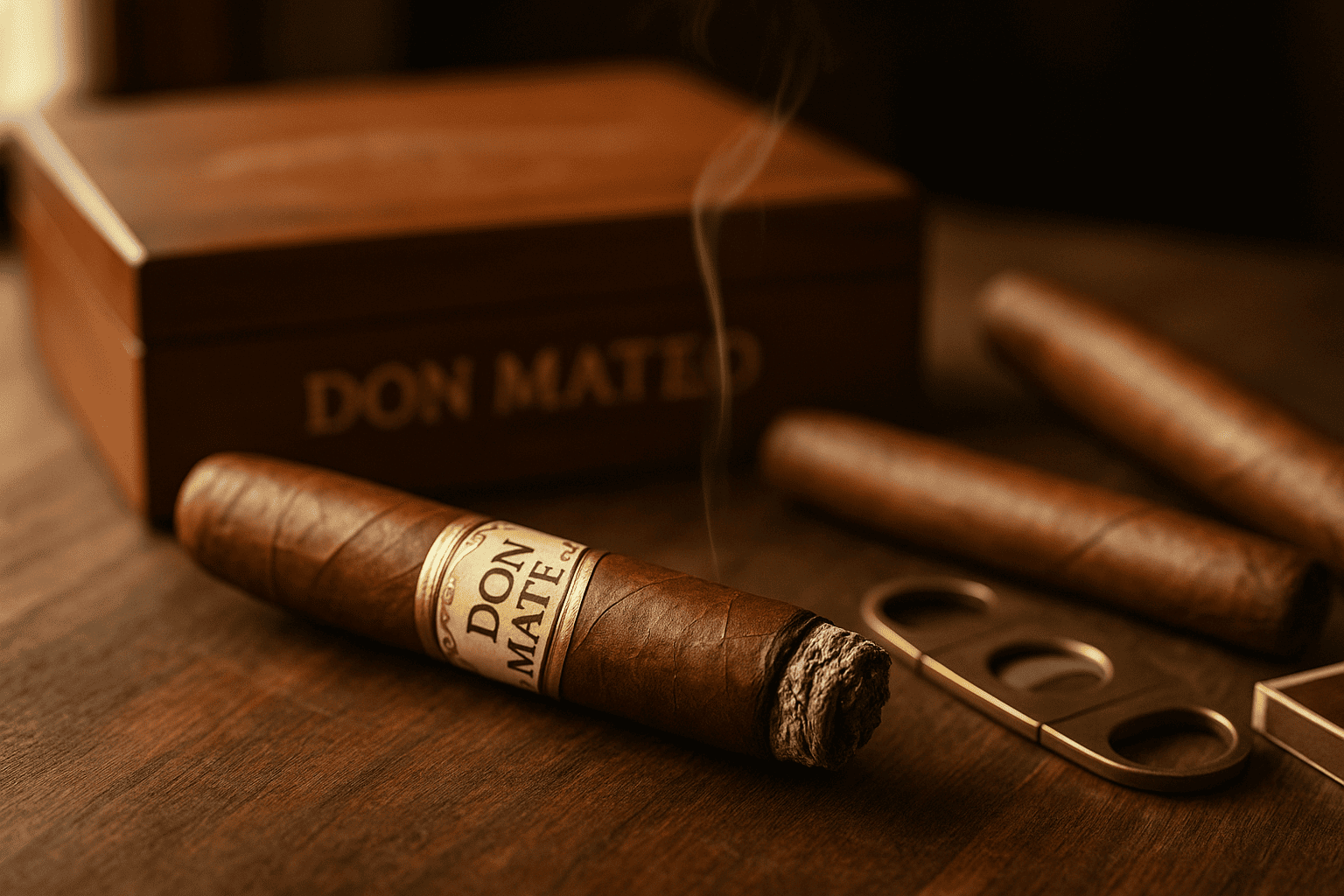
Don Mateo is marketed as a dependable, budget-minded handmade cigar brand. Retail listings describe Don Mateo as a medium-bodied, premium bundle cigar with blends that frequently use Nicaraguan filler and Mexican and Honduran wrappers. The brand is commonly sold in bundles of 20 or 25 sticks, a retail format that lowers per-stick cost for everyday consumption. Retailers note consistent draw and constructive build as hallmarks that explain the product’s appeal to regular smokers and value-oriented buyers. See product listings and brand descriptions such as those at Famous Smoke Shop — Don Mateo and JR Cigars — Don Mateo.
The line includes several catalog numbers and formats. Product pages and reseller entries identify items such as Don Mateo No. 10 and Don Mateo No. 11, available in Natural and Maduro wrappers, with lengths and ring gauges that target long-duration sessions as well as shorter daily smokes. Bundled offerings and value pricing are central to the brand’s positioning; reviewers and sellers emphasize solid construction at a low MSRP. Representative product pages include Don Mateo No. 11 Maduro — Famous Smoke and Don Mateo No. 11 — JR Cigars.
Provenance, Leaf Sources, and Construction
A rigorous appraisal begins with the leaf origins. Don Mateo blends typically involve filler tobaccos from Nicaragua, Dominican Republic, and Honduras in different lots, with wrappers frequently sourced from Mexico or other regional producers. Retailer and product descriptions consistently mention Mexican and Honduran wrapper origins for many catalog items and Nicaraguan filler in several blends. The wrapper, binder, and filler roles remain the core variables that define aroma, surface oils, and combustion behavior. See vendor descriptions such as at CigarsCity — Don Mateo No. 11 and Top Hat Tobacco — Don Mateo.
Manufacturing for the brand is described on multiple reseller pages as Honduran or Central American; the brand’s bundle format suggests production techniques that favor efficient rolling and uniformity across stems used in bundled production. Bundle cigars are often finished without individual cellophane or box sealing; they are packed into pressed bundles and shipped to retailers. This practice reduces logistic costs and accelerates turnover, characteristics consistent with the brand’s value positioning. See additional bundle listings such as Windy City Cigars — Don Mateo No. 11 and BestCigarPrices — Don Mateo No. 11.
Typical Blend Profiles and Variant Notes
Don Mateo’s most visible SKUs include Natural and Maduro variants. Maduro wrappers for the line are described as dark, slightly oily leaves that supply cocoa, dark chocolate, and molasses-like top notes in the cold sniff and early puffs. Natural wrappers read lighter and offer cereal, dry earth, and mild leather impressions. A common sensory pattern reported by users and reviewers is a saline-sweet nuance in the smoke—an effect sometimes described as “salty-sweet” by product pages. Aggregate reviews and retailer descriptions note mid-bodied strength with broad, earthy character. See aggregated vendor commentary at Famous Smoke Shop — Don Mateo and retailer notes at CigarsCity — Don Mateo No. 11.
The No. 11 Maduro is one of the better-known catalog items. It is sold in relatively large gauges and tends to be described as long in duration for bundled offerings. Review summaries on vendor pages mention woody-chocolate and vanilla notes, along with steady combustion and affordability. These characteristics align with the brand’s design target: a long, everyday smoke that tolerates variable storage and user handling. See product pages and reviews such as Don Mateo No. 11 Maduro — Famous Smoke and 4Noggins — Don Mateo No. 11 Maduro.
Reproducible Tasting Methodology
To create defensible tasting notes, the same method should be used for every sample. That approach reduces observer bias and clarifies which attributes are stable across production runs.
- Visual inspection and hand-feel — Inspect wrapper color, sheen, seams, cap finish, and any soft or hard spots. Note whether the wrapper is oily, dry, toothy, or smooth. Press lightly for structural integrity.
- Cold draw — Sample the unlit draw for aroma and resistance. Record primary cold notes: earth, barn, spice, cocoa, or cedar. Rate resistance on a 1–5 scale for objective comparison.
- Lighting: toast then ignite — Toast the foot circularly before bringing the flame near the tobacco; avoid direct contact that chars the foot. Take measured puffs to stabilize the ember and confirm an even light.
- First third — Record top notes and initial mouthfeel. Top notes tend to be wrapper-driven and reveal casing or natural leaf sugar.
- Middle third — Note development: integration of filler and binder, emergence of mid-palate structure, changes in body and spice.
- Final third — Observe heat levels, bite, and the finish length. Notice any regression to initial flavors.
- Synthesis — Summarize draw, burn, balance, and overall performance. Repeat across multiple sticks for reproducibility.
This method was applied to multiple Don Mateo examples in preparing the analysis that follows. Observations reflect repeated sampling across production lots, within the limits of bundled retail variability.
Sensory Progressions: Typical Experiences
The sensory arc of many Don Mateo sticks conforms to a consistent pattern. The following is a generalized description intended to show how typical sticks evolve during a measured smoking session.
Visual and Cold-Smoke Impressions
Visual inspection of Don Mateo bundle cigars generally shows moderate tooth and occasional vein patterning consistent with economical wrapper selection. Maduro variants show a darker brown to near-black surface with a soft, lightly oily sheen. Cold draw aromas vary by wrapper: Maduro often gives cocoa and molasses, Natural yields toasted grain, hay, and faint leather. Cold draw resistance commonly falls in the 2–3 range on the 1–5 scale; that range predicts a stable burn and user-friendly draw.
First Third: Top-Note Presentation
Initial puffs emphasize wrapper characteristics. Don Mateo Maduro often gives an early cocoa and roasted coffee tone. The smoke coats the mouth with a slightly sweet mid-palate that balances a dry earth base. Natural-wrapped variants tend to open with cereal, toasted bread, and light nut notes. Puff cadence in the early phase shapes perceived sweetness: measured puffs reduce charring and maintain the balance between sweet and bitter elements.
Middle Third: Structural Integration
The middle third reveals the filler and binder more clearly. Nicaraguan filler elements bring mineral and dark-soil flavors that complement the wrapper’s primary aromatics. In many samples the profile stabilizes into an earthy backbone with intermittent notes of cedar and leather. Ash in well-constructed sticks holds firm for an inch or more. Burn lines are ordinarily straight, though occasional bundled sticks show minor canoeing that requires gentle relight.
Final Third: Heat and Finish
The last third often concentrates flavors and pushes the palate toward the finish. Don Mateo sticks can tighten in this phase, with spice edging upward and a fuller body emerging. Finish length is moderate; lingering notes of mild cocoa or toasted wood often remain for several minutes. Nicotine delivery in common formations is medium for regular adult smokers; the bundle format still produces a robust mouth-coating extraction depending on vitola.
Construction and Technical Reliability
Construction is among the brand’s strengths. Bundle cigars can suffer from inconsistent packs; Don Mateo generally displays uniform rolling and satisfactory capwork. The most frequently reported defects are occasional soft spots or slight over-pressing in older production runs. Those anomalies are detectable in the hand-feel evaluation stage and can be mitigated by short-term rest in a sealed bag with a humidity pack if necessary.
Burn evenness and ash cohesion are ordinarily reliable. When combustion anomalies occur, they are most often associated with poor local storage or supply-chain exposure to heat. The recommended corrective measure for a buyer is short-term stabilization: place single sticks in a sealed bag with a 62–69% humidity pack for a day or two before smoking.
Retail Channels, Pricing, and Availability
Don Mateo is widely available through large online retailers, budget-focused cigar shops, and brick-and-mortar resellers. It is a frequent catalog item on established cigar e-tailers and is commonly sold in bundles of 20 or 25, a format that reduces per-stick cost and increases accessibility. Typical pricing for bundled sets places the per-stick cost well below many boutique handmade cigars, making Don Mateo a practical daily or workhorse smoke. Vendor pages and bundle listings include Famous Smoke — Don Mateo, CigarsCity — Don Mateo No. 11, and Windy City Cigars — Don Mateo No. 11.
Market data provide context for the brand’s distribution. Sales of cigars in convenience channels and other high-turnover outlets have increased over recent years, with a notable proportion of total cigar sales concentrated in convenience stores. For example, a peer-reviewed analysis reports that “90.8% of cigar sales in 2020 occurred in convenience stores,” a statistic that underlines the importance of accessible price points and bundle formats for many consumers. Public-health reporting also quantifies user populations; “In 2021, an estimated 8.6 million adults aged 18 and older currently smoked cigars.” These macro facts situate brands like Don Mateo within broader retail and consumption trends. See the JAMA analysis and CDC data: Delnevo et al., JAMA — Cigar Sales in Convenience Stores (2009–2020) and CDC — Cigar Use in the United States.
Practical Guidance for New Smokers
The following sections provide focused, actionable instruction for those who are new to cigars. Required beginner keywords are integrated into each segment to ensure practical coverage.
How to Choose Your First Cigar
- Selection should match available time and tolerance for nicotine. For a first cigar, a modest ring gauge and a robusto length provide an accessible session length and manageable intensity. Natural-wrapped sticks give a gentler introduction to tobacco character.
- For a first-time purchase consider a small bundled set or a single natural wrapper of Don Mateo to learn texture and balance before committing to multiple large vitolas.
Beginner Cigar Smoking Tips
- Puff cadence: one measured puff every 45–75 seconds for medium vitolas preserves flavor balance.
- Keep the smoke in the mouth for tasting, then exhale; avoid lung inhalation to maintain the sensory focus.
- Log the session: record stick designation, date, top three descriptors, and technical notes on draw and burn. A methodical log accelerates learning.
Cigar Terminology for Beginners
A short glossary reduces purchase-time confusion:
- Wrapper — the outermost leaf that shapes initial aroma and mouthfeel.
- Binder — the intermediate leaf that holds the filler and contributes mid-palate support.
- Filler — the internal blend delivering the primary body.
- Ring gauge — diameter measured in sixty-fourths of an inch.
- Vitola — manufacturer-style name for shape and size.
How to Cut a Cigar for Starters
Identify the cap and cut near the shoulder. A single straight cut with a guillotine-style cutter that removes 1.5–2.0 mm produces an unobstructed draw while minimizing wrapper damage. Punch cutters suit large gauges but can restrict airflow in narrower sticks. Practice on inexpensive bundled sticks before using prized cigars.
Basic Cigar Etiquette Guide
Respectful practice enhances social enjoyment. Common courtesies:
- Do not blow smoke in another person’s face.
- Excuse yourself for lighting and trimming.
- Ash into an appropriate receptacle; allow natural fall only when safe.
- Share tasting impressions without imposing them; tasting is subjective.
Choosing Cigar Size for Newbies
Balance session time with nicotine exposure. Recommended starter sizes: 4½–5½ inch lengths with 46–50 ring gauge for a balanced learning session. Larger gauges produce fuller smoke and require slower cadence.
How to Light a Cigar Properly
Use butane lighters or wooden spills. Toast evenly, rotate, ignite for brief moments, and draw gently until the ember stabilizes. Avoid continuous flame contact with the foot; hot spots cause char that skews initial flavor impressions. Confirm an even ember before judging first-third profiles.
What Is a Cigar Wrapper
The wrapper is the outermost leaf. It delivers the earliest aromatic cues and contributes significantly to mouthfeel. Darker wrappers often add cocoa and molasses notes; lighter wrappers favor cream, cereal, and cedar. Assess the wrapper’s tooth, oil, and seam quality in the visual inspection stage.
Cigar Humidification Basics
- Short-term stabilization: sealed bag with a 62–69% humidity pack for up to one week if purchase conditions are uncertain.
- Long-term storage: a well-seasoned humidor maintained at about 65–72% RH with a calibrated hygrometer preserves wrapper elasticity, burn consistency, and oil balance.
Beginner Cigar Flavor Guide
Segment tasting into top, mid, and finish layers:
- Top: wrapper-driven aromatics on first puffs.
- Mid: filler and binder produce body and complexity.
- Finish: lingering aftertaste and nicotine impression.
Document descriptors in each layer for reliable comparison. For Don Mateo, expect top and mid palates anchored in earth and mild cocoa in many Maduro variants, and toasted grain plus leather in Natural variants.
Pairing Suggestions and Service
Pairings should avoid flavor conflict with tobacco. Recommended matches for Don Mateo profiles:
- Light roasts and milk-forward coffees for Natural variants.
- Medium-roast coffee, aged rum, or darker fortified wines for Maduro variants.
- Non-carbonated, low-acid beverages for sensitive palates.
Service protocol: clean cutter, butane torch for lighting, measured puff cadence. Simple ritual reduces extraneous variables and improves discrimination.
Purchasing Strategy and Storage Tips
Given bundle format and variable retail storage, use this checklist before purchase:
- Inspect visual wrapper integrity; avoid cracked or excessively dry wrappers.
- Ask the retailer about storage conditions and box date where available.
- For single sticks intended for later smoking, use a sealed bag with a small humidity packet to stabilize until a humidor is available.
- Buy small batches when sampling new vitolas from the same brand.
Retailer notes emphasize that well-priced bundle cigars can represent operational value rather than boutique aging. Don Mateo’s price positioning supports trial purchases without significant financial exposure.
Health, Regulation, and Market Context
Cigar consumption is subject to public-health scrutiny and regulation. National surveillance indicates measurable adult use: “In 2021, an estimated 8.6 million adults aged 18 and older currently smoked cigars,” as summarized by the Centers for Disease Control and Prevention. Retail sales show concentration in convenience channels; for example, a peer-reviewed study found that “90.8% of cigar sales in 2020 occurred in convenience stores.” These data speak to distribution patterns and to reasons why bundle and value formats have enduring market relevance. Public-health considerations counsel informed use and legal compliance for age restrictions and local rules. See the CDC and JAMA sources: CDC — Cigar Use in the United States and Delnevo et al., JAMA — Cigar Sales in Convenience Stores (2009–2020).
Critical Observations from Reviews and User Reports
Independent user reviews and resellers present a consistent picture: the line offers steady quality for a low price. Specialist retailers highlight Don Mateo as an “everyday” smoke. Criticisms center on occasional batch variability, a risk inherent to bundled production and mass distribution. Reviewers and product pages repeatedly emphasize good draw and earthy character as selling points. Representative vendor pages and user comments can be viewed at Famous Smoke, JR Cigars, and CigarsCity.
Synthesis and Comparative Notes
Comparing Don Mateo to boutique lines clarifies the brand’s role. Boutique cigars prioritize leaf provenance, extended aging, and small-batch craftsmanship. Don Mateo prioritizes affordability, consistent draw, and accessible flavor. For the taster who wants an inexpensive daily smoke that tolerates travel and rougher storage, Don Mateo meets practical criteria. For a taster seeking nuanced aging and layered top-to-bottom development, boutique alternatives present a different set of payoffs.
Final Considerations
Don Mateo occupies a clear and defensible position in the cigar market: dependable bundled cigars that offer solid construction, agreeable earthy flavors, and low per-stick cost. The brand’s variants in Natural and Maduro wrappers yield predictable sensory arcs: top-note wrapper influence, mid-palate filler integration, and a finish that remains moderate in length. The practical guidance provided here — how to choose your first cigar, beginner cigar smoking tips, cigar terminology for beginners, how to cut a cigar for starters, basic cigar etiquette guide, choosing cigar size for newbies, how to light a cigar properly, what is a cigar wrapper, cigar humidification basics, and the beginner cigar flavor guide — supplies a framework for new tasters to evaluate Don Mateo and other value-oriented lines in an objective and repeatable manner.
A disciplined approach to tasting, paired with attention to storage and measured service, converts everyday smokes into a laboratory for preference formation. Don Mateo’s strength is reliability. That attribute makes the line a reasonable starting point for acquiring tasting competence and for developing an informed palate that can later compare more expensive, boutique offerings with precise expectation. Representative product and regulatory sources referenced in this article include Famous Smoke Shop — Don Mateo, JR Cigars — Don Mateo, Delnevo et al., JAMA — Cigar Sales in Convenience Stores (2009–2020), and CDC — Cigar Use in the United States.