
Among famous cigar-smoking celebrities, Clint Eastwood occupies a category defined less by excess and more by economy. His on-screen relationship with cigars and cigarillos was never ornamental. It functioned as punctuation—brief, deliberate, and loaded with meaning. Across decades of film, Eastwood’s tobacco use shaped how audiences read silence, authority, and restraint. In that process, Clint Eastwood cigars became inseparable from how cigars shaped celebrity image within American and European cinema.
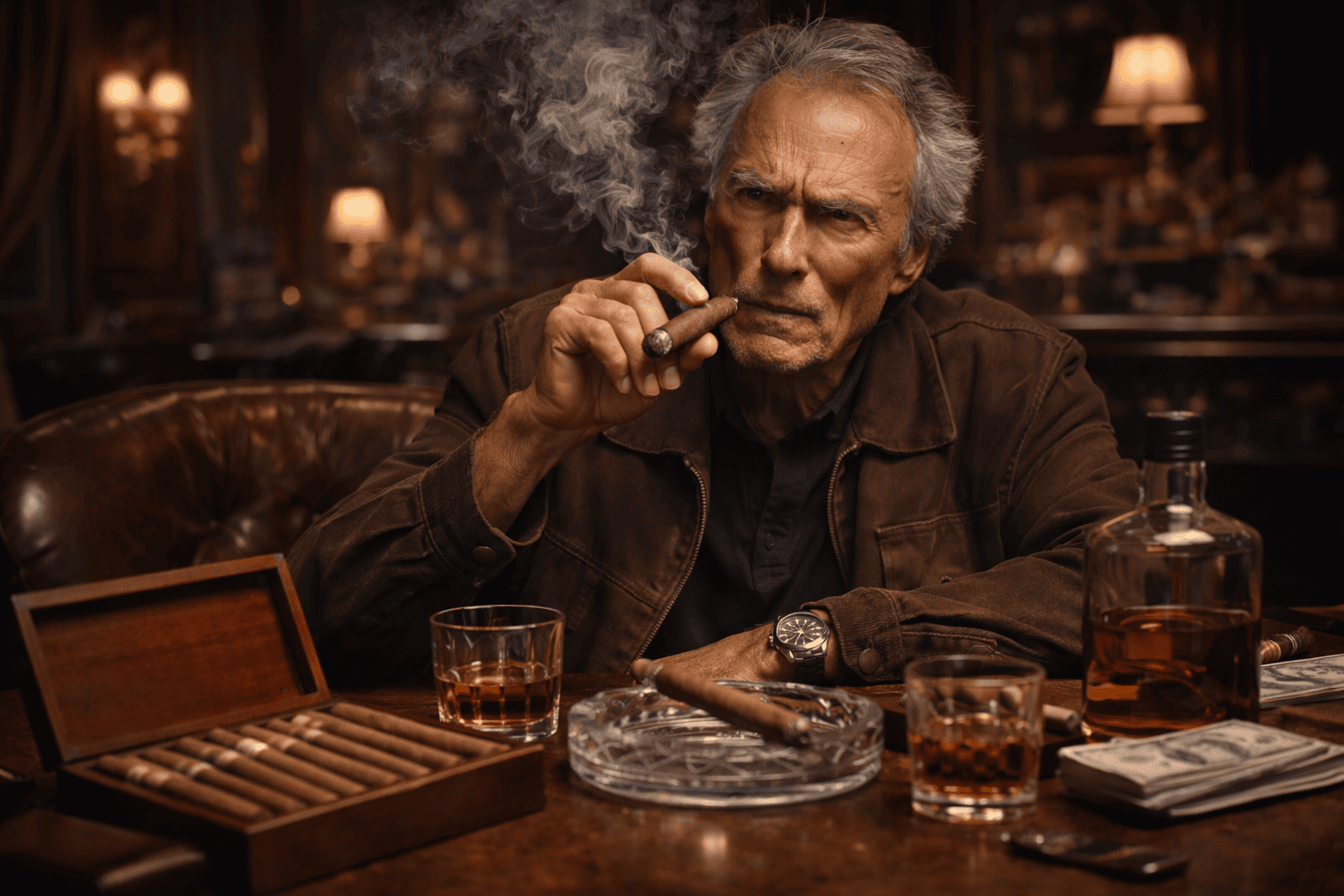
Eastwood’s tobacco presence unfolded gradually. It began not in the polished settings of Hollywood power, yet in dusty landscapes shaped by Sergio Leone’s camera. There, smoke replaced dialogue. A cigarillo between the lips became a timing device, controlling when a character spoke, moved, or acted. That visual grammar continues to influence cigars in movies and TV, long after the embers faded.
Historical Context: Cigars, Cigarillos, and Postwar Cinema
The mid-20th century marked a transitional period for tobacco on screen. Cigarettes had dominated earlier decades, closely tied to studio-era glamour. Cigars, by contrast, carried connotations of authority, experience, and distance. Film historian Thomas Doherty noted that cigars in postwar cinema often signaled “men who operate outside polite society, yet control their own rules.”
By the 1960s, when Eastwood rose to international prominence, cigar consumption in the United States remained culturally visible. According to the Cigar Association of America, cigars held a consistent place in adult consumption through the postwar decades, later expanding during the cigar revival of the 1990s.
Source: https://www.cigarassociation.org/industry-statistics/
Eastwood’s timing placed him at a crossroads where cigars could function symbolically without overwhelming the frame.
The Man With No Name: The Cigarillo as Character
Eastwood’s most formative tobacco imagery emerged during the “Dollars Trilogy,” directed by Sergio Leone. Rather than traditional premium cigars, Eastwood’s character smoked small cigarillos, often lit, relit, or clenched between his teeth during extended silences.
Leone later explained the choice in interviews, noting that the cigarillo added “a sense of ritual and impatience at the same time,” allowing the character to appear calm while coiled for action. Film critic Christopher Frayling documented Leone’s intent in Something to Do With Death, writing that the cigarillo “became a metronome for the character’s inner rhythm.”
These moments formed some of the earliest iconic cigar scenes in modern cinema. Smoke drifted slowly, cutting through barren landscapes. The act of smoking replaced dialogue. That restraint proved influential.
Sensory Reading: What the Cigarillo Communicated
Though smaller than traditional cigars, the cigarillos Eastwood smoked carried sensory implications familiar to experienced smokers.
Opening Phase
Initial lighting suggested sharp, dry aromas. Cigarillos typically deliver quick ignition and immediate tobacco presence. Visual cues implied bitter cocoa husk, dry wood, and faint spice rather than sweetness.
Mid-Section
As the cigarillo burned, smoke output stabilized briefly. The character’s draw cadence slowed. This phase suggested earth and charred grain, reinforcing grit rather than comfort.
Final Stretch
Cigarillos conclude quickly. The abrupt end reinforced urgency. There was no lingering finish. That brevity aligned with characters defined by decisive action.
This sensory economy contrasted sharply with longer-format cigars associated with leisure, reinforcing Eastwood’s screen persona as controlled and unsentimental.
Transition To American Authority: Dirty Harry and Urban Power
Eastwood’s later roles shifted tobacco symbolism. In films such as Dirty Harry, cigars appeared more sparingly, often replaced by cigarettes or absent entirely. When cigars did surface, they carried different weight.
Urban settings reframed the cigar as an object of institutional authority rather than frontier survival. The cigar no longer marked an outsider. It suggested experience hardened by repetition. These pop culture cigar moments reinforced the cigar’s adaptability across narrative environments.
Film scholar Robert Kolker observed that Eastwood’s characters evolved from “men defined by gesture to men defined by restraint.” Tobacco use followed that arc.
Cigars, Silence, and Masculine Minimalism
Eastwood’s lasting influence lies in how little he required from props. The cigar functioned as one of few external cues allowed. That minimalism resonated with audiences and filmmakers alike.
Within discussions of how cigars shaped celebrity image, Eastwood stands apart. His cigars did not suggest indulgence or wealth. They signaled patience and inevitability. Smoke drifted while nothing happened—until everything did.
This approach influenced later cigars in movies and TV, from neo-westerns to crime dramas. Characters who smoked cigars without commentary inherited Eastwood’s grammar of silence.
Real-World Habits and Public Image
Unlike some contemporaries, Eastwood was not widely known for heavy cigar smoking off-screen. His public life emphasized health, discipline, and longevity. In interviews, he often discussed fitness and moderation rather than indulgence.
That distinction mattered. Eastwood’s cigars remained cinematic tools rather than lifestyle endorsements. He avoided celebrity cigar endorsements and never entered the market of celebrity cigar brands. This absence reinforced authenticity. The cigar belonged to the character, not the man.
Cigar Consumption, Cinema, and Cultural Influence
The influence of Eastwood’s cigar imagery extended into later decades, coinciding with the cigar revival of the 1990s. During that period, U.S. cigar consumption increased significantly, doubling between 1993 and 1998.
Source: https://www.cigarassociation.org/industry-statistics/
As cigars re-entered popular culture, Eastwood’s earlier work gained renewed relevance. His restrained tobacco use contrasted with more flamboyant portrayals emerging elsewhere, offering an alternative model rooted in understatement.
Famous Cigar Lounges and the Eastwood Archetype
Eastwood’s characters rarely occupied famous cigar lounges. Their smoking occurred outdoors, in liminal spaces, or in private rooms. That absence reinforced a narrative distinction: cigars were tools, not destinations.
Yet the archetype influenced lounge culture indirectly. Patrons often referenced Eastwood’s films when describing preferences for quiet, low-intervention environments. Silence, spacing, and restraint became aspirational qualities.
In that sense, Eastwood shaped cigars and luxury lifestyle expectations without participating directly in the lifestyle.
Collectible Celebrity Cigars and Cinematic Memorabilia
While Eastwood never released branded cigars, memorabilia tied to his cigar scenes remains highly collectible. Props, still photographs, and promotional materials featuring his cigarillo imagery circulate widely.
These artifacts function similarly to collectible celebrity cigars, valued for narrative association rather than tobacco composition. Their appeal lies in what they represent: a distilled visual language of control.
Film archivist accounts from institutions such as the Academy Museum document continued interest in Eastwood’s western iconography, including tobacco-related props.
Source: https://www.academymuseum.org/
Cigars, Aging, and Longevity
Eastwood’s longevity adds another dimension. Remaining active well into his 90s, he embodies moderation and discipline. His limited, purposeful tobacco imagery reinforces a model where cigars exist within boundaries.
Public health data from the Centers for Disease Control and Prevention illustrates long-term declines in cigarette smoking across decades, while cigar use remained more episodic and situational.
Source: https://www.cdc.gov/tobacco/data_statistics/
Eastwood’s portrayal aligns with that episodic framing. Cigars appear at moments of narrative weight, not habit.
Legacy Across Generations
Eastwood’s influence persists across filmmakers and actors who adopt similar restraint. Modern westerns, crime films, and prestige television often reference his pacing and minimalism. When cigars appear, they do so quietly.
Within lists of famous cigar-smoking celebrities, Eastwood occupies a singular position: not prolific, not promotional, yet foundational. His cigars spoke through absence as much as presence.
Final Considerations
Clint Eastwood cigars represent one of cinema’s most disciplined uses of tobacco imagery. From the sharp bite of a cigarillo in a silent standoff to the occasional cigar marking hard-earned authority, tobacco served narrative timing rather than decoration.
For readers examining how cigars shaped celebrity image and contributed to enduring pop culture cigar moments, Eastwood offers a study in restraint. His cigars burned briefly, deliberately, and without explanation. In that silence, they carried weight that continues to inform how cigars appear on screen—measured, purposeful, and never rushed.