
This article addresses cigar types, sizes, and formats from the standpoint of a practiced connoisseur who values measurable description, reproducible observation, and historical and technical context, to provide the reader with clear view on what cigar options are available in today’s cigar market.
Terms and Units of Measure
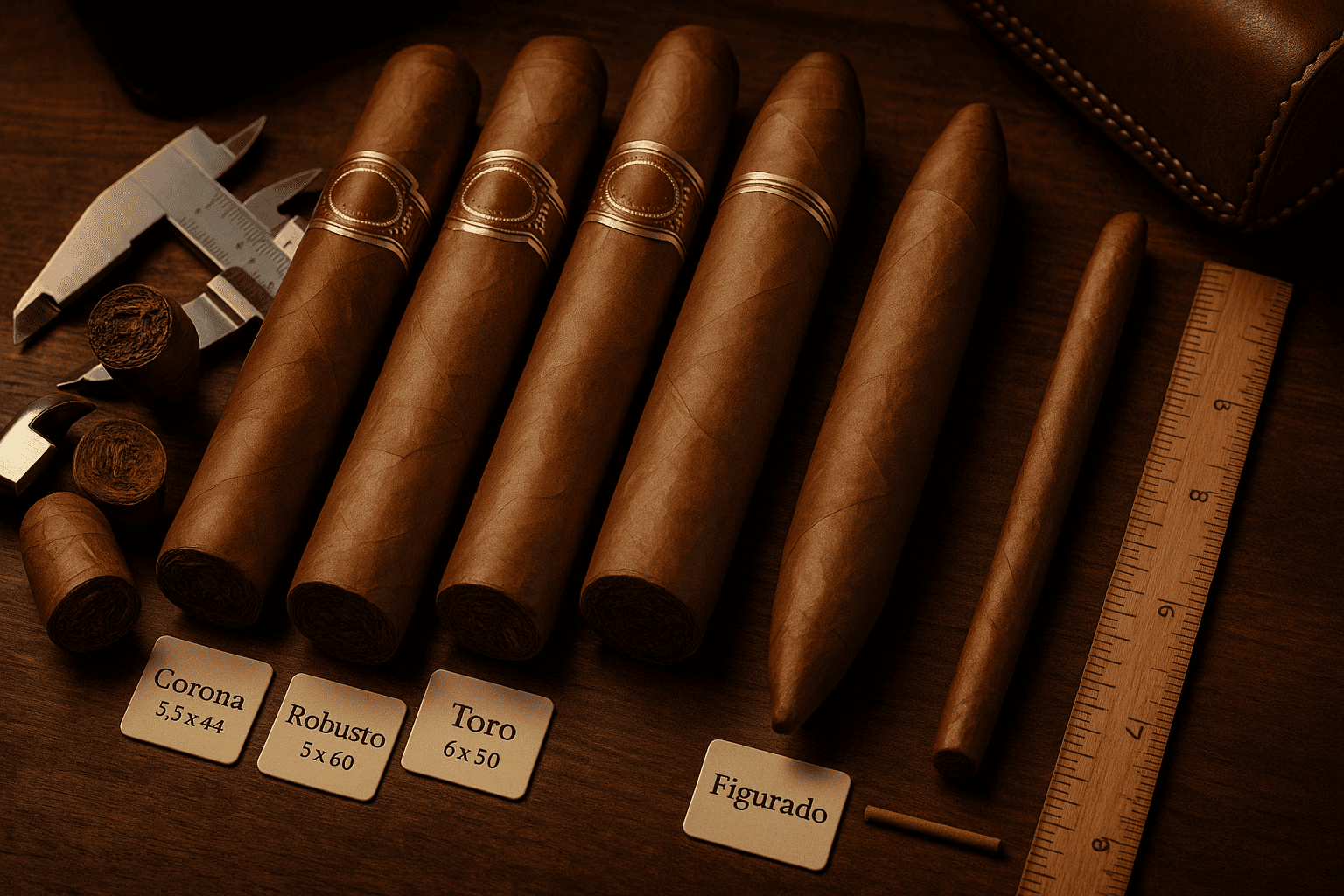
Cigar sizing is expressed with two principal measures: length (in inches or millimetres) and diameter expressed as ring gauge. Ring gauge is a count of sixty-fourths of an inch; therefore a 64 ring gauge would be one inch in diameter. A succinct industry definition captures this relationship: “Cigars are measured by two factors: length, which is given in inches, and ‘ring gauge,’ a designation of a cigar’s diameter broken into 64ths of an inch.” (Cigar Aficionado).
Two corollaries follow and are useful when reading commercial specifications:
- Converting ring gauge to diameter in inches: diameter (in inches) = ring gauge / 64.
- Converting ring gauge to millimetres: diameter (mm) ≈ (ring gauge / 64) × 25.4.
A third practical note informs sensory expectation: size influences burn temperature and the ratio of wrapper to filler per puff. Thinner cigars tend to concentrate flavors and burn warmer; fatter cigars burn more slowly and tend to deliver cooler smoke at equivalent cadence. This relationship is not merely anecdotal: authoritative producers note that larger formats “burn slowly and deliver a large volume of rounder smoke” and that “thinner Habanos smoke more quickly and concentrate the flavours on the tongue giving a slightly sharper taste.” (Habanos).
Vitola: Names, Factory and Market Terms
Two naming schemas coexist in the industry:
- Vitola de galera — the factory name (used by rollers and manufacturers).
- Vitola de salida — the market name (what a consumer sees on a box or catalogue).
These names can differ between brands; a single market name can represent different factory shapes and vice versa. Awareness of both naming conventions helps the connoisseur map sensory experience to construction.
Principal Parejo Sizes (Straight-Sided Formats)
The most frequently encountered group of cigar formats is the parejos — straight-sided, cylindrical cigars that end in a capped head and have an open foot for lighting. Below is a practical catalog of common parejo sizes, with typical dimensions and a short description of their time-to-smoke and sensory tendencies. Wherever possible, established industry references are cited for standard dimensions.
Petit Corona (Mareva)
Typical size: ~4⅞–5⅛ in × 40–42 ring gauge (≈124–129 mm × 15.87–16.67 mm).
Profile: Compact; permits focused, balanced extraction. Habanos lists the Mareva with dimensions 5⅛ in × 42 ring gauge and notes it as “by far the most popular of all the sizes.” (Habanos).
Corona
Typical size: ~5½–6 in × 42–44 ring gauge.
Profile: A benchmark size; offers a classical balance of construction and flavor. Cigar Aficionado refers to the Corona as the benchmark size against which others are measured. (Cigar Aficionado).
Robusto
Typical size: ~4¾–5½ in × 48–52 ring gauge (commonly cited as 5×50).
Profile: Short, relatively wide; provides concentrated flavor in a moderate time (often 30–45 minutes). Cigar Aficionado notes the Robusto as “the most popular cigar size in America.” (Cigar Aficionado).
Toro / Corona Gorda
Typical size: ~5⅝–6 in × 46–52 ring gauge (commonly 6×50).
Profile: Slightly longer than robusto; offers an extended mid-palate development while maintaining robust intensity. (Cigar Aficionado), (Habanos).
Churchill
Typical size: ~7 in × 47 ring gauge.
Profile: Long, steady burn suited to extended sessions. Habanos provides the classic Churchill dimensions and historical context. (Habanos).
Double Corona / Prominente
Typical size: ~7½–8½ in × 49–52 ring gauge.
Profile: A marathon format; used to showcase complex blends that evolve over a longer smoke. (Cigar Aficionado).
Lonsdale
Typical size: ~6½ in × 42 ring gauge.
Profile: A slender, lengthened corona that balances sustained burn with a refined wrapper contribution. Habanos lists 6½×42 as a classic Lonsdale/Montecristo No. 1 size. (Habanos).
Practical usage note: these dimensions are typical, not absolute. Producers vary lengths and ring gauges across releases; the vitola name therefore gives a family of expectations rather than a guarantee of identical sensory output.
Figurados: Tapered and Shaped Formats
Figurados break from the straight cylinder form and influence airflow and mouthfeel by altering the geometry of the head, shoulder, or foot. The most common figurado subgroups are:
- Pyramids / Torpedoes: A tapered head that concentrates wrapper influence in the initial draws, often measured at 6–7 in in length with head diameters around 40 widening to 52–54 at the foot. Habanos describes the pirámide as having the tapered head and shoulders that “has special advantages when it comes to combustibility.” (Habanos).
- Perfectos: A tapered head and tapered foot with a bulge in the middle. The shape modifies the sequence of flavor release as the burning column reaches wider and narrower sections. (Cigar Aficionado).
- Belicoso: A short pyramid with a rounded point, often ~5–5½ in × ~50 ring gauge, providing a direct, intense delivery. (Cigar Aficionado).
- Double Figurado / Salomones: Large, double-tapered formats used for long, evolving smokes. Habanos describes diademas and Salomones as very large figurados, sometimes eight inches or more. (Habanos).
Functional implications: the narrowed head of a figurado concentrates air velocity and can alter perceived spice and intensity. Blenders sometimes create specific wrapper/binder/filler ratios for figurados to compensate for geometry-dependent burn and extraction.
Specialty Format Variations and Contemporary Trends
Since the early 2000s the industry has seen a trend toward larger ring gauges (60 and above) and box-pressed shapes. These design choices affect time-to-smoke and mouthfeel:
- Grande / Gordo: Ring gauges of 60 or more. These formats provide a large thermal mass, promoting a slower, cooler burn and increased perceived cream or sweetness. Cigar Aficionado has observed that “grandes” with ring gauges 60 and fatter have become part of many portfolios. (Cigar Aficionado).
- Box-pressed: A square cross-section achieved by pressing the freshly rolled cigars in molds prior to final resting and packaging. The presentation is compact and can influence draw and how the cigar rests on the palate.
Manufacturers experiment with non-traditional sizes and pressings to create signature physical profiles and to respond to consumer interest in varied session lengths.
Common Size Chart — Practical Reference
The following reference list shows frequently encountered vitolas with conventional dimensions. These are practical, consumer-oriented approximations drawn from manufacturer/trade sources.
- Petit Corona (Mareva): ~5⅛ in × 42 ring gauge. (Habanos).
- Corona: ~5½–6 in × 42–44 ring gauge. (Cigar Aficionado), (Habanos).
- Robusto: ~4¾–5½ in × 48–52 ring gauge (commonly 5×50). (Cigar Aficionado).
- Toro / Corona Gorda: ~5⅝–6 in × 46–52 ring gauge. (Cigar Aficionado).
- Lonsdale: ~6½ in × 42 ring gauge. (Habanos).
- Churchill: ~7 in × 47 ring gauge. (Habanos).
- Lancero (Laguito No. 1): ~7–7½ in × 38 ring gauge; Habanos catalogues the Lancero as 7½ in × 38 ring gauge. (Habanos).
- Belicoso: ~5–5½ in × ~50 ring gauge. (Cigar Aficionado).
- Perfecto: variable; both ends tapered with a bulge in the middle; dimensions vary by release. (Cigar Aficionado).
- Double Corona / Prominente: ~7½–8½ in × 49–52 ring gauge. (Cigar Aficionado).
For precision in tasting or reproduction, consult manufacturer specification sheets; the names alone do not guarantee identical dimensions across brands.
How Size Alters the Sensory Sequence
The geometry of a cigar affects how the blend’s components express themselves across the smoke. A working model that maps size to sensory expectation is:
- Thin, long cigars (Lancero, Lonsdale, Panetela): greater wrapper influence on overall flavor; faster heat penetration; sharper initial concentration on the tongue; smaller filler mass requires careful blending to avoid overheated bitterness. Habanos notes that “thinner Habanos smoke more quickly and concentrate the flavours on the tongue giving a slightly sharper taste.” (Habanos).
- Medium gauges (Corona, Robusto, Toro): balanced expression between wrapper and filler; flexible for blends that seek even evolution over 30–75 minutes. Cigar Aficionado identifies Corona as a benchmark and Robusto as a popular stocky shape that packs flavor into moderate time. (Cigar Aficionado).
- Large gauges (Gordo, Double Corona): increased thermal mass and greater filler contribution per puff; slower combustion yields cooler smoke and extended time for tertiary notes to develop. Cigar Aficionado documents the rise of grandes (ring gauges 60+) and attributes to them a different smoking dynamic. (Cigar Aficionado).
A controlled approach to testing the effect of size on flavor is to hold the blend constant while varying wrapper or vitola; the resulting sensory differences will, in many cases, be attributable to geometry and resultant thermal dynamics of combustion.
Technical Considerations for Rollers and Blenders
From an industrial perspective, size and format influence manufacturing and quality control:
- Roller skill: thin vitolas (lanceros) demand precise placement of filler and tension control to avoid tunnelling or soft spots. These vitolas are often assigned to experienced torcedores. Habanos and other producers note the historic association of Lanceros with the most skilled rollers. (Habanos).
- Binder selection: in small ring gauges the binder must be elastic yet thin; in wide ring gauges binders must handle the extra bulk without compromising draw.
- Fermentation strategy: larger formats may benefit from a higher proportion of ligero (top priming) leaves to sustain body without harshness; thinner formats typically have reduced ligero in the blend to avoid over-concentration of heat-sensitive compounds.
Manufacturers document both factory names and market names for vitolas so that blending and assembly can be standardized across batches and over time.
Time-to-Smoke, Nicotine Delivery and Heat Management
Size correlates with nominal session time, but the relationship is modulated by filler composition and smoker cadence. Typical guidance for time-to-smoke:
- Petit Corona / Petit Robusto: ~20–30 minutes.
- Robusto: ~30–45 minutes.
- Toro / Corona Gorda: ~45–60 minutes.
- Churchill: ~60–90 minutes.
- Double Corona / Salomon: >80–120 minutes.
Nicotine delivery is primarily a function of filler composition (ligero content, leaf priming) rather than size per se; nevertheless, size influences perceived nicotine intensity because of heat dynamics: smaller formats can create higher mouth temperature and a sensation of greater strength at the same cadence. When assessing nicotine and strength, control for:
- Puff cadence: recommended starting cadence for controlled tasting is 45–60 seconds per puff; faster pacing raises combustion temperature and can amplify bitter and astringent elements. Practical reference material often recommends measured intervals to preserve nuance. (Cigar Aficionado).
- Draw resistance: correct construction yields a slight resistance that ensures laminar extraction of smoke volatiles. Too tight or too loose a draw will alter perceived strength and mouthfeel.
Packaging, Presentation and Format Economics
Format affects packaging choices and cost structure. Large ring gauge cigars require more tobacco leaf per stick, increasing production cost and storage requirements. Wrapper quality remains a major cost driver: premium, unblemished wrapper leaf is scarce and commands higher prices. Cigar Aficionado observes that wrappers “when purchased, are the most expensive type of tobacco.” (Cigar Aficionado).
Box formats and presentation vary:
- Boxes of 25 — standard for many parejos.
- Coffins / Gifts — elongated boxes suitable for special figurados or premium series.
- Sampler packs — allow consumers to sample vitolas across a blend or brand without committing to a full box.
From an inventory management perspective, format diversity increases SKU complexity and requires careful rotation and humidity control in retail humidor displays.
Market Context and Scale
Understanding product formats benefits from placing them in a macroeconomic setting. Recent market analyses estimate global demand and scale. One industry report states: “The global cigar and cigarillos market size was estimated at USD 54.79 billion in 2024 and is projected to reach USD 102.17 billion in 2033, growing at a CAGR of 7.2% from 2025 to 2033.” This market-scale statistic documents a commercial environment in which format innovation and premium releases remain commercially important. (Grand View Research — Cigar & Cigarillos Market).
Public health statistics contextualize prevalence. The Centers for Disease Control and Prevention reports: “In 2021, an estimated 8.6 million adults aged 18 and older currently smoked cigars.” This prevalence data is relevant for understanding regulatory environments, venue policies, and demographic patterns within the consumer base. (CDC — Tobacco Product Use Among Adults, 2021).
The Scientific Basis: Fermentation, Maillard Chemistry, and Format Choice
Processing of tobacco — air-curing and subsequent fermentation — creates the chemical substrate that a given format will reveal. Modern metabolomics and microbiome studies have documented that fermentation induces shifts in microbial consortia and biochemical pathways that generate Maillard reaction products and other aroma precursors. Representative research finds that microbial community structure changes significantly during artificial fermentation and that metabolites correlated with flavor increase during the process. These scientific findings explain why prolonged or controlled fermentation produces darker, sweeter wrapper character used in maduro and other heavy formats. (PMC — Microbial community and metabolic function).
A practical implication for format choice is the interaction between fermentation intensity and geometry: heavily fermented leaves used as wrappers in thin vitolas may overwhelm the palate because the wrapper-to-filler ratio increases; conversely, the same wrapper on a large-gauge cigar can contribute sweetness and texture without dominating.
Comparative Methodology: Testing the Effect of Format on Perception
A controlled experiment to assess the effect of size on taste and evolution can be implemented by the practitioner as follows:
- Select a controlled set: obtain three cigars from the same box that share blend and binder but are offered in different vitolas (e.g., Robusto, Toro, Lancero). If identical cutter/press formats are not available, choose the closest available versions.
- Standardize storage: keep all sticks in the same humidor conditions (e.g., 68–70°F and 65–70% RH) for at least two weeks to equalize moisture content. Manufacturer guidance on humidor conditioning is available from suppliers and two-way humidity pack providers; adhering to manufacturer recommendations reduces confounding variables. (Habanos), (Cigar Aficionado).
- Use a consistent protocol: cut with the same cutter type, toast the foot similarly, and maintain a puff cadence of 45–60 seconds. Record the start and end times for each smoke.
- Record metadata: vitola name, measured length and ring gauge, storage RH/T, cut type, time out of humidor.
- Use a three-phase note structure: record observations for the initial phase (first third), middle phase (second third), and final phase (last third), including construction notes (draw, ash, burn line).
- Compare results: look for consistent differences attributable to size: wrapper dominance, perceived heat, mouthfeel changes, retrohale differences.
This approach converts subjective impressions into data and allows the user to correlate format with sensory outcomes.
Practical Advice for Purchase and Aging by Format
- Buy a sample pack when trying a new brand: examine three to five sticks across vitolas if available before bulk purchasing.
- Consider storage footprint: large-gauge cigars occupy more humidor space and require more two-way humidity management.
- Match intended session length to format: plan robustos for time-constrained sessions and Churchills/Double Coronas for long, contemplative sessions.
- Aging strategy by format: large ring gauges can accumulate integrated sweetness over long aging because of larger leaf mass and slower oxidative processes; thin cigars may not benefit as much from extended aging because wrapper oils and volatile aromatics can attenuate over time.
Common Misconceptions and Practical Corrections
- “Bigger equals stronger.” Strength is primarily a factor of filler and leaf priming (ligero proportion). Size modulates perceived strength through thermal effects, but does not, by itself, determine nicotine content. (Cigar Aficionado).
- “Vitola names are universal.” Brand variation in vitola naming is common; measurement is the reliable descriptor. Habanos explains that the same size often has different market names and that understanding both factory and market names avoids confusion. (Habanos).
- “Thin cigars are inferior.” Thin formats concentrate wrapper character and showcase certain blending skills; they also require skilled rolling. A well-made lancero is an example of deliberate craftsmanship rather than compromise. (Habanos).
Design Choices for Blending by Format
A blender’s decision tree for selecting format includes these considerations:
- Goal of the blend: If the objective is wrapper-forward nuance, choose a thinner vitola or a vitola that amplifies wrapper contribution (e.g., Lancero or slender figurado).
- Target session length: Build filler distribution to yield the intended evolution across the selected duration—lighter secs for early sweetness, ligero in calculated proportion for later backbone.
- Construction tolerances: For large ring gauges the filler mass can be more forgiving, but the wrapper must be robust and flexible to prevent tearing under the larger surface area.
These decisions require iterative sensory trials and documentation to ensure reproducibility across production runs.
Collectors, Limited Editions, and Format Rarity
Collectors should be aware that certain formats are produced in limited quantities—especially large figurados and vintage vitolas from historic factories. Limited-edition releases are often pressed into unusual shapes or larger gauges, which affect both aging trajectories and secondary market valuations. When purchasing limited formats, collectors are advised to test a few sticks, confirm storage practices, and record provenance and age.
Summary of Key Reference Quotes and Data
- Ring gauge definition and measurement protocol: “Cigars are measured by two factors: length, which is given in inches, and ‘ring gauge,’ a designation of a cigar’s diameter broken into 64ths of an inch.” (Cigar Aficionado).
- On how size affects taste: “The bigger the Habano, the richer the taste will tend to be, and the cooler the smoke. Fat Habanos burn slowly and deliver a large volume of rounder smoke that drenches the palate with the full mixture of flavours. Thinner Habanos smoke more quickly and concentrate the flavours on the tongue giving a slightly sharper taste.” (Habanos).
- Market scale: “The global cigar and cigarillos market size was estimated at USD 54.79 billion in 2024 and is projected to reach USD 102.17 billion in 2033…” (Grand View Research).
- Prevalence data: “In 2021, an estimated 8.6 million adults aged 18 and older currently smoked cigars.” (CDC — Tobacco Product Use Among Adults, 2021).
- Fermentation science: representative research on microbial community changes during fermentation and associated metabolites. (PMC — Microbial community and metabolic function).
Readers should consult the linked primary sources for complete methodological details.
Practical Checklist for the Practitioner
- Record vitola measurements (length and ring gauge) in notes for every tasting session.
- Use a consistent puff cadence (45–60 seconds) during comparative trials to control temperature. (Cigar Aficionado).
- When sampling a brand, include at least two different vitolas to observe format influence.
- Standardize storage conditions for all samples prior to tasting (68–70°F, 65–70% RH is common guidance). See manufacturer humidor-conditioning instructions for seasoning protocols. (Habanos), (Grand View Research).
Final Considerations
Format and size are structural variables that materially influence the sensory output of a cigar. The vitola determines how wrapper, binder, and filler interact under combustion: thin cigars highlight wrapper character and require precise blending; medium gauges permit balanced evolution; large gauges offer slow, cool development and extended flavor layering. Technical practice and quality control—skilled rolling, correct binder selection, and controlled fermentation—are prerequisites for ensuring that a chosen format expresses a blend as intended.
Actionable items for immediate application:
- When selecting cigars for tasting or purchase, rely on explicit dimensions rather than name alone; measure ring gauge and length or consult the manufacturer specification. (Cigar Aficionado), (Habanos).
- Use controlled comparative testing to map how a specific blend behaves across multiple vitolas; standardize storage and cadence to reduce confounding variables.
- For collectors: be mindful of storage footprint and rotation; large formats require more space and gradual acclimation. (Habanos).
- Keep an evolving tasting ledger keyed to vitola to convert qualitative impressions into repeatable data.
The careful practitioner will approach vitola selection as an experimental variable rather than an aesthetic afterthought. Through disciplined testing, documentation, and reference to manufacturer and scientific sources, a reliable mapping between format and sensory outcome emerges—allowing informed choice, refined evaluation, and reproducible tasting results. (Cigar Aficionado), (Habanos), (PMC — Microbial community and metabolic function), (CDC — Tobacco Product Use Among Adults, 2021), (Grand View Research).