
This guide addresses the practical, legal and sensory aspects of transporting and using premium cigars while traveling. Wherever the craft and sensory experience matter, we will strive to offer practical techniques and checks that a refined palate can apply in transit and at the destination.
Principles Before Departure
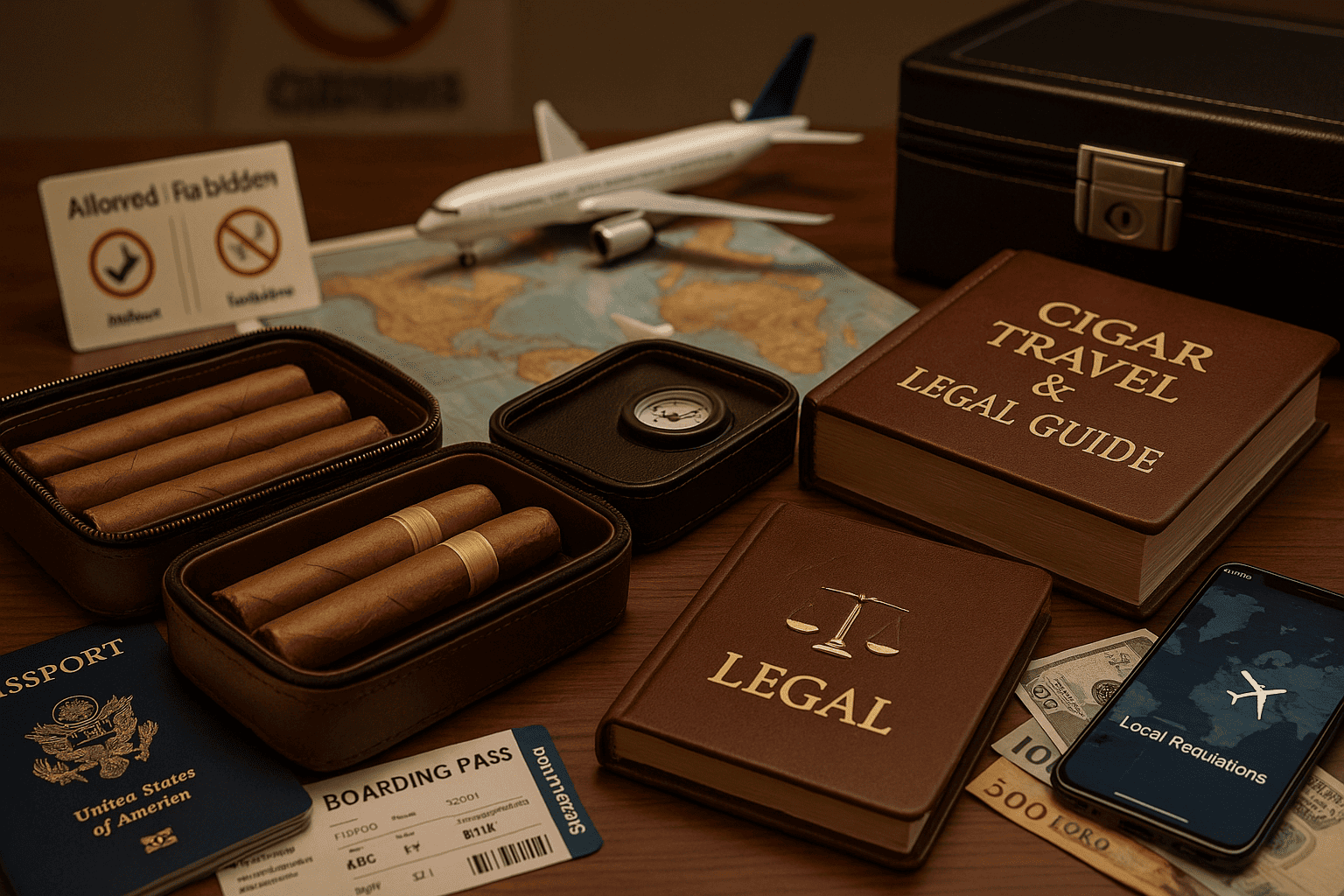
A clear set of principles reduces risk and preserves quality.
- Know the rules for origin, transit and destination: customs allowances, carrier policies and local laws may all differ. Regulatory requirements can change; a reliable source is the official customs or transport agency for the country involved.
- Protect the leaf: humidity, crushing and heat are the principal physical hazards. A travel humidor or tightly packed protected case mitigates those hazards.
- Document provenance when relevant: for aged, rare or taxed items, retain receipts, box codes and import documents where required.
- Declare when required: failure to declare dutiable tobacco can lead to seizure or penalties; treat declarations as routine and risk-limiting.
These principles guide the operational steps in the remainder of the guide.
Airline Travel: Security, Carriage and In-Flight Rules
Security screening and permissibility
Cigars are permitted through Transportation Security Administration (TSA) screening. The TSA lists cigars as permitted in both carry-on and checked baggage: “Cigars: Carry On Bags: Yes Checked Bags: Yes.” See the TSA guidance on permitted items for confirmation. (TSA — Cigars: permitted items).
Airlines and cabin crew enforce in-flight rules: smoking (including the use of lit cigars) is prohibited on scheduled passenger flights under U.S. federal regulations. The Code of Federal Regulations states, “Air carriers shall prohibit smoking on the following flights: (a) Scheduled passenger flights.” The regulation is a federal safety rule; penalties for violation can be substantial. (14 CFR Part 252 — Smoking Aboard Aircraft).
Practical implications:
- Always pack cigars unlit; do not plan to light a cigar on an aircraft.
- Make carry-on the preferred option for short flights because cabin baggage is less likely to be exposed to extreme temperature or crushing.
- Check airline-specific baggage rules: while many carriers permit cigars, some discourage or require particular packaging; large humidors may exceed carry-on size limits.
Checked luggage — pros and cons
Checked baggage is permissible for cigars, but it exposes the cigar to low humidity and variable temperature in the cargo hold. For short flights, carefully cushioned and sealed humidified cases may suffice; for long-range or very hot destinations, carry-on is safer. If a humidor is unavailable, a tightly sealed plastic tube with a humidification pouch is a minimal mitigation. Always respect airline carry-on size rules if selecting the cabin option.
Electronic nicotine devices and batteries
Electronic cigarettes and related devices have distinct safety rules: many carriers prohibit e-cigarettes in checked baggage because of the lithium battery risk. The FAA and DOT guidance restrict such devices to the cabin (carry-on) rather than checked storage. Do not store batteries or e-cigarettes in checked luggage. See official air-safety guidance for details.
Customs and Personal Allowances
Customs regimes vary by country; the traveler must be explicit at declaration.
United States: personal exemptions and declarations
Customs and Border Protection (CBP) publishes guidance on personal exemptions and limits. Travelers should consult CBP pages for precise, up-to-date thresholds and the rule that duties may apply beyond the exemption. For example, CBP advises on country-specific import rules and personal exemption allowances. (U.S. Customs and Border Protection — Travel).
CBP also maintains country-specific guidance: for Cuba, U.S. policy states that “Effective September 24, 2020, authorized travelers may no longer return to the United States with alcohol and/or tobacco products acquired in Cuba.” Confirm current CBP guidance before planning purchases in Cuba. (CBP — Bringing in Cuban goods and/or cigars into the United States).
European Union and the United Kingdom
Travel into EU countries follows defined limits for bringing tobacco for personal use. The European Commission guidance gives illustrative allowances, for example that a traveler “can carry 50 cigarillos and 25 cigars” under higher-limit conditions; verify the exact allowance for the specific member state. (European Commission — Alcohol, tobacco and excise duties).
The United Kingdom publishes personal allowances for arrivals into Great Britain, including a tobacco allowance that lists “50 cigars” as one option among combinations. If arrival quantities exceed allowances, duty and VAT may be payable. (UK Government — Bringing goods into Great Britain for personal use).
Practical customs checklist
- Research exact allowances for each country in the itinerary (origin, transit, destination).
- Retain receipts for purchases made abroad to support declaration and valuation if asked.
- Declare proactively: declare tobacco honestly on the arrival form when required; undeclared tobacco is a routine audit trigger.
- Keep quantities reasonable: if the purpose is personal consumption, stay within commonly accepted personal quantities (tens, not hundreds of sticks) unless planning a commercial import where permits and duties apply.
Special Case: Cuba and Cuban Cigars
The regulatory history for Cuban cigars is complex and has changed multiple times. U.S. policy has alternated between liberalizing deliveries and restricting imports tied to Cuba-specific rules. Travelers acquiring Cuban cigars should confirm current CBP and OFAC guidance before purchase or transport. See the OFAC FAQ and CBP pages for the latest restrictions. (U.S. Treasury — OFAC FAQ on Cuba-related travel), (CBP — Bringing in Cuban goods and/or cigars).
Mailability, Shipping and the PACT Act
When travel implies shipping cigars rather than carrying them, the legal picture diverges from cigarettes and certain smokeless products. CBP and postal guidance clarify that “Tobacco cigars are not covered by the PACT Act and are mailable.” That is an operational point: certain tobacco products face PACT Act restrictions, but cigars may be mailed under defined domestic postal rules. For international shipments, consult carrier rules and foreign import restrictions. (CBP — Mailing tobacco products (help article)), (USPS — Smoking products guidance).
Operational shipping tips:
- Use insured shipping and document the contents clearly for customs; ensure the recipient’s jurisdiction permits import.
- For high-value or rare boxes, require signature on delivery and consider customs broker assistance for importing into another country.
- Domestic mail is permissible for cigars under current PACT Act definitions, but the status of products can change; verify with USPS and carrier guidance before shipping.
Packing and Protecting Cigars in Transit
Preserving the condition of cigars is an art of microclimate control.
Humidity and temperature targets
- Target RH (relative humidity): 65–70% is a standard target for long-term storage; short-term travel humidity of 62–68% is an acceptable compromise to reduce risk of swelling or mold when crossing climates.
- Temperature: avoid extremes. Extended exposure above 30°C (86°F) risks tobacco oils leaching and band discoloration; freezing or prolonged sub-zero exposure risks wrapper cracking.
Cases and humidification options
- Travel humidors (rigid cases with built-in humidification) are best for carry-on. They combine mechanical protection with a sealed, humidified interior. Many models use a small gel or silica-based humidification packet rated for a specified RH.
- Humidified zip pouches: a sealed plastic bag with a small regulated humidification packet (e.g., Boveda or similar) is a low-cost alternative; use a thin layer of foam or paper towel to cushion.
- Tubes and single-stick protectors are useful for one or two cigars and avoid crushing.
- Avoid loose placement in luggage where friction and crushing can damage the wrapper.
Packing sequence for carry-on
- Place humidified items into a rigid travel humidor or sealed zip bag.
- Cushion the case in the center of the carry-on with soft clothing to minimize shocks.
- Keep the case accessible for customs inspection and to reduce time in overheated checked compartments if a pocket change is necessary.
For checked baggage, the principal recommendations are stronger sealing and double-cushioning. Use a primary humidor within a secondary hard case if the planned itinerary requires checked storage for any leg.
Documentation, Receipts and Box Codes
For higher-value travel purchases or shipments intended as gifts or resale, retain documentation.
- Receipts: itemized receipts with vendor name, prices, and box codes support customs declarations and defend against valuation disputes.
- Box codes and cellared dates: record them. A box code frequently encodes manufacture date or factory lot; customs and collectors value clarity on provenance.
- Photographic record: photograph boxes and single sticks before shipping or prior to entering a new jurisdiction. Date-stamped photos strengthen provenance claims.
Hotels, Cruise Ships and Ground Transport
Hotels
Hotel policies vary widely; many prohibit smoking in rooms and on balconies. When booking:
- Confirm hotel smoking policy in writing; select a property with designated outdoor smoking spaces or ask about their cigar policy.
- Avoid lighting in rooms; many hotels charge cleaning and deodorization fees if guests smoke in non-smoking rooms.
- Use designated outdoor areas where permitted and be mindful of local etiquette and ventilation.
Cruise ships
Major cruise lines maintain controlled policies for cigars. Carnival and Royal Caribbean publish designated outdoor smoking areas and note that cigar and tobacco pipes are permitted only in specified outdoor areas or cigar bars. Consult each operator’s published rules for deck locations and enforcement. (Carnival — Locations where you can smoke), (Royal Caribbean — Designated smoking areas).
Ground transport and cross-border driving
When driving across borders, apply customs guidance at the border crossing: entries often require immediate declaration of dutiable goods. Pack receipts and declare items at the first port of entry. Keep cigars in sealed packaging to demonstrate an intent for personal consumption and to facilitate inspection.
Local Laws at Destination: Restriction, Age and Public Use
In many jurisdictions public smoking is restricted or prohibited in enclosed public spaces. Age restrictions for purchase and possession often differ: some jurisdictions set the tobacco purchase age at 18 years; others impose 21. Check local laws before travel. Passenger-facing agencies and public health websites typically provide up-to-date rules.
Examples of application:
- Minimum purchase age: consult destination government portals (e.g., FDA for U.S. policy) for federal baseline and the destination state or country for local rules.
- Public consumption rules: many nations ban smoking in indoor public spaces, and some restrict smoking near doorways, beaches or public parks. Respect posted signs and staff instructions.
Practical Customs Examples and Short Quotes
- TSA permissibility: “Cigars: Carry On Bags: Yes Checked Bags: Yes.” (TSA — Cigars).
- PACT Act and mailability: “Tobacco cigars are not covered by the PACT Act and are mailable.” (CBP — Mailing tobacco products).
- FAA smoking ban summary: “Air carriers shall prohibit smoking on the following flights: (a) Scheduled passenger flights.” (14 CFR Part 252).
- EU guidance example of allowance: travelers “can carry 50 cigarillos and 25 cigars” under illustrative higher-limit allowances. (European Commission — allowances).
- CBP Cuba-specific note: “Effective September 24, 2020, authorized travelers may no longer return to the United States with alcohol and/or tobacco products acquired in Cuba.” (CBP — Cuba guidance).
These short quotations are selected because they are concise legal or policy pivots and they carry operational content that any traveler must know.
Checklist: Day-Before Packing
- Confirm destination customs allowances and whether cigars require declaration. (CBP — Travel), (European Commission — allowances).
- Prepare a travel humidor or sealed zip bag with an appropriate humidification packet.
- Put receipts and box codes in a labelled document folder in carry-on.
- Pack humidified case in carry-on where possible; if checked, double-seal and cushion.
- Confirm airline carry-on dimensions and whether the travel humidor fits overhead or under seat.
- If shipping, verify carrier policy and ensure the item is insurable and documented; check USPS or carrier guidance for domestic mailing. (USPS — guidance on smoking products).
Incident Response: If Held at Customs or Denied Import
- Stay civil and document: photograph the parcel, the box codes and any official seizure or inspection form.
- Request written explanation from the customs official; note the statute or regulation cited.
- Contact the vendor for proof of provenance and purchase receipts.
- If seizure occurs, consult a customs broker or attorney experienced in tobacco importation for advice on appeals or release procedures.
Sensory Notes for Travel: What to Expect After Transit
Transit affects sensory expression. Typical observations:
- Immediate post-transit: if humidity was low, expect the smoke to feel drier; sweet top notes may be less pronounced.
- After reconditioning (24–72 hours in stable humidor): sweetness, oil and mouthfeel recover as moisture equilibrates.
- Heat stress: extreme heat can cause oils to bloom and band glue to separate; inspect wrappers for splitting or visible discoloration.
A practical regimen: let cigars rest in a controlled humidor for 24 to 72 hours after arrival before sampling to allow the leaf to re-equilibrate. This mitigates false negative impressions derived from transit-induced dryness.
Insurance, High-Value Transit and Commercial Shipments
For rare boxes or high-value collections, typical consumer protections can be inadequate.
- Use insured freight for box lots crossing borders, and consider a customs broker for smooth clearance.
- Document chain of custody: keep transfer documents and import/export papers.
- Consider bonded warehousing if storing in a foreign jurisdiction before domestic return, and confirm VAT or tax liabilities on reimport.
Practical Examples: Two Travel Scenarios
Business trip — short domestic flight, single-stay hotel
Pack 3–4 cigars in a travel humidor placed in carry-on, include receipts and selection list. Use hotel designated smoking area or authorized outdoor spaces. Do not plan to light indoors. Confirm local smoking rules at hotel reception.
International leisure trip — multi-country itinerary with purchases
Before buying abroad, check destination import allowances for each subsequent country on the itinerary. When returning home, confirm home-country customs rules and declare purchases. For high-value boxes, document purchase and consider shipping insured via carrier with customs brokerage.
Both scenarios emphasize planning, documentation and conservative quantities consistent with personal use.
Cultural and Etiquette Notes While Traveling
- Respect local customs: the social acceptability of cigar smoking varies significantly; in some locales, smoking is integral to hospitality; in others, it is taboo in many public places.
- Ask permission before lighting in semi-private settings (patios, hotel terraces).
- Remove bands if sharing casually with hosts who dislike branding; this is a courtesy in some social circles.
- Offer a proper cutter and ashtray when sharing a cigar; avoid improvised receptacles.
Etiquette reduces friction and preserves the social dimensions of the cigar ritual during travel.
Quick Reference Links
- (TSA — Cigars: permitted items)
- (U.S. Customs and Border Protection — Travel)
- (CBP — Mailing tobacco products (help article))
- (European Commission — Alcohol, tobacco and excise duties)
- (Carnival — Locations where you can smoke)
- (Royal Caribbean — Where to smoke onboard)
Readers should consult the cited official pages immediately before travel because regulations and allowances change.
Final Considerations
Travel with premium cigars is a matter of preparation, respect for law and attention to leaf preservation. Key legal touchstones — permissibility through airport security, the FAA prohibition on inflight smoking, customs allowances, and the mailability of cigars under the PACT Act definitions — create a predictable framework of actions and constraints. Pragmatic steps — carry-on humidified storage, receipts and box codes, proactive declaration, and use of designated smoking areas — protect both the commodity and the traveler.
Operationally: prefer carry-on for short-haul flights; use a travel humidor with a calibrated packet; document purchases and box codes for customs; and verify destination-specific rules (age, public-smoking restrictions, import allowances). If shipping, use insured, documented carriers and check both origin and destination import rules. For cruise and hotel travel, rely on operator-published smoking area maps and accept their enforcement policies.
When the traveler pairs sensory discipline with regulatory compliance and documentation, the experience is preserved for consumption and, when appropriate, collection or resale. The result is effective preservation of the cigar’s character and avoidance of predictable regulatory and logistics pitfalls.