
This article is written for readers who seek a disciplined, reproducible approach to cigar smoking, blending technical instruction with sensory description and ritual observance, and it emphasizes measurable technique, controlled practice, and careful observation, so sit back and enjoy the journey.
Framing: Purpose and Principles of Technique
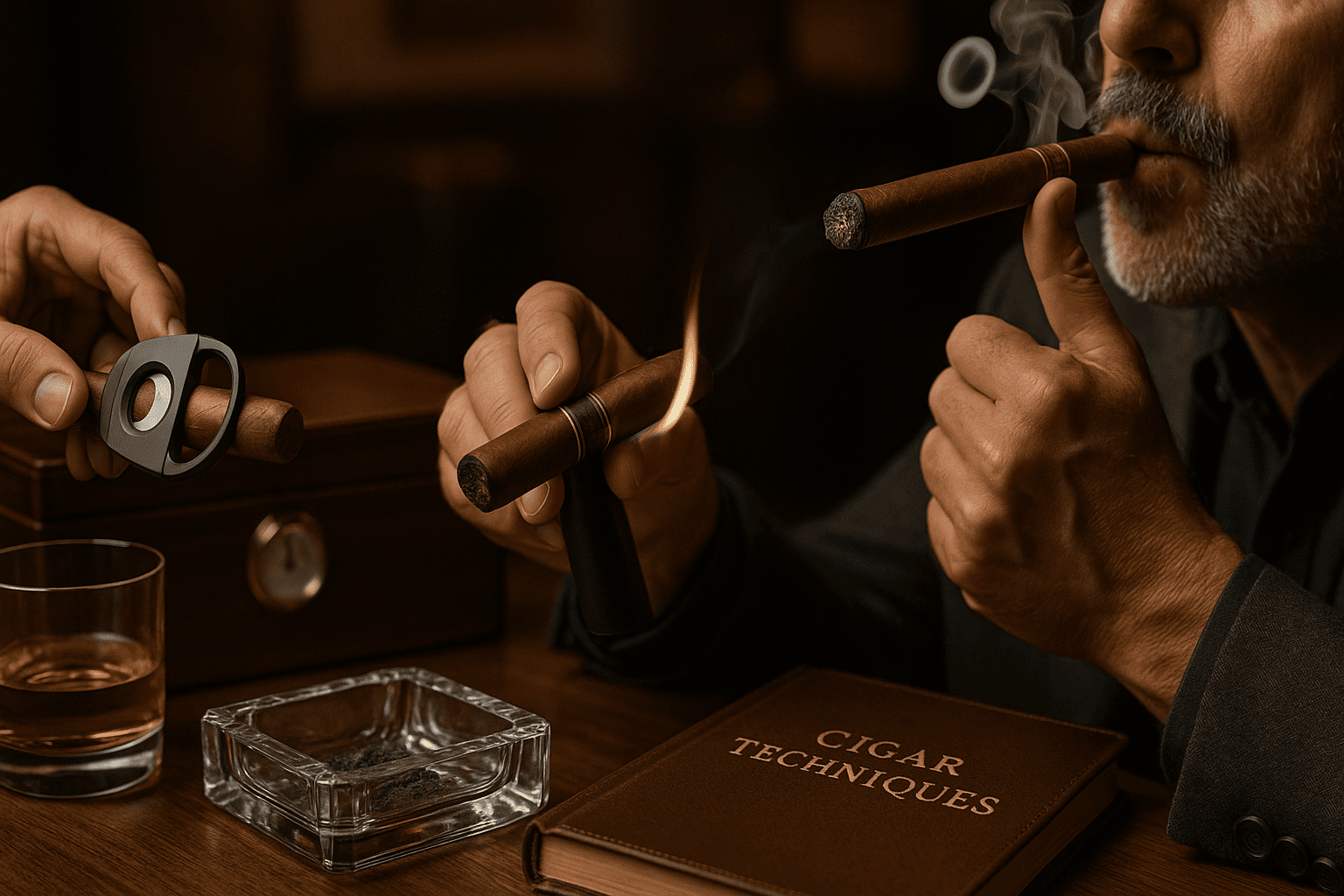
A cigar is intended to be tasted rather than inhaled. The core objective of technique is to present the blend’s aromas and flavors to the mouth and retronasal olfactory system at a temperature and rate that reveal nuance rather than obscure it. Technique governs thermal management, smoke density, and the extraction of volatiles from the tobacco matrix. It also shapes the ritual context—the way a session is entered, conducted, and finished.
Three practical principles guide all subsequent instruction:
- Moderation of heat — keep combustion cool and steady so flavors evolve without charring.
- Consistent extraction — regulate draw and cadence to sustain balanced smoke volume and flavor delivery.
- Clean sensory practice — avoid actions that introduce extraneous tastes (char, fuel residue, mechanical adhesives).
These operational principles are the baseline by which methods are judged. The remainder of the article translates them into stepwise technique and an empirical practice regimen.
Tools and Small Rituals
Technique begins before the first draw. The tools and their handling materially affect the outcome.
Cutters
- Straight guillotine — versatile for most vitolas; offers a clean, broad opening.
- V-cutter — creates a focused channel that can concentrate smoke and modify perceived draw resistance.
- Punch — produces a smaller circular opening; favored when the wrapper cap is thin or fragile.
Best practice: cut near the cap shoulder (approximately 1/16 inch above the head for many vitolas) to avoid cap unraveling while enabling adequate flow.
Lighters and Matches
- Butane soft-flame — produces a clean burn without residual odors.
- Torch (jet) lighters — fast and reliable; instructive caution: avoid applying a direct torch flame into the foot for prolonged periods, which heats tobacco unevenly.
- Wood matches or cedar spills — traditional; use when chemical neutrality of the flame is desired.
Technique: toast the foot prior to first puff by holding the flame just above the tobacco and rotating the cigar until the surface chars evenly; then bring the flame to the foot and take initial puffs while continuing to rotate.
Ashtrays and Hold
A wide, stable ashtray is practical. Hold the cigar between the thumb and index finger near—but not on—the shoulder to allow micro-adjustments of angle. Avoid gripping the cigar behind the cap or pinching the body, which can affect draw and heat transfer.
Cutting, Lighting, and the First Draw — Exact Steps
A reproducible sequence reduces error and improves sensory reliability.
- Inspect the stick for soft spots, uneven seams, or visible damage.
- Cut decisively using the chosen cutter; remove only what is necessary. A hesitant, shallow or ragged cut increases the risk of cap unravel.
- Toast the foot: no immediate deep draw. Heat the foot by rotating the cigar near the flame until the perimeter chars. This initial toasting avoids embedding hot spots.
- Light while taking small, measured puffs to draw the char inward; the goal is to create an even ember across the foot.
- Settle into a rhythm before pursuing longer draws.
This measured approach reduces the number of relights and prevents the introduction of carbonized char notes.
Puff Cadence and Draw Control: Data-Backed Guidelines
Cadence—the time interval between puffs—affects temperature and volatile extraction. Reputable teaching in the field converges on a measured interval. One practical guide observes that “Puffing every 30 seconds to a minute should be an appropriate interval,” and notes that a five-inch cigar typically lasts at least 45 minutes under measured smoking. See a practical discussion at (The Smoke Co. — 10 Things Every Cigar Smoker Should Know).
Another practical maxim is framed as operational advice: strive for a slow, cool approach to extraction. Operational translation:
- Beginner cadence: one puff roughly every 45–60 seconds.
- Intermediate: 30–45 seconds depending on vitola and wrapper type.
- Advanced: modulate to taste; increase frequency lightly if the cigar is over-humidified and tends to go out, but be mindful of heat build-up.
Draw resistance further controls smoke volume per puff. The practitioner aims for a smooth, slightly resistive draw—too tight reduces flavor delivery and produces effortful puffs; too loose increases smoke volume and temperature. If draw is tight, a careful recut or slight warming of the cigar’s foot (gentle toasting) often helps.
Heat Management and Burn Behavior
Temperature is the variable that most directly degrades desirable flavor. Overheated combustion produces acrid char and suppresses nuanced volatiles; underheated combustion leads to re-lights and an interrupted session.
Signs and remedies:
- The cigar runs hot: rapid, sharp flavor with blackened ash; remedy: slow cadence, let the cigar rest between puffs, and avoid large puffs.
- Cigar goes out frequently: often a sign of over-humidification or under-drawing; remedy: a short warm-up to toast the foot thoroughly and maintain a slightly faster cadence until the ember stabilizes.
Ash color and layer structure are secondary diagnostics: light gray to white ash that holds a compact stack is consistent with well-fermented leaf. Flaky dark ash or excessive black flecks suggests uneven fermentation or overly rapid combustion.
The Three Phases: Observing Flavor Evolution
A methodical taster records impressions in three successive phases—initial, middle, final—each described with attention to aroma, flavor, mouthfeel, and perceived nicotine.
- Initial Phase (first third) — wrapper-driven characteristics—surface sweetness, cereal, or light spice appear. The initial puffs set expectations for balance and richness.
- Middle Phase (second third) — filler and binder begin to assert complexity. Secondary notes (nuts, leather, citrus peel, espresso) may appear and interact with the wrapper-derived tones. Retrohaling, if practiced, often reveals spice and floral elements at this stage.
- Final Phase (last third) — concentration and textural weight increase. Bitter or drying elements may emerge if heat control lapses. Nicotine perception often intensifies.
The third-division method is a repeatable observational frame that allows disciplined comparison across sticks and storage regimes.
Retrohale: Purpose, Limits, and Stepwise Instruction
Retrohaling—exhaling smoke through the nasal passages without inhaling into the lungs—engages olfactory receptors that are essential to flavor discrimination. Many practitioners report that retrohaling reveals volatile spice and tertiary aroma compounds absent from oral tasting alone.
A pragmatic step sequence:
- Draw the smoke into the oral cavity as usual; do not inhale.
- Pause briefly to settle the smoke.
- Gently push a small amount of smoke to the back of the throat using the tongue and soft palate.
- Exhale slowly through the nose; begin with only a fraction of the draw and increase cautiously as tolerance builds.
Guidance sources emphasize gradual training: begin with mild cigars and short retrohales until nasal sensitivity acclimates. Practical tutorials and step-by-step instructions are available at sources such as (JR Cigars — How To Retrohale) and (Famous Smoke — Retrohaling: The Nose Knows).
Relighting, Resting, and Session Management
Relighting is a normal part of practice; the quality of relighting affects flavor integrity.
- Relighting technique: re-toast the foot and then take measured puffs until the ember is restored; avoid pressing a high flame directly into the tobacco for extended periods.
- Resting: placing the cigar on the ashtray between puffs allows the wrapper and embers to cool slightly, preserving subtle profiles. The “puff and rest” cadence is not merely ceremony: it materially lowers combustion temperature.
- Interruption and restart: if the cigar has gone out and acquired a charred, bitter edge, cut off the affected foot portion and relight cleanly.
Repeated relights are sometimes unavoidable; the aim is to minimize their number and duration.
Mouthfeel, Smoke Weight, and Perception
Mouthfeel is the tactile complement to flavor. It is described in terms such as thin, creamy, oily, or astringent. Technique can shift mouthfeel:
- Slow, light puffs emphasize cream and sweetness, often perceived as “smoother.”
- Deep, voluminous puffs increase smoke weight and can highlight bitter or astringent components.
As a practice exercise, the connoisseur measures the same cigar across three sessions varying cadence—once at 60 seconds per puff, once at 30 seconds, and once at 20 seconds—while recording mouthfeel, burn, and ash. Controlled comparison helps map the cigar’s thermal tolerance.
Pairing Protocols and Palate Management
Pairing is not an obligation but a method for contextualizing flavor.
- Coffee — matches many mild-to-medium cigars, especially when the coffee’s roast is aligned with the cigar’s roast profile.
- Spirits (whisky, cognac, rum) — pair with medium-to-full cigars; oak, caramel, and toasted sugar in spirits often harmonize with Maduro wrappers and Habano blends.
- Non-alcoholic — black tea, sparkling water, or unsweetened cold brew coffee maintain palate clarity without introducing alcohol.
When pairing, sip sparingly to avoid numbing the palate. Record the effect of the pairing on the cigar’s mid-palate and retrohale impressions.
Common Technical Errors and Corrective Actions
The following errors recur among practitioners and are accompanied by remedies.
- Overpuffing (too frequent) — symptom: hot smoke, bitterness, rapid ash fall. Remedy: lengthen interval, hold the cigar more horizontally, allow cooling intervals. Observational guidance recommends leaving at least 30 seconds between puffs and favoring a slow, cool approach; see practical notes at (The Smoke Co.).
- Cutting too deep — symptom: unraveling of cap, loose wrapper head. Remedy: recut conservatively at the shoulder; use a punch or V-cut for delicate caps.
- Charring the foot when lighting — symptom: sulfuric or bitter notes. Remedy: toast first, then light with measured puffs.
- Improper storage effects — symptom: cigars that burn hot (dry) or go out often (over-humidified). Remedy: harmonize storage (see humidor guidance) and allow cigars to acclimate before smoking.
These corrections are procedural rather than speculative; they are readily testable by iterative practice.
Sensory Narrative: Writing Tasting Notes with Technical Rigor
The advanced practitioner writes tasting notes that separate objective observation from subjective interpretation.
A structured template:
- Metadata: date, cigar name, vitola, wrapper origin, storage RH/T, cut type, time out of humidor.
- Initial phase: aroma from foot, first puffs—list three descriptors (e.g., toasted almond, cream, light cedar).
- Middle phase: transitions—record mouthfeel, any retrohale descriptors.
- Final phase: concentration, any drying or bitter elements, nicotine impression.
- Burn and construction: draw resistance, burn line evenness, ash quality.
This template yields reproducible records and allows empirical correlation of storage variables, technique, and sensory outcomes.
Advanced Tactics: Modifying Draw and Airflow
Seasoned practitioners employ subtle actions to tune draw and smoke temperature.
- Partial punch: for cigars that run hot, reducing the aperture with a partial punch or V-cut can concentrate smoke and sometimes cool the perceived temperature by altering surface-to-volume dynamics.
- Box-press advantage: box-pressed cigars often burn more slowly due to reduced surface area; technique may be adjusted with slightly slower cadence.
- Angling the cigar: holding the cigar at a slightly upward angle can change ember contact and ash trajectory, occasionally helpful to moderate localized hot spots.
These adjustments are incremental and should be evaluated by the same tasting template.
Social and Ritual Aspects That Inform Technique
Cigar technique is practiced in contexts: lounges, tastings, and private sessions. Social norms influence pacing, sharing, and demonstrative technique.
- Pacing in company — synchronise cadence informally with companions; avoid aggressive puffing that creates heat and intrusive smoke.
- Offering a cigar — presentation and lighting for a guest follow a compact etiquette (offer, present band, light for guest if asked).
- Smoking as conversation — technique that conserves flavor and maintains a steady ember supports conversation; aggressive or inconsistent technique interrupts both sensory and social flow.
These norms are functional: they conserve flavor, limit nuisance to others, and preserve the ritual integrity of the session.
Health, Safety, and Regulatory Context
Technique must be contextualized within health and legal frameworks. Notably, public-health data indicate scale and prevalence, which inform social norms and regulation. The Centers for Disease Control and Prevention reports that “In 2021, an estimated 8.6 million adults aged 18 and older currently smoked cigars.” See the CDC report at (CDC — Tobacco Product Use Among Adults, 2021). Practitioners should remain attentive to venue rules, local law, and public-health guidance.
Technique does not negate risk; it seeks to permit reliable sensory evaluation while respecting legal and health constraints.
Practice Regimen and Skill-Building Exercises
Technique improves with disciplined practice that isolates variables. A recommended regimen:
- Week 1: Cutting practice — alternate cutter types on three identical vitolas; record draw and cap integrity.
- Week 2: Lighting and toasting — practice toasting without drawing for a series of short sessions; measure time-to-stable ember.
- Week 3: Cadence testing — smoke identical cigars across sessions at 20s, 40s, and 60s cadence; record ash, flavor, and heat.
- Week 4: Retrohale training — practice short retrohales after the middle third and record nasal sensations; begin with mild cigars.
- Ongoing: maintain a tasting log and periodically review notes to detect pattern shifts associated with storage, new tools, or technique variations.
A regimen converts tacit knowledge into explicit skill and yields measurable progress.
Tools of the Advanced Practitioner
Recommended equipment for reproducible technique:
- High-quality guillotine and punch — for consistent cap integrity.
- Butane soft-flame lighter and one torch for travel; practice both lighting methods.
- Digital hygrometer and basic humidor — preserve storage so technique is assessed against a stable baseline.
- Tasting ledger — structured template for metadata and sensory notes.
The aim is not gear accumulation but reliable, repeatable practice.
Troubleshooting Session-Level Problems
If a session shows degraded flavor, follow a diagnostic thread:
- Check cadence and draw — lengthen interval, reassess draw resistance.
- Inspect for off-notes immediately after relight — if char or chemical odors predominate, cut the foot and relight.
- Check recent storage — if the cigar was recently moved from a very humid or very dry environment, allow 20–60 minutes for partial acclimation.
- Record and compare — note the anomaly and compare to previous sessions to determine whether the issue is product-specific or technique-specific.
A rational troubleshooting approach avoids conflating product variance with operator error.
Examples: Two Short Tasting Narratives
The following model tasting journals show how technique and observation interrelate.
Example A — Mild Connecticut Robusto (Measured Session)
- Preparation: guillotine cut at shoulder, toasted foot, initial draws at 60s cadence.
- Initial: cream and fresh hay; very low spice. Ember even; ash light gray.
- Middle: cedar and toasted almond; slight honey retrohale reveals delicate vanilla. Cadence maintained.
- Final: mild pepper on finish; mouthfeel remains creamy. Final ash compact; overall balance maintained.
The measured cadence preserved cream and avoided heat-induced bitterness.
Example B — Maduro Toro (Controlled Heat Variation)
- Preparation: V-cut, toasted foot. Initial cadence 45s. After 20 minutes, cadence increased to 30s to examine thermal response.
- Initial: dark chocolate and espresso bean; sweet molasses on the foot.
- Middle: leather and black pepper increase with tighter cadence; slight astringency emerges at 30s cadence indicating heat sensitivity.
- Remedy: return to 45–60s cadence; astringency recedes and molasses sweetness returns.
The experiment demonstrates how cadence modulates perceived bitterness and mouthfeel.
Ethical and Cultural Considerations in Practice
Practitioners should respect venue policies and other people’s comfort. The social license to smoke depends on consent and legal compliance. Technique practiced in private differs from technique in public lounges; social context determines allowable pace and volume.
Evidence and Guidance References
Selected operational guidance quoted above includes cadence and session-length guidance and practical maxims. For practical cadence notes and a compact guide to session pacing consult (The Smoke Co.). For retrohale technique and stepwise instruction see resources such as (JR Cigars — How To Retrohale), (Famous Smoke — Retrohaling: The Nose Knows), and practical tutorials such as (Cigar Dojo — How To Retrohale). For storage-related procedural constraints that intersect with smoking practice (for example, seasoning a humidor) consult manufacturer guidance such as (Boveda — Tobacco (seasoning instructions)). For public-health prevalence data see the CDC report (Tobacco Product Use Among Adults — United States, 2021).
Final Considerations
Technique converts a cigar session from an accidental occurrence into an intentional tasting. The practices described above are not ornamental: cadence, cut, lighting, and retrohale materially influence the extraction of flavor, the thermal environment of combustion, and the sensory clarity of the session. A disciplined regimen—structured cutting practice, cadence testing, retrohale training, and careful note-taking—produces measurable improvements.
Key action items the practitioner can apply immediately:
- Measure and control draw rate: aim initially for a puff every 45–60 seconds and refine according to the cigar’s response.
- Prioritize even toasting and a measured lighting procedure to avoid charred flavors.
- Train retrohale progressively with mild cigars and brief nasal exhalations to increase olfactory discrimination.
- Record objective metadata and sensory notes using a consistent template to convert impressions into data.
Technique is iterative: test, record, refine. With attention to thermal moderation, measured extraction, and consistent recording, the practitioner can make objective comparisons across blends, storage conditions, and methods. The reward is not mere ceremony but a clearer, more reliable mapping between a cigar’s construction and its sensory expression.