
Cherry Bomb cigars occupy a defined niche at the intersection of flavored and infused tobacco culture: designed to deliver a pronounced fruit-forward aroma and a rapid, dessert-like flavor arc within a compact smoking time. This report combines technical scrutiny of construction and blend intent with a staged sensory narrative that records how aroma, taste, and mouthfeel evolve across the stick. It also situates Cherry Bomb-style products within market forces, manufacturing methods, and consumer guidance for storage and pairing.
Product Identity and Market Signals
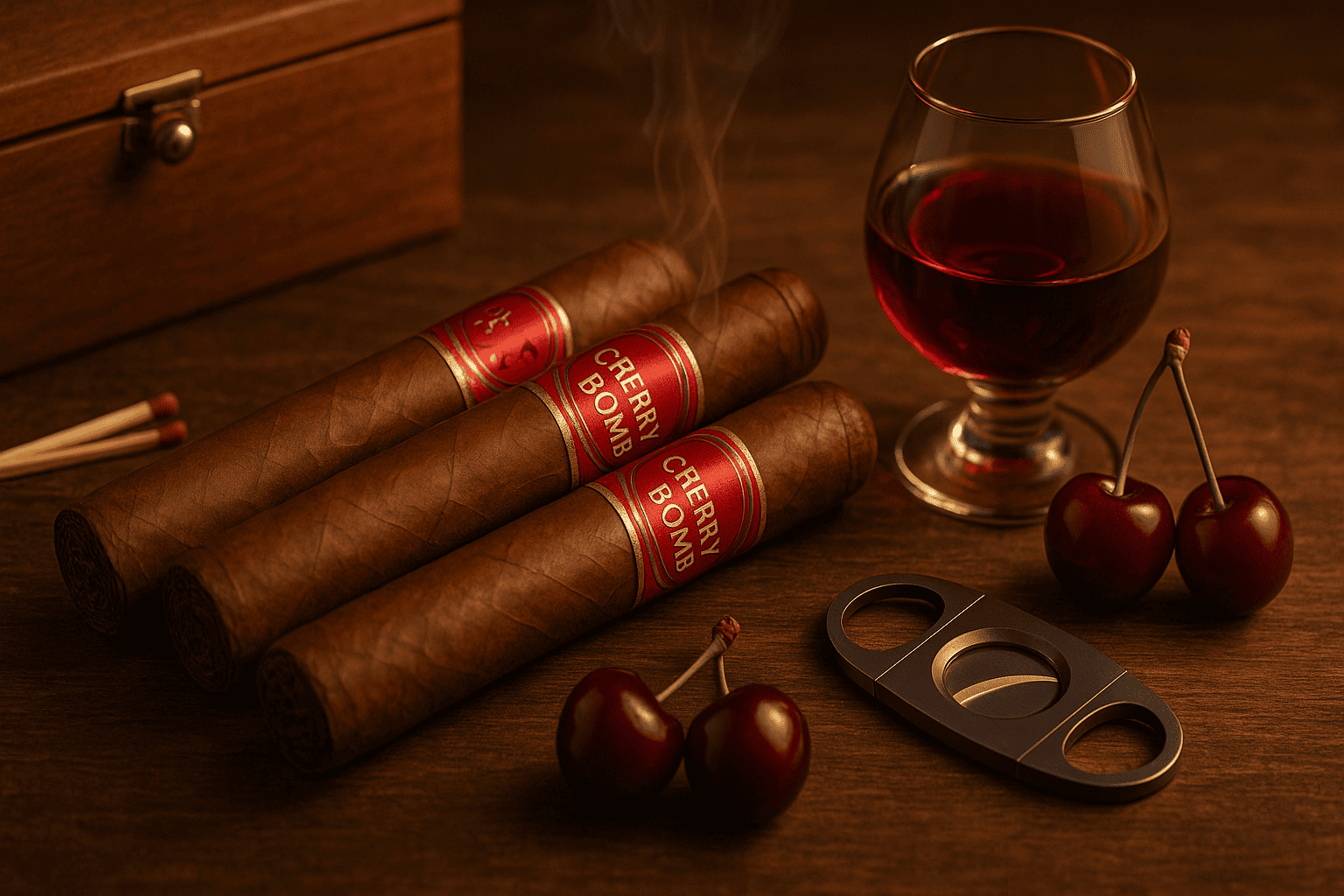
Cherry Bomb is most widely recognized as an entry in the flavored and infused segment produced under established factory lines such as CAO Flavours, where the product description states: “Notes of cherry and black currant are mellowed by a core of creamy vanilla.” This phrasing communicates a deliberate layering of fruit and cream notes designed to be prominent from the pre-light condition through the early puffs. CAO
The scale of the broader market is relevant for context. The global cigar and cigarillos market was estimated at USD 54.79 billion in 2024, which explains manufacturers’ investments in alternative formats and flavor innovations. Market growth supports product diversification from handcrafted long-fillers to tins and small-format flavored lines intended for fast consumption. Grand View Research
What Are Infused Cigars and How They Differ from Flavored Cigars
Clarity of terminology helps the taster and buyer. The phrase what are infused cigars commonly refers to premium cigars that have been exposed to flavoring agents—essential oils, botanical vapors, or steeped essences—during curing or aging so the tobacco absorbs aromatic compounds. Infused vs flavored differences is sometimes debated in enthusiast communities: industry documentation typically treats infusion as part of the manufacturing lifecycle (aging in aroma-rich environments) while flavored cigars may be sprayed, dipped, or wrapped with flavored homogenized leaf additives. An authoritative summary notes that infusion methods deliberately create a lasting internal aroma profile rather than surface coating alone. How Cigars Are Made (Cigar Aficionado)
This distinction matters for sensory expectations. An infused cigar may present integrated aromatics that persist across thirds. A flavored cigar whose flavoring is primarily surface-applied may show a stronger pre-light aroma and a rapid decline in perceived flavor as heat extracts constituent tobacco compounds.
Construction, Blend Intent, and Technical Signals
Cherry Bomb-style cigars are typically built to emphasize immediate aromatic clarity:
- Wrapper and binder selection. Producers often use Cameroon, Connecticut Broadleaf, or similar wrappers that present a sweet, neutral surface for added fruit or cream notes. The wrapper choice affects initial aroma and how added flavors marry with tobacco oils. Cigar resources
- Filler composition. Long-filler blends preserve burn stability and ash cohesion; many flavored or infused lines use long fillers to deliver a cleaner combustion and a steadier carrier for added essences. Short-filler constructions remain common in lower-price flavored lines and shorten the time required to deliver pronounced flavor.
- Infusion process. Where infusion is used, leaves are conditioned in aromatic environments or exposed to essential-oil vapor so flavors are absorbed into the leaf matrix rather than only adhering to the surface. This yields a different profile than a sprayed-on or sweetened wrapper.
Inspect for visual and tactile indicators of care: seamless wrapper application, consistent coloration, and modest oil sheen consistent with intended aromatic expression. These signs often correlate with better integration of added flavors and more stable combustion.
A Phase-Based Tasting Narrative
A disciplined tasting registers the cigar across three phases: opening, development, and finish. The following narrative records a canonical Cherry Bomb experience, noting measurable metrics and sensory descriptors.
- Opening (pre-light and first third): The pre-light aroma is dominated by a pronounced cherry note with vanilla undertones. On the first ignitions the palate registers a sweet-fruit top note—candied cherry or black cherry—supported by creamy vanilla on the retrohale. Draw resistance typically measures in the mild-to-moderate range (1–3 on a 1–5 scale) for many Cherry Bomb formulations. The burn line is usually even when construction is sound. The initial mouthfeel is soft, with a dessert-like sweetness that is never entirely tobacco-free.
- Development (middle third): The tobacco’s binder and filler begin to temper the top notes. Earth and light baking-spice tones appear, providing structure beneath the fruit. If infusion was deep, the cherry and vanilla remain present but less candy-like, integrating with the core tobacco flavors. If the product relies on surface flavoring, sweetness may retreat quickly and the tobacco backbone becomes dominant. Measure ash cohesion (millimeters of straight ash) and burn deviation to ensure construction integrity in this phase.
- Finish (final third): The last third concentrates residual oils. A well-integrated infused cigar will close with warm vanilla and toasted sugar notes layered on a mild leather or cedar base. A less carefully made flavored cigar sometimes produces bitter or chemical-like accents if the sweeteners burn too hot; sensible pacing (one puff every 20–30 seconds) mitigates such risks.
Record retrohale intensity and finish duration (seconds) to quantify persistence beyond the last puff. This data-driven approach aids repeatable comparison across brands and vintages.
Flavored Cigar Pros and Cons
Flavored cigar pros and cons present practical trade-offs:
- Pros: Immediate aromatic appeal, lower barrier to entry for new smokers, strong pairing potential with sweet beverages, and attractive packaging that can support gifting and sampling.
- Cons: Potential for surface-heavy flavor application leading to quick fade; increased risk of sugar-related harshness if puffing too rapidly; regulatory attention that sometimes restricts sales and advertising; and debate within enthusiast communities about aging potential and perceived legitimacy. Evidence-based sources note both commercial success and regulatory scrutiny for these products. Drew Estate
Are Flavored Cigars Natural?
The question are flavored cigars natural is not binary. Many infused lines use botanical extracts and natural essential oils—vanilla extract from real beans, for example—while other products use synthetic flavorings or sweetened homogenized leaf additives. Product descriptions are often explicit about sources: a vanilla-labeled line may reference “Madagascar vanilla” as a marketing point, but only manufacturer documentation fully verifies the extract’s provenance. Reviews and trade guides advise readers to consult brand pages for ingredient claims and to prefer lines that disclose infusion methods when natural extracts are important to the buyer. Cigar Aficionado
Vanilla Infused Cigars Review (Representative Notes)
Vanilla-infused lines illustrate how aromatic infusion can be done well. Notable examples include CAO’s vanilla offerings and Drew Estate ACID variants. A representative vanilla-infused cigar delivers a warm, bakery-like cream that underlies and smooths tobacco bitterness, with the vanilla character persisting through the midsection when infusion is deep. Independent reviews of vanilla releases note that successful examples avoid cloying sweetness and preserve a tobacco backbone, producing a dessert-like but balanced impression. ACID (Drew Estate)
Storage Guidance: Flavored Cigar Storage Tips
Flavored and infused cigars require deliberate storage considerations because added oils and sugars can alter humidity dynamics and wrapper pliability. Practical rules:
- Store at standard humidor conditions for short-term retention (approximately 65–70% relative humidity).
- For infused cigars, use sealed containers or separate drawers to avoid cross-flavoring with other cigars; strong infused lines can perfume neighboring sticks.
- Avoid high humidity and long-term cellaring for sugar-heavy flavored cigars, as persistent moisture and sugar can increase the risk of mold or wrapper degradation.
- Rotate and sample periodically; flavored lines often benefit from short-term freshness rather than prolonged aging. Vendor guides and tobacconist resources recommend using sealed tins for travel and brief carry. Cigar storage guide
How Cigars Are Flavored: Methods and Implications
How cigars are flavored spans techniques from steeping and vapor infusion to topical application:
- Steeping/infusion: Leaves are exposed to aroma-rich environments allowing permeation; this method yields integrated aroma.
- Topical application / spray: Flavorings applied externally create a strong pre-light scent but may fade quickly under combustion.
- Homogenized leaf wrappers: Flavored homogenized leaf (HCL) wrappers with incorporated flavorings offer another route; they can be very consistent but are often associated with lower price points.
The methodology impacts the longevity of flavor, the product’s compatibility with humidor storage, and the way aromatics interact with tobacco’s natural oils.
How to Pair Flavored Cigars and Cocktail Pairings for Flavored Cigars
How to pair flavored cigars requires proportional matching between cigar intensity and beverage body:
- Cherry-forward cigars: Pair with bourbon that has cherry or toasted oak notes, cherry liqueur cocktails, or a robust espresso when looking for dessert alignment.
- Vanilla-infused cigars: Pair with cream-forward cocktails (vanilla Old Fashioned, cream liqueur), or a medium-roast coffee. A vanilla simple syrup in whisky cocktails can mirror the cigar’s sweetness.
- Spiced or coffee-infused cigars: Pair with dark rum-based cocktails or cold-brew Negroni variants that can equalize intensity.
A short list of cocktail pairings for flavored cigars: vanilla Old Fashioned (bourbon, vanilla syrup), espresso martini (for chocolate/coffee-infused sticks), and cherry Manhattan (rye, cherry liqueur) for cherry-accented cigars. When pairing, keep volume moderate and avoid mixing multiple intense flavors; the goal is complementarity rather than competition.
Best Infused Cigar Brands
Best infused cigar brands commonly cited by retailers and reviewers include Drew Estate (ACID and Tabak Especial), CAO Flavours, and other specialist lines. These brands balance tobacco integrity with aromatic ambition. Retailer and top-list resources name ACID and CAO among the most visible, while curated lists provide entry points for experimentation. Drew Estate CAO
Practical Buying and Use Recommendations
- Purchase single sticks or small packs before committing to large quantities.
- Verify pack descriptions for “infused,” “flavored,” or specific extract names if natural sourcing is relevant.
- Keep flavored cigars separate in the humidor to prevent cross-contamination. Use resealable tins for travel.
These pragmatic steps reduce purchaser risk and preserve intended aromatic profiles for short-term enjoyment.
Final Considerations
Cherry Bomb-style cigars illustrate the craft and controversy of aromatic tobacco innovation. When infusion is executed with care—the use of long filler, appropriate wrapper selection, and a restrained infusion process—the product offers reliable, vivid aromatics that persist through the smoking phases and pair well with dessert-style beverages. For consumers, the essential evaluation factors are construction quality, method of flavor application, and storage practice. Retail and industry data confirm the commercial relevance of flavored and infused lines, and manufacturer-provided descriptions and independent reviews give concrete guidance for matching price to sensory expectation. Test with measured puffs, document draw and finish metrics, and pair thoughtfully to make the most of Cherry Bomb-style offerings. Grand View Research How Cigars Are Made