
The Dominican Republic occupies a particular place in premium cigarmaking: a large, diversified production base, multiple generations of family firms, and a range of terroirs that supply both wrapper and filler leaf. For a taster seeking the Dominican idiom—its floral sweetness, soft cream, and capacity for elegant mid-palate complexity—several houses stand out by reputation, consistency, and the way their blends illustrate tobacco blending basics and wrapper vs filler differences. This article surveys the leading Dominican brands, frames the agricultural and technical background that gives them identity, and offers tasting and purchase guidance grounded in measurable facts and quoted industry observations.
Market context and scale
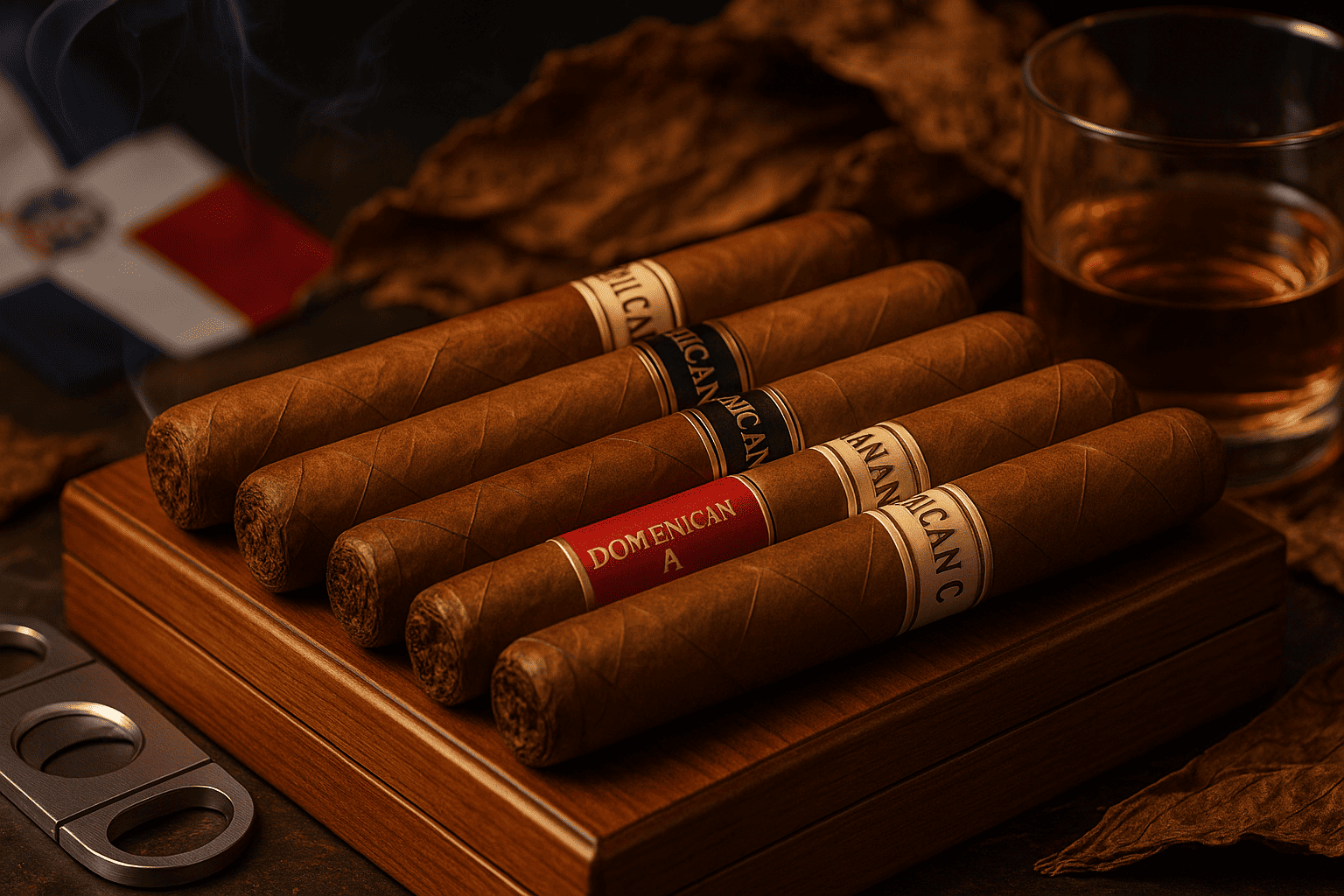
The premium cigar segment supports flagship brands and long-term cellar projects. The global premium cigar and cigarillos market was valued at US$12,087.5 million in 2024, reflecting persistent demand for handmade, blend-focused products. See market reporting from Grand View Research for industry figures. Grand View Research — Premium Cigar Market. At a larger scale, the global cigar and cigarillos market was estimated at USD 54.79 billion in 2024, indicating the broader commercial footprint in which Dominican producers operate. Grand View Research — Cigar & Cigarillos Market.
Agricultural foundation: seed, soil and processing
Dominican leaf expresses a spectrum of character because seed and place affect oil, sugar, and nicotine chemistry. The distinction of Cuban seed vs Criollo and related classifications matters in practice: Cuban-seed (often referred to commercially as “Habano”) denotes seed lines originally native to Cuba but cultivated elsewhere; Criollo refers to a traditional Cuban variety whose modern hybrids and regional expressions differ by location. Seed sets genetic potential; terroir sculpts it. For a primer on Cuban-seed terminology see specialist overviews. Holts — What Is Cuban-Seed Tobacco?
How terroir affects cigars is measurable: elevation, soil mineralogy, and rainfall influence leaf thickness, oil content, and sugar-to-nicotine ratios. Dominican valleys such as the Cibao produce leaves renowned for balanced, sweet aromatics, which is why many Dominican firms emphasize in-house agriculture and graded leaf selection when designing blends that emphasize silkiness over brute force. Industry analysis on terroir and tobacco flavor offers further context. Cigar Journal — Terroir and Tobacco Flavor.
What to look for in Dominican production
Practical technical attributes that distinguish reliable Dominican offerings:
- Wrapper vs filler differences: the wrapper governs immediate aromatics (vanilla, cream, spice) while filler determines lengthwise structure, nicotine, and evolution. Blenders choose wrappers (Cameroon, Connecticut-derivatives, Habano, Maduro) to set the entry tone and place binder/filler to control energy.
- Aged tobacco flavor impact: controlled fermentation and cellar time reduce harsh chlorophyll and integrate sugars and oils, producing smoother mouthfeel and tertiary notes like cedar, dried fruit, and leather. Industry glossaries and technical articles describe fermentation and aging chemistry. Cigar Aficionado — Aging
- Seed lineage: Cuban-seed varieties will not taste identical outside Cuba; growers blend seed and place to achieve intended outcomes.
Brands that define Dominican tradition
The following firms exemplify Dominican strengths across history, blending, and technique.
Arturo Fuente (Tabacalera A. Fuente y Cia.)
Arturo Fuente is one of the Dominican Republic’s most influential houses. The family enterprise combines estate production with an emphasis on traditional rolling and careful priming of filler; its Hemingway line and other figurados are often cited in critical lists for consistent construction and balanced aromatic profiles. The company’s official site and trade reviews document its long-standing production practices. Arturo Fuente.
La Aurora
La Aurora claims the longest continuous history in Dominican cigar production. The firm mixes historical production methods with modern quality control and has lines that showcase regional Dominican wrapper and filler profiles. La Aurora’s company information and brand history are available from the producer. La Aurora.
La Flor Dominicana
La Flor Dominicana is explicitly farm-and-factory integrated: its founders invested in tobacco acreage and experimental blends that pushed shape and strength boundaries. The brand is noted for fuller profiles and innovative vitolas; its Ligero- and Double Ligero-focused lines show how Dominican-grown ligero can drive power without losing clarity when combined with careful binding and aging. La Flor Dominicana.
Davidoff (Dominican production site)
Davidoff is a Swiss-founded brand whose premium manufacturing is located in the Dominican Republic; the company notes that its high-end production operations are based in the country and that it maintains strict quality-control standards. Davidoff’s corporate materials outline its production history and factory commitments. Davidoff — Our Factories.
Ashton and other artisan houses
Ashton cigars are rolled in Dominican facilities and demonstrate an older-school style that favors refined Connecticut and Sun Grown wrappers atop Dominican filler. Ashton’s consistent scoring in trade reviews and its retailer presence make it a mainstay for those seeking a balanced Dominican expression. Ashton.
Historical marques made in the Dominican Republic (Montecristo, Romeo y Julieta, etc.)
Several legacy brands with Cuban origin have parallel, non-Cuban production lines manufactured in the Dominican Republic by groups such as Altadis; Montecristo and Romeo y Julieta are notable examples. These versions often retain brand identity while reflecting local Dominican tobaccos in filler or binder. Comparing Cuban-made and Dominican-made iterations provides a practical lesson in seed and terroir effects. Altadis — Montecristo.
Tasting practice: how to read a Dominican cigar
To get the most instructive experience from Dominican brands:
- Visual and tactile inspection. Note wrapper color, oil, and cap finish to set expectations for the first third (Connecticut shade wrapper profile vs darker Maduro wrapper characteristics).
- Cut and toast. Use the best cigar cutting methods for the vitola and practice how to toast a cigar, heating evenly to avoid scorching; then apply the flame allowing rotation so that how to light a cigar evenly is observed.
- Mindful inhalation. Use proper cigar draw technique and remember that premium cigars are enjoyed by mouth only—smoking a cigar without inhaling is standard practice for flavor evaluation.
- Pacing. Employ cigar puffing rhythm tips and slow smoking for flavor to maintain temperature control and prevent harshness. If desired, a measured retrohale (retrohale method explained) reveals top-end aromatics safely.
- Observe evolution. Track how wrapper-led aromatics recede and filler-driven structure (spice, leather, cedar) appears; note the aged tobacco flavor impact across the second and final third.
Buying and cellaring guidance
- Source: Purchase from reputable retailers or directly from brand-appointed merchants; provenance matters for boxes and limited runs.
- Storage: Maintain 65–70% RH and 65–70°F for general preservation; some fuller Dominican blends will benefit from incremental cellaring to evolve sugars and tertiary notes (aged tobacco flavor impact).
- Comparative purchases: Buy single sticks from multiple brands to compare Connecticut shade wrapper profile examples against Maduro wrapper characteristics and see how Dominican tobacco flavor notes present in the context of different blends.
Final Considerations
The Dominican Republic provides the global cigar market with both venerable history and modern experimentation. Brands such as Arturo Fuente, La Aurora, La Flor Dominicana, Davidoff (Dominican production), Ashton, and the Dominican iterations of legacy marques illustrate different approaches to tobacco blending basics, seed selection, and the practical management of how terroir affects cigars. For the taster who wishes to train sensory discrimination, comparing Connecticut shade wrapper profile examples to Maduro wrapper characteristics within Dominican production clarifies wrapper vs filler differences and the aged tobacco flavor impact that careful fermentation and cellar time create. Engaging the recommended tasting method—using the best cigar cutting methods, practicing how to toast a cigar and how to light a cigar evenly, applying proper cigar draw technique, observing cigar puffing rhythm tips, using the retrohale method explained in moderation, practicing slow smoking for flavor, maintaining cigar burn line, and following cigar ash handling tips—converts brand reputation into repeatable sensory knowledge and reveals what makes the best Dominican cigar brands worth study and cellar allocation.