
Positioning Within the Contemporary Cigar Market
Good Days Cigars occupies a carefully judged space in the modern premium cigar ecosystem, where accessibility, consistency, and restrained ambition define its identity. The brand does not present itself as an ultra-rare collectible or as a mass-market commodity. Its portfolio instead addresses smokers seeking reliable construction, clear flavor progression, and pricing that aligns with repeat enjoyment rather than occasional indulgence. This placement situates the brand naturally within conversations around mid-priced cigar reviews and best cigars under $10, categories that have gained relevance as consumers balance quality expectations with realistic spending habits.
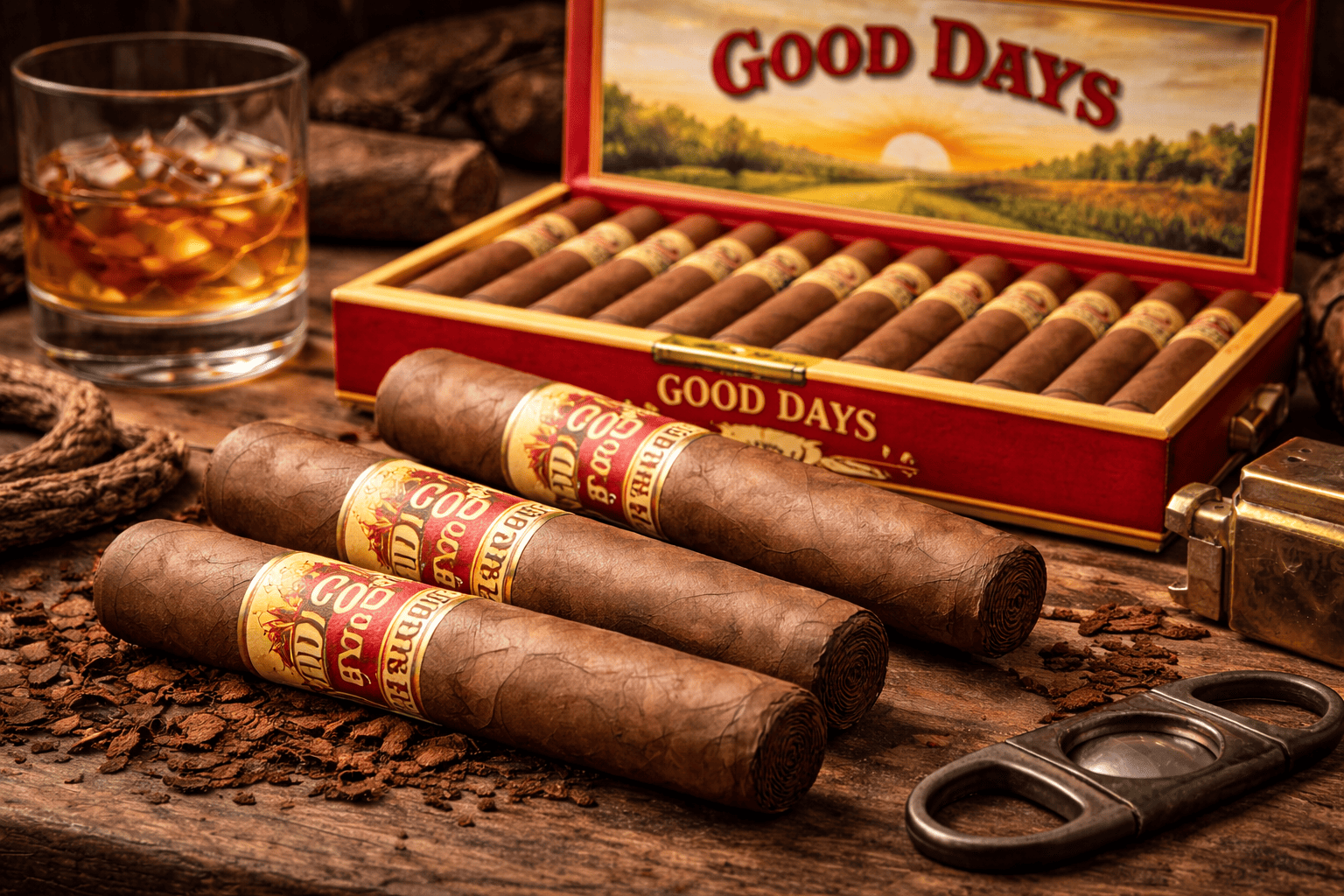
The global handmade cigar market remains modest in scale compared to other luxury consumables. According to the Premium Cigar Association, annual U.S. handmade cigar imports have hovered around 300–350 million units in recent years, a fraction of machine-made volume. Within that segment, brands like Good Days rely less on scarcity narratives and more on process discipline: stable tobacco sourcing, predictable fermentation cycles, and formats that suit long-standing smoking preferences.
Tobacco Sourcing and Blending Philosophy
Good Days Cigars emphasizes Central American tobaccos, with Nicaragua playing a prominent role in filler and binder selection. Nicaraguan tobacco, particularly from Estelí and Jalapa, is widely documented for its balance of strength and aromatic clarity. Estelí contributes darker mineral tones and black pepper; Jalapa offers sweetness and aromatic lift. The brand’s blends frequently introduce a Honduran or Dominican component to moderate combustion rate and temper nicotine intensity.
The wrapper choices lean toward familiar, proven varietals—Ecuadorian-grown Habano and Connecticut-seed wrappers dominate the line. Ecuador’s cloud cover allows thinner leaf with consistent elasticity, improving burn uniformity. In tasting terms, this translates into a surface sweetness and measured spice that supports the filler rather than obscuring it. This blending restraint explains why several Good Days offerings appear in informal discussions of smooth cigars for beginners, even when underlying strength approaches medium-plus.
Construction Standards and Rolling Technique
Construction remains the non-negotiable foundation of any serious cigar evaluation. Across multiple vitolas, Good Days Cigars shows attention to bunching symmetry and wrapper tension. Draw resistance typically falls within the accepted range of 40–60 cubic centimeters per minute, ensuring smoke production without overheating the ember. Ash formation tends toward compact, medium-gray stacks, indicating balanced mineral content and proper fermentation.
Seams are pressed flat and adhesive usage remains discreet, avoiding the brittle burn interruptions associated with excess vegetable gum. Caps are applied with consistency, allowing clean cuts across guillotine, punch, or V-cutter methods. These details may appear unremarkable, yet they directly influence placement in long-smoke cigar rankings, where even burn and stable draw outweigh novelty.
Cigar Tasting Notes Explained Through Progressive Phases
Understanding cigar tasting notes explained requires patience and context rather than theatrical description. A Good Days robusto illustrates this measured evolution clearly.
Opening third:
Ignition introduces dry cedar, toasted grain, and a restrained white pepper note concentrated through the nasal passage rather than the palate. Smoke texture remains medium-bodied, with no aggressive sharpness. Retrohale reveals a faint citrus peel, suggesting well-preserved upper primings in the wrapper.
Middle third:
Heat stabilizes and combustion widens. Earth and roasted coffee emerge, joined by a muted cocoa powder impression. Nicotine presence increases slightly, though mouthfeel remains rounded. The balance achieved here explains why certain blends are referenced alongside best full-bodied cigars without overwhelming less experienced smokers.
Final third:
The profile tightens. Pepper returns with greater structure, accompanied by leather and charred oak. Sweetness recedes, replaced by a savory mineral note common to Nicaraguan seco. Proper pacing prevents bitterness, though rapid smoking may accelerate tannin buildup.
This arc demonstrates intentional blending rather than accidental convergence, reinforcing the brand’s reputation for dependable flavor sequencing.
Vitola Selection and Smoking Duration
Good Days Cigars maintains a vitola range that reflects consumer habits rather than experimental excess. Robustos, coronas, and toro formats dominate. A standard 5 x 50 robusto averages 60–75 minutes of smoking time under moderate cadence, aligning it with expectations in long-smoke cigar rankings without demanding extended commitment.
Larger ring gauges deliver cooler smoke and prolonged combustion but reduce wrapper-to-filler ratio. Good Days balances this by adjusting filler composition to preserve aromatic clarity. Smaller formats, where available, highlight wrapper nuance and are often cited among top rated small-batch cigars when limited production runs are released.
Aging Potential and Storage Considerations
These cigars are blended for near-term enjoyment rather than prolonged aging. That said, controlled humidor rest at 65–68% relative humidity for six to twelve months tends to soften pepper edges and integrate secondary notes. Overextended aging may flatten the profile, particularly in blends using lighter wrappers with lower oil concentration.
From a practical standpoint, this characteristic appeals to smokers seeking immediate gratification rather than speculative cellaring. It reinforces the brand’s alignment with everyday ritual rather than deferred consumption.
Seasonal Context and Pairing Sensibility
Seasonal cigar reviews often highlight how ambient conditions influence perception. Good Days Cigars perform reliably across climates, though specific blends show seasonal affinity.
- Cooler months: Fuller-bodied expressions pair effectively with black coffee or barrel-aged spirits, where warmth amplifies cocoa and spice.
- Warmer months: Connecticut-wrapped offerings maintain clarity without palate fatigue, pairing well with mineral water or lightly sweetened tea.
This adaptability contributes to the brand’s consistent rotation among smokers who prefer a small, dependable portfolio rather than expansive collections.
Pricing Structure and Market Comparisons
Retail pricing commonly falls between USD $6 and $9 per cigar, placing Good Days squarely within discussions of best cigars under $10. This pricing allows fair comparison with established brands that appear in top 10 premium cigars lists, albeit without the marketing premiums attached to heritage labels.
Value assessment here rests on construction reliability and flavor integrity rather than rarity. In blind tastings conducted by independent cigar clubs, cigars within this price tier frequently score within a narrow band of one another, reinforcing that execution often outweighs brand legacy.
Limited Editions and Production Scale
When Good Days introduces short-run releases, quantities remain modest yet accessible. These offerings may use higher priming wrappers or experimental fermentation durations, placing them within the orbit of best limited edition cigars without artificial scarcity. The objective appears educational rather than speculative, offering insight into how small changes in leaf selection alter flavor dynamics.
Such releases attract experienced smokers interested in comparative analysis rather than novelty-driven acquisition.
Cultural and Social Dimensions of the Smoking Experience
Cigar smoking retains a ceremonial aspect shaped by pace and presence. Good Days Cigars integrates smoothly into this ritual by avoiding extremes. Strength does not demand bravado; subtlety does not require reverence. The cigars accommodate conversation, reflection, and shared experience without drawing attention away from the moment itself.
This social compatibility explains the brand’s presence in lounges where mixed-experience groups gather. Novices find accessibility; seasoned smokers find consistency. The cigar becomes a facilitator rather than a focal point.
Educational Utility for Developing Palates
For smokers refining sensory vocabulary, Good Days Cigars offer a stable reference framework. Repeated exposure highlights how changes in combustion temperature, cadence, and pairing affect perception. This pedagogical quality aligns with the needs of those studying cigar tasting notes explained as a discipline rather than a performance.
By revisiting the same blend across different conditions, smokers develop calibration skills essential for objective assessment.
Final Considerations
Good Days Cigars demonstrates that thoughtful blending, disciplined construction, and realistic pricing remain central to sustained relevance. The brand’s offerings integrate smoothly into evaluations of mid-priced cigar reviews, contribute credibly to discussions around best full-bodied cigars, and provide approachable options among smooth cigars for beginners. Without leaning on spectacle or scarcity, it maintains a steady presence defined by reliability and measured character.
For those seeking cigars that respect both the craft and the cadence of daily life, Good Days Cigars offers a grounded expression of contemporary premium smoking—one shaped less by rhetoric and more by repetition, observation, and quiet consistency.