
Cheyenne Vanilla Cigars occupy a specific and enduring position within the American cigar market, defined less by prestige and more by approachability, sensory familiarity, and ritual consistency. They represent a category often discussed peripherally in cigar discourse yet central to actual consumption patterns: the flavored, machine-made cigar designed for regular use. Far from incidental, this category offers insight into how flavoring, industrial precision, and cultural habit intersect to sustain long-term relevance.
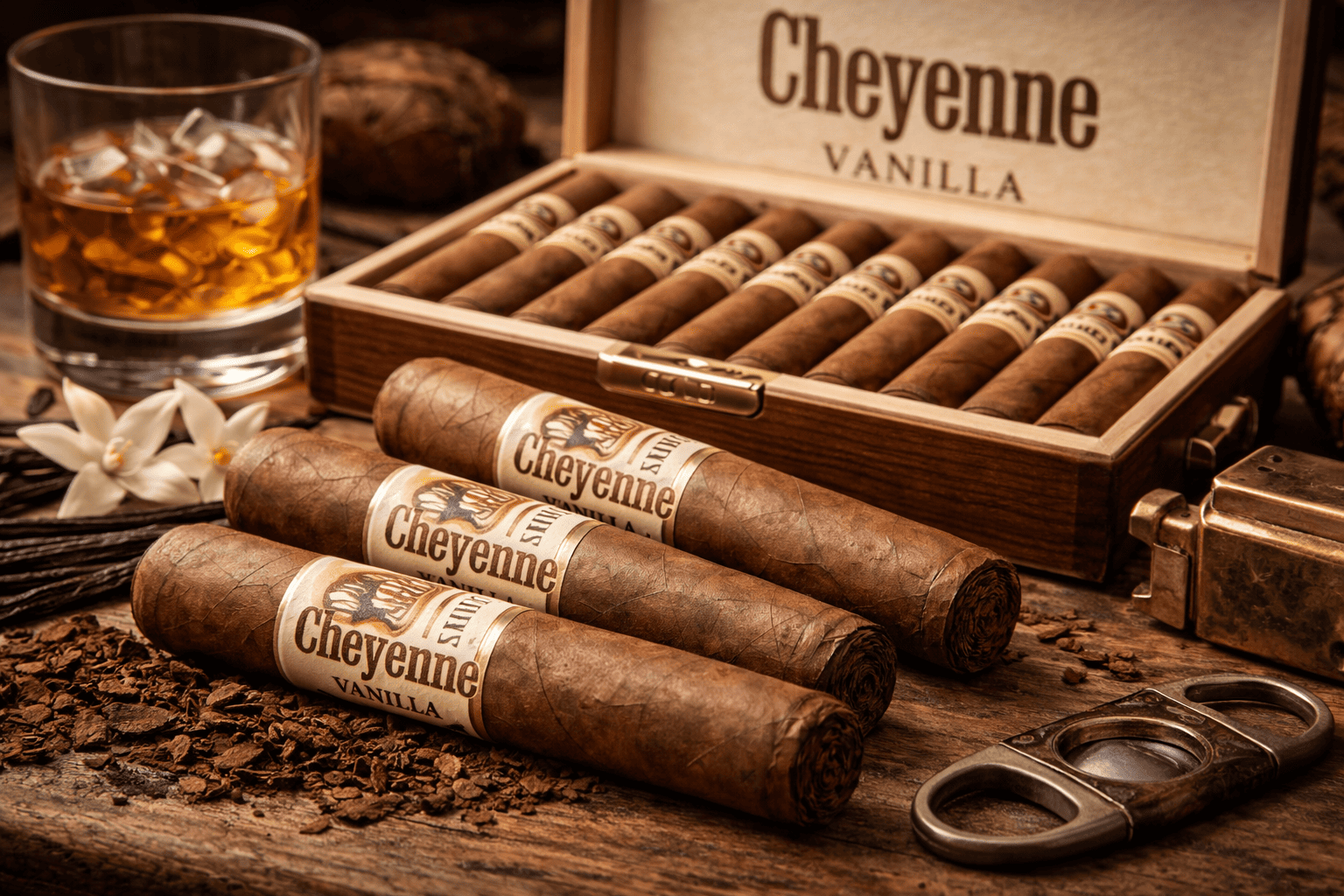
Cheyenne Vanilla does not attempt to compete with handmade cigars associated with the luxury cigar makers list or the prestige narratives of Cuban cigar brand history. Its role follows a different logic. It addresses a smoker seeking predictability, mildness, and a defined aromatic profile that integrates seamlessly into daily routines. Through this lens, Cheyenne Vanilla becomes an instructive object, revealing how flavor engineering and tobacco processing shape experience just as meaningfully as terroir or aging.
Brand Background and Manufacturing Lineage
Cheyenne Cigars are produced in the United States and distributed nationally, positioning the brand firmly within the domestic value segment. The Cheyenne line has long been associated with affordability and consistency, qualities that place it within discussions of best value cigar brands rather than aspirational or boutique categories.
The brand operates within a manufacturing framework characteristic of long-established cigar manufacturers, emphasizing standardized inputs, controlled flavor application, and broad distribution. This industrial orientation enables Cheyenne to maintain stable pricing and consistent sensory output across production runs, even as agricultural inputs fluctuate.
Cheyenne Vanilla reflects this philosophy clearly. It is not marketed as an experimental product or part of a rotating release schedule common among boutique cigar makers to know. Instead, it functions as a permanent offering, designed to meet repeat demand rather than generate novelty-driven attention.
Product Classification and Intended Audience
Cheyenne Vanilla Cigars fall within the machine-made, flavored cigar category. This classification carries technical and cultural implications. Machine-made cigars rely on homogenized tobacco leaf wrappers and short-filler blends, allowing for uniform combustion and flavor delivery.
This construction method supports a target audience that values mild strength, predictable draw resistance, consistent aroma, and minimal maintenance. Such preferences often differ from those associated with smokers evaluating top Nicaraguan cigar brands or consulting a Dominican cigar houses guide. Cheyenne Vanilla addresses a different use case, oriented toward casual smoking contexts rather than focused tasting sessions.
Tobacco Base and Flavor Application
At the structural level, Cheyenne Vanilla Cigars utilize a blend of short-filler tobaccos sourced from multiple regions, combined with a homogenized tobacco leaf wrapper. This wrapper serves as both a combustion medium and a carrier for flavor infusion.
Vanilla flavoring is applied during manufacturing through controlled casing processes. In cigar production, casing refers to the application of flavoring agents and humectants to tobacco prior to rolling. This process ensures even distribution and long-term aroma stability.
Vanilla, as a flavoring agent, presents specific technical advantages. It integrates smoothly with natural tobacco sweetness, retains aromatic presence at lower combustion temperatures, and avoids sharp chemical notes when properly dosed. These properties explain vanilla’s historical prevalence in flavored tobacco products. Its use in Cheyenne Vanilla reflects calculated formulation rather than novelty.
Pre-Light Evaluation and Aromatic Profile
Visual inspection reveals a medium-brown wrapper with uniform coloration and minimal surface variation. The cigar’s appearance emphasizes consistency over visual complexity. Caps are machine-applied, producing clean, functional seams.
Aromatic evaluation prior to lighting reveals immediate vanilla presence. This aroma presents as soft and rounded rather than sharp or confectionary. Secondary notes include light cocoa, papered tobacco, and faint caramel. These aromas indicate controlled casing rather than surface spraying, a distinction that affects how flavor behaves during combustion.
Cold draw resistance remains moderate, calibrated to support steady airflow without rapid burn. On the cold draw, vanilla registers subtly, integrated rather than dominant, suggesting restraint in flavor application.
Initial Smoking Phase: Establishing the Aromatic Framework
Upon ignition, Cheyenne Vanilla Cigars produce smoke quickly and evenly. The initial flavor profile establishes the cigar’s central identity through creamy vanilla, mild toasted grain, and soft wood. The vanilla character remains present without overwhelming the tobacco base. Smoke texture appears light-to-medium, contributing to an accessible mouthfeel.
Nicotine delivery remains low, positioning the cigar for extended sessions without fatigue. Retrohale presence remains gentle, reducing nasal irritation and supporting relaxed pacing. This phase illustrates how flavored cigars prioritize immediacy rather than progression. The goal centers on delivering a recognizable profile from the outset.
Mid-Section: Maintenance of Flavor and Balance
As the cigar advances, Cheyenne Vanilla maintains its established profile. Flavor continuity remains its defining attribute. Vanilla integrates with warmed tobacco notes, presenting a slightly drier character as combustion progresses.
Flavor impressions during this stage include vanilla bean, light bread, and dry cocoa. Combustion behavior remains stable, supported by uniform wrapper density and short-filler distribution. Ash formation tends toward light gray, compact and cohesive, reflecting balanced burn chemistry.
This consistency differentiates Cheyenne Vanilla from handmade cigars where evolution defines quality assessment. In this context, reliability replaces narrative progression.
Final Portion: Soft Resolution Without Escalation
The closing segment maintains composure. Vanilla presence tapers gradually, allowing neutral tobacco notes to surface without bitterness. Combustion temperature remains moderate, reducing acrid development.
Strength levels remain controlled through the final third, reinforcing Cheyenne Vanilla’s suitability for habitual use. The cigar concludes without sharp transitions or sensory spikes, reflecting manufacturing priorities centered on predictability.
Construction Performance and Mechanical Reliability
From a technical standpoint, Cheyenne Vanilla Cigars demonstrate consistent mechanical performance. Even burn lines appear across samples, draw resistance remains stable, and wrapper integrity shows resilience under typical storage conditions.
Such performance aligns with expectations for machine-made cigars produced by long-established cigar manufacturers. While lacking artisanal variance, Cheyenne compensates through functional dependability.
These attributes contribute to its frequent mention within discussions of best value cigar brands, particularly among smokers prioritizing cost efficiency and consistency.
Cultural Role and Social Context
Cheyenne Vanilla Cigars occupy a cultural space shaped by informality. They are commonly associated with outdoor settings, casual gatherings, and solitary routines. This context contrasts with lounge-centric rituals surrounding premium handmade cigars.
In these environments, Cheyenne Vanilla functions as an accompaniment rather than a focal point. Its aroma remains recognizable without dominating shared spaces, supporting social interaction rather than introspection.
This role parallels historical consumption patterns that predate modern premium segmentation, when cigars served as everyday objects rather than curated experiences. In this sense, Cheyenne Vanilla reflects continuity within American smoking culture.
Position Within the Broader Cigar Market
Cheyenne Vanilla occupies a stable niche distinct from new cigar brands to try or experimental flavored releases. Its longevity rests on sustained demand rather than innovation cycles.
Within comparative frameworks that include best premium cigar brands 2025 or entries from a luxury cigar makers list, Cheyenne Vanilla serves as a counterpoint. It illustrates how accessibility and familiarity maintain relevance alongside prestige-driven narratives.
Its continued production suggests alignment with consumption realities rather than aspirational positioning.
Educational Perspective for Emerging Smokers
Cheyenne Vanilla Cigars offer an accessible entry point for smokers developing baseline sensory awareness. The clear vanilla profile helps isolate flavor perception, supporting early palate training.
For those beginning to contextualize premium experiences informed by Cuban cigar brand history or regional guides, Cheyenne Vanilla provides contrast rather than competition. It highlights how flavoring alters combustion dynamics and aroma delivery.
This contrast supports broader understanding of how production methods influence experience across cigar categories.
Flavoring Ethics and Industry Context
The use of flavor in cigars remains a subject of regulatory and cultural discussion. In the United States, flavored cigars continue to occupy a contested space within tobacco regulation. Despite shifting policy landscapes, demand for flavored cigars persists.
Cheyenne Vanilla’s restrained approach illustrates how flavoring can coexist with tobacco identity rather than obscure it. This balance contributes to its acceptance among smokers who might otherwise avoid flavored products.
Final Considerations
Cheyenne Vanilla Cigars represent a disciplined expression of flavored cigar manufacturing, defined by consistency, accessibility, and aromatic clarity. Their value lies in reliable performance and a stable sensory profile rather than complexity or evolution. Within discussions that span best value cigar brands, family-run cigar companies, and broader market analyses, Cheyenne Vanilla occupies a pragmatic and instructive position.
For smokers seeking mild strength, familiar aroma, and dependable construction, Cheyenne Vanilla remains a relevant presence within the modern cigar ecosystem.