
Cherokee Cigars occupy a clearly defined position within the American cigar market, shaped by consistency, accessibility, and functional design rather than aspiration toward luxury signaling. Their identity emerges from a utilitarian philosophy that values repeatability, cost control, and familiarity. For many smokers, Cherokee represents a habitual object rather than a ceremonial one, yet that very role offers insight into how value-oriented cigars maintain relevance across decades of shifting taste preferences and regulatory pressure.
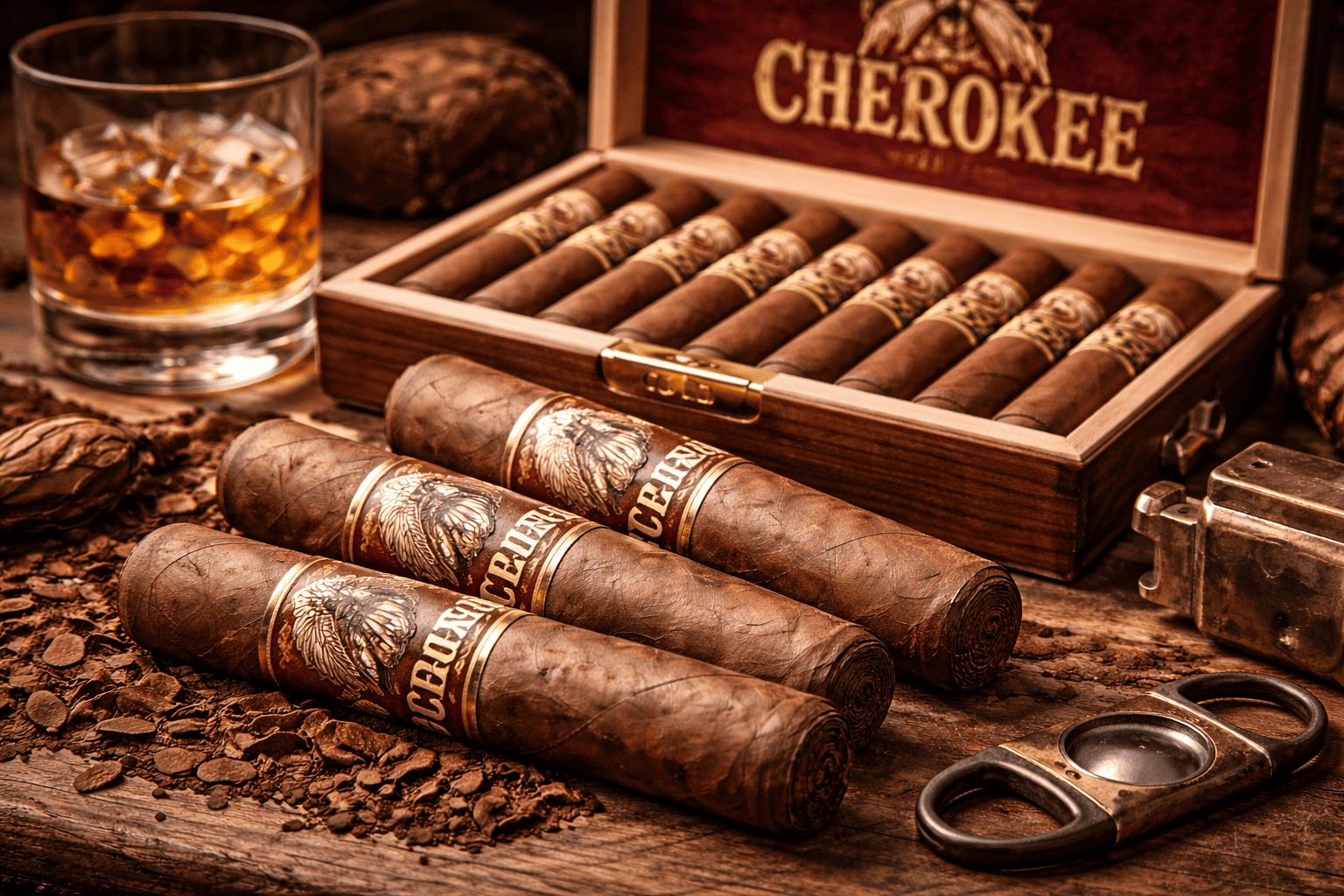
Examined through a technical and cultural lens, Cherokee Cigars reveal a parallel narrative to premium handmade production. This narrative prioritizes industrial discipline, standardized tobacco sourcing, and predictable performance. Such attributes place Cherokee within conversations about best value cigar brands, even as they stand apart from the aesthetics and rituals associated with the luxury cigar makers list.
Brand Origins and Corporate Structure
Cherokee Cigars are produced by Swisher International, one of the largest cigar manufacturers in the world. Founded in 1862, Swisher International operates as a privately held, family-run cigar company, maintaining vertical integration across sourcing, production, and distribution. This structure allows for tight cost control and product consistency across global markets.
Swisher’s portfolio includes both mass-market cigarillos and traditional cigars, positioning the company among long-established cigar manufacturers whose scale enables price stability even during periods of agricultural volatility. Cherokee was introduced to address demand for a mild, affordable cigar with consistent burn characteristics and a familiar flavor profile, particularly within the United States.
This strategic intent distinguishes Cherokee from boutique cigar makers to know or new cigar brands to try. The brand does not seek differentiation through limited releases or experimental blends. Its identity rests on reliability rather than novelty.
Product Classification and Market Segment
Cherokee Cigars are classified as machine-made cigars. They are typically sold in boxes or bundled formats, reinforcing their function as everyday smoking products rather than occasional indulgences. This classification places them outside the handmade premium category, yet their role within the broader cigar ecosystem remains substantial.
In market analyses, machine-made cigars represent a significant portion of overall cigar consumption in the United States. According to data published by the U.S. Alcohol and Tobacco Tax and Trade Bureau, machine-made cigars account for the majority of cigar units sold annually, even as handmade cigars dominate revenue share. Cherokee participates directly in this volume-driven segment.
This dynamic helps contextualize why discussions of best premium cigar brands 2025 increasingly include acknowledgment of value-driven counterparts. While premium cigars command attention through craftsmanship narratives, machine-made brands like Cherokee sustain the habitual behaviors that underpin the category as a whole.
Tobacco Composition and Manufacturing Approach
Cherokee Cigars are constructed using homogenized tobacco leaf wrappers combined with short-filler tobacco blends. Homogenized tobacco leaf is produced by binding finely ground tobacco particles into uniform sheets, allowing for consistent thickness and combustion properties.
Key manufacturing characteristics include:
- Uniform wrapper density across production runs
- Controlled moisture levels optimized for shelf stability
- Short-filler blends sourced from multiple regions
The filler tobaccos used in Cherokee Cigars typically originate from Central American and Caribbean growing regions, though exact sourcing varies based on supply availability. Unlike top Nicaraguan cigar brands that emphasize terroir expression, Cherokee’s blending philosophy prioritizes neutrality and balance.
This approach minimizes variance between individual cigars, reinforcing predictable draw resistance and burn behavior. From a technical standpoint, this consistency remains one of Cherokee’s defining attributes.
Pre-Light Characteristics and Sensory Indicators
Visual inspection reveals a medium-brown wrapper with smooth surface texture and minimal veining. The appearance reflects industrial uniformity rather than agricultural variation. Caps are machine-applied, producing consistent seams without ornamental detailing.
Aromas detected prior to ignition include dried paper, light cereal grain, and faint cocoa powder. These pre-light notes align with expectations for homogenized tobacco leaf wrappers, offering limited aromatic complexity while signaling controlled fermentation and absence of residual ammonia.
Cold draw resistance remains moderate, calibrated to support steady airflow without rapid combustion. This design choice supports prolonged smoking sessions with minimal maintenance.
Initial Smoking Phase: Establishing the Baseline
Upon lighting, Cherokee Cigars deliver immediate smoke production. Combustion stabilizes quickly, a result of uniform wrapper thickness and short-filler distribution. The opening flavor profile remains restrained, featuring toasted grain, light wood, and subtle sweetness.
Nicotine delivery registers at a low-to-moderate level, positioning Cherokee as a suitable option for extended consumption without sensory fatigue. Retrohale presence remains minimal, reducing nasal irritation and supporting casual pacing.
This opening phase illustrates how industrial manufacturing can replicate consistency across large volumes. Rather than progression, Cherokee emphasizes maintenance of a stable baseline.
Mid-Section: Continuity Over Evolution
As the cigar progresses, flavor continuity remains its defining characteristic. Smoke texture stays light-to-medium, with no significant shifts in body or strength. Flavor impressions continue along established lines of neutral wood, dry bread, and mild cocoa.
Ash formation remains compact, with light gray coloration indicative of balanced combustion chemistry. Burn lines tend to remain straight, requiring minimal correction.
This lack of evolution differentiates Cherokee from handmade cigars featured in a Dominican cigar houses guide or analyses of Cuban cigar brand history, where progression often defines quality perception. In Cherokee’s case, stability replaces narrative development.
Final Portion: Controlled Resolution
The final segment maintains composure without introducing bitterness or overheating. Flavors soften rather than intensify, gradually tapering toward neutral tobacco notes. Combustion temperature remains moderate, reducing acrid development often associated with machine-made cigars nearing completion.
This controlled resolution reflects production priorities centered on reliability. Cherokee avoids abrupt strength increases, reinforcing its suitability for habitual use.
Performance Metrics and Reliability
From a technical perspective, Cherokee Cigars demonstrate consistent mechanical performance. Burn deviation remains minimal across samples, draw resistance stays within narrow tolerances, and wrapper integrity shows resilience under variable humidity.
Such metrics align with expectations for mass-produced cigars manufactured by long-established cigar manufacturers. While lacking artisanal nuance, Cherokee compensates through functional dependability.
These characteristics contribute to its frequent inclusion in best value cigar brands discussions, particularly for consumers prioritizing cost-per-unit efficiency.
Cultural Function and Social Context
Cherokee Cigars function primarily as utilitarian smoking objects. They are often associated with outdoor settings, work breaks, and informal social environments. This context differs markedly from the lounge-centered rituals surrounding premium handmade cigars.
Within these settings, Cherokee’s mild profile and predictable performance support conversation rather than contemplation. The cigar becomes an accompaniment rather than a focal point, reflecting a cultural role shaped by accessibility.
This function parallels traditions upheld by many family-run cigar companies during earlier industrial periods, when cigars served as everyday commodities rather than luxury signifiers.
Position Within the Broader Cigar Landscape
Cherokee occupies a stable niche within the contemporary cigar market. It does not compete directly with new cigar brands to try or experimental releases seeking attention through innovation. Instead, it sustains relevance through volume, price stability, and familiarity.
In comparative terms, Cherokee stands apart from luxury cigar makers list entries through its manufacturing method, though its longevity places it within the historical continuum of American cigar consumption. This continuity offers insight into how different segments coexist within the same category.
For analysts tracking consumption patterns rather than prestige indicators, Cherokee remains a useful reference point.
Educational Perspective for Developing Smokers
Cherokee Cigars offer an accessible entry point for understanding baseline tobacco flavors without the confounding variables of complex blending or aging. For smokers beginning to contextualize premium experiences, Cherokee provides contrast rather than competition.
This contrast supports broader education efforts that contextualize Cuban cigar brand history alongside modern industrial practices, illustrating how production scale influences sensory outcomes.
Final Considerations
Cherokee Cigars represent a disciplined expression of industrial cigar manufacturing, defined by consistency, accessibility, and functional design. Their value lies not in sensory evolution or artisanal distinction, though in reliable performance sustained across decades. Within discussions that span best premium cigar brands 2025, top Nicaraguan cigar brands, and Dominican cigar houses guide frameworks, Cherokee occupies a parallel lane grounded in everyday utility.
For smokers seeking predictability, affordability, and minimal maintenance, Cherokee remains a relevant and instructive presence within the modern cigar ecosystem.