
A cigar is a composite of living plant material, volatile oils, and delicate architecture. Preserving its structural integrity and aromatic profile requires control of moisture and temperature; absent a dedicated humidor, the challenge is to create a predictable microclimate with minimal equipment and clear procedures. This article supplies practical, evidence-based methods for storing cigars without a humidor, presents the scientific reasons behind each recommendation, and describes monitoring and maintenance routines that keep cigars ready to smoke. The analysis integrates manufacturer instructions, peer-reviewed findings on pest risk, retail distribution data, and practical sensory observations so that readers can make pragmatic choices in real time.
Why proper storage matters
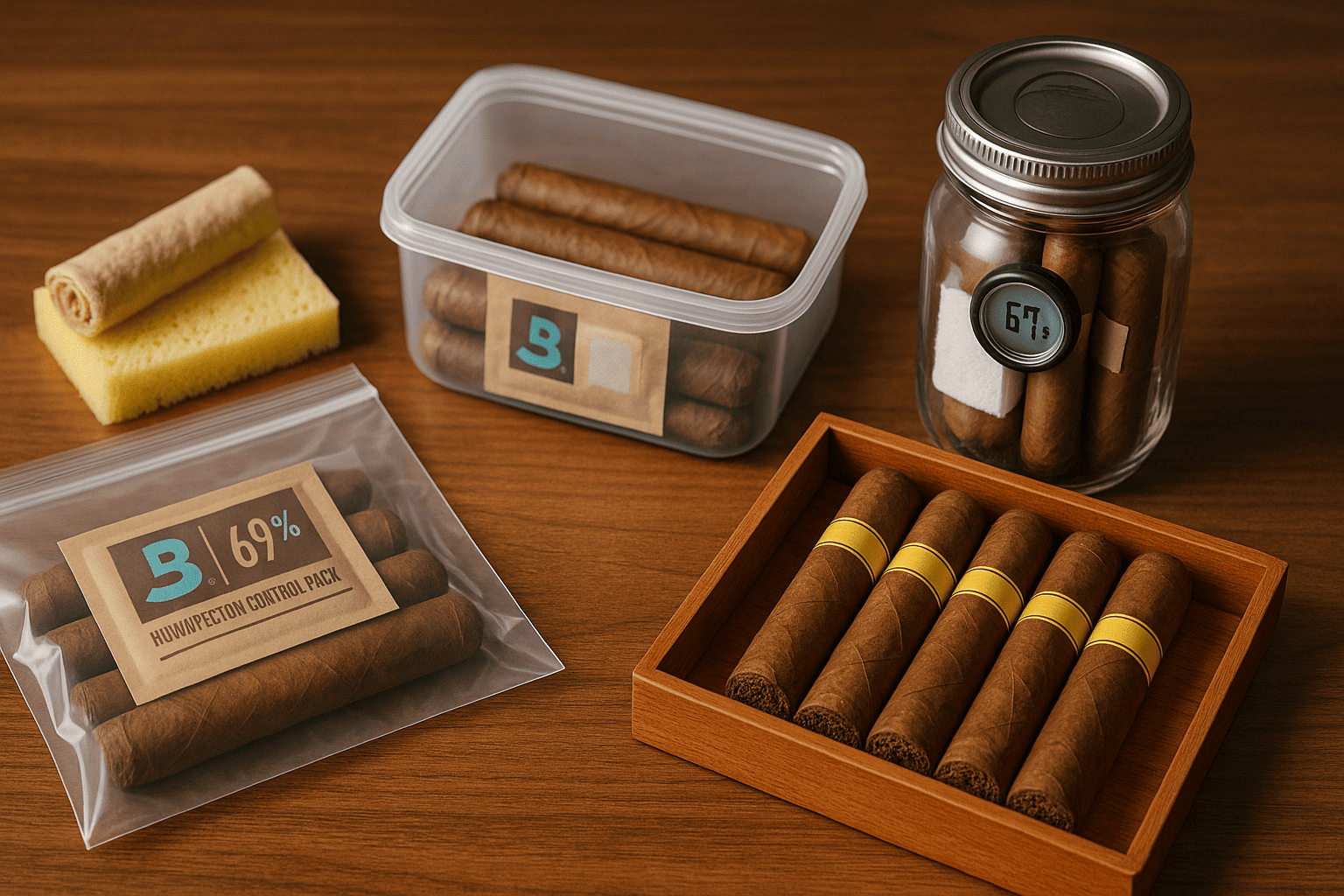
Tobacco leaf is hygroscopic: it exchanges moisture with air until a new equilibrium is reached. Humidity affects wrapper pliability, the behavior of the burn line, and the expression of volatile aroma compounds. Temperature interacts with humidity to alter relative humidity and to speed chemical reactions in leaf oils. Poor storage either dries the leaf and causes mechanical failure, or holds excess moisture and invites mold or insect activity.
Public-health and market data underline the practical scope of the problem. The U.S. Centers for Disease Control and Prevention reports that “In 2021, an estimated 8.6 million adults aged 18 and older currently smoked cigars.” That scale of consumption helps explain why many purchases occur at retail outlets where long-term storage is not available, creating a need for accessible preservation methods. (See CDC: Cigar Use in the United States.)
Retail research also shows the distribution context for many cigar purchases. One peer-reviewed analysis found that “90.8% of cigar sales in 2020 occurred in convenience stores,” which places many buyers in environments without optimal storage. (Delnevo et al., JAMA: Cigar Sales in Convenience Stores in the US, 2009–2020.)
These facts inform the practical question: when a humidor is not available, what steps produce the longest storage life with the least risk?
The targets: humidity, temperature, and air tightness
Any storage solution approximates the three physical goals that a humidor addresses:
- Ideal humidor humidity levels. The commonly accepted maintenance band for premium cigars sits in the high 60s to low 70s percent relative humidity (RH). Many vendors and humidification-product manufacturers recommend a range near 65–72% RH for general storage; slightly higher values (70–72%) may be used when a user explicitly wants to preserve oils for aging. (See Boveda guidance for maintenance RH choices: Boveda.)
- Temperature control. Keep temperature moderate and stable. High temperatures accelerate oxidation and increase the chance of insect hatching; cooler, stable temperatures reduce chemical reaction rates and help preserve aroma compounds.
- Airtightness and small-volume control. A small sealed container is easier to stabilize than a large, porous space. Reducing air exchange slows moisture drift and makes a small humidification source effective.
These targets guide all recommended techniques below.
How long do cigars last without a humidor? Practical timeframes
Lifespan depends on initial condition (factory-sealed box, cellophane, or loose cigar), ambient environment, and whether any buffering medium is present.
- Unprotected, open at room conditions (no humidification): noticeable drying and flavor loss often appear within 48–72 hours; wrapper brittleness and increased chance of cracks within a few days. Retail advice and hobbyist experience align with this short window.
- Factory-sealed box left unopened: relative stability for several weeks is typical; some sellers advise that sealed boxes can remain serviceable for up to about six weeks if ambient conditions are not extreme.
- Airtight bag or container with a two-way humidity pack (Boveda or equivalent): preservation for weeks to months; two-way packs actively buffer RH by releasing or absorbing moisture as needed, making them a dependable method for non-humidor storage. See manufacturer guidance at Boveda.
- Tupperdor (airtight plastic container with cedar and two-way packs): multi-month reliability when packs are sized to the container and periodic checks occur.
- Long-term cellaring (many months to years) without a humidor: not recommended; for multi-year aging, a properly seasoned cedar humidor or electric cabinet is preferable because improvised methods lack long-term stability.
The choices below expand these timeframes with precise, actionable steps.
Ranked practical methods (from simplest to most robust)
1) Zip-top freezer bag + two-way humidity pack (fastest, lowest cost)
Rationale. Two-way packs maintain a set RH by releasing or absorbing moisture; pairing a pack with an airtight bag creates a small sealed volume that is easy to regulate.
Materials.
- Heavy-duty freezer-grade resealable bag (large enough to avoid crushing cigars).
- Two-way humidity pack sized for the internal volume (Boveda 60–67 g sizes are common for a few cigars or a single box).
Procedure.
- Place cigars in the bag in a single layer or in their box.
- Insert the appropriate two-way pack (select RH target per preference: 65%, 69%, 72%).
- Press out excess air and seal tightly.
- Store in a cool, dark place and check after 24–48 hours.
Performance. Provides weeks to months of stable storage depending on seal integrity and pack capacity.
Failure modes. Repeated opening, punctures, or selecting too-small a pack for the volume will allow drift.
Why recommended. This method leverages minimal equipment for a reliable microclimate; two-way packs are designed to be safe in contact with cigars and remove user guesswork.
2) Mason or glass jar + small two-way pack (single-stick or small group)
Rationale. Glass is inert and airtight; small volumes stabilize quickly.
Materials.
- Wide-mouth Mason jar.
- Small Boveda or equivalent pack.
Procedure.
- Place the cigar(s) and the two-way pack inside; seal.
- Verify after 24 hours for feel and absence of condensation.
Performance. Excellent for single-stick preservation and travel returns; avoids odors.
Failure modes. Sudden ambient temperature swings can produce condensation.
3) Airtight plastic container (“tupperdor”) + cedar sheet + two-way packs (best low-cost alternative)
Rationale. A gasketed food-storage container forms an effective sealed chamber for larger quantities; Spanish cedar inserts add buffering.
Materials.
- Food-grade airtight container with good seal.
- Thin Spanish cedar sheet or separators.
- Two-way packs sized to container volume.
Procedure.
- Place cedar on the bottom to reduce direct contact.
- Position cigars with slight spacing; insert two-way packs per manufacturer sizing chart.
- Close and store away from heat; check hygrometer if available.
Performance. Reliable multi-month storage; commonly adopted in the hobby as a “Tupperdor.”
Caveats. Avoid storing in garages or attics where ambient temperatures swing widely.
4) Small cooler (“coolidor”) + humidification system (for larger collections without a humidor)
Rationale. Coolers are insulated and reasonably airtight; they offer thermal inertia and can hold larger inventories.
Materials.
- Small portable cooler (food-grade).
- Cedar trays or separators.
- Two-way packs or a small bead/gel humidifier.
Procedure.
- Line with cedar sheets, arrange cigars, add humidification packs or beads.
- Place in condition-controlled room and inspect monthly.
Performance. Good for extended storage if packs are sized correctly and cooler is odor-free.
Failure modes. Some coolers impart plastic odors; choose one verified food-safe and odorless.
5) Travel humidor + gel humidifier or two-way pack (for transit)
Rationale. Designed for short-term protection during transport or brief trips; not a substitute for months-long storage.
Materials.
- Soft travel case.
- Gel reservoir or two-way pack.
Procedure.
- Pack cigars loosely with humidification media.
- Keep out of direct sunlight and avoid leaving in hot cars.
Performance. Protects during transport and for short stays.
Emergency triage: reviving dry cigars and rescuing over-humidified sticks
Reviving a dry cigar
- Do not soak or dunk. Rapid rehydration causes wrapper splitting.
- Use a two-way pack at 65–69% RH inside an airtight bag or jar. Check after 24 hours; repeat as needed slowly over days until pliability returns.
- Avoid heat during reconditioning.
Salvaging over-humidified cigars
- Remove cigars from saturated environment.
- Place loosely on a plate in a stable room, or use a sealed container with a small desiccant compartment (kiln-dried cedar is preferable) to reduce RH gradually.
- Monitor frequently; discard any cigars showing fuzzy mold.
Humidification media: options, pros and cons
- Two-way humidity packs (Boveda and equivalents).
- Pros: fixed RH targets, passive, safe in contact with cigars, low maintenance.
- Practical note: manufacturer instructions explicitly show how to season cedar and use packs (for seasoning: “Place the 84% Boveda seasoning pack(s) inside your empty wooden humidor. Close the lid and don’t open the humidor for 14 days—no matter what your hygrometer readings are.”). See Boveda — Season Wood Humidor.
- Gel jars / small sponge reservoirs (with distilled water).
- Pros: inexpensive and rechargeable.
- Cons: require distilled water, careful refilling, and cleaning to avoid microbes and mineral deposits.
- Humidity beads (polymer beads).
- Pros: rechargeable and adjustable.
- Cons: require handling and are less “plug-and-play” than two-way packs.
- Active mini-humidifiers.
- Pros: continuous output; useful in larger coolers.
- Cons: require power, distilled water, and preventive maintenance.
Recommendation. For non-humidor storage, two-way packs provide the best mix of safety, predictability, and low effort.
How to monitor without a humidor: tools and calibration
Monitoring is essential even for improvised storage. A small digital hygrometer/thermometer inside the sealed container provides numerical feedback.
Calibration. Use the salt test or a manufacturer’s calibration protocol to confirm accuracy before relying on readings. Uncalibrated instruments can mislead maintenance decisions.
Placement. Put the sensor among the cigars (centrally located in a box or drawer) or in a dedicated drawer in a larger container; plan to verify readings daily during the first week after sealing.
Keyword guidance. The practical phrase how to monitor humidor temp suggests placing a digital thermometer alongside the hygrometer to track both RH and temperature; logging both values helps detect seasonal drift and insect risk.
Best humidor setup tips applied to non-humidor practice
- Use distilled water in any reservoir-based system to avoid mineral deposits and microbial growth.
- Season wood properly when a cedar-lined surface is used—follow manufacturer directions for cedar seasoning (how to season a humidor step-by-step).
- Calibrate hygrometers and keep an independent backup sensor.
- Avoid overpacking; allow modest airflow around sticks to prevent localized moisture pockets.
- Segregate aromatics: store flavored or infused cigars separately to avoid flavor transfer.
- Maintain a schedule: check conditions daily for the first week and then weekly or monthly depending on system stability (humidor maintenance schedule).
These practices reduce common errors and preserve sensory quality.
Preventing and understanding pest and mold risks
Warm and humid storage encourages both mold and tobacco/cigarette beetle activity. Research on Lasioderma serricorne (tobacco/cigarette beetle) shows developmental rates that increase with temperature; keeping storage cool and avoiding sustained RH above the low-to-mid 70s in warm conditions mitigates hatch risk. See controlled studies on temperature effects for guidance (e.g., Wang et al., PMC article on development). Extension resources also provide species-specific thresholds and control measures.
Practical steps.
- Avoid storing at high RH if ambient temperature is high.
- Inspect periodically for small holes in wrappers (sign of larval activity) or for powdery mold or fuzzy growth.
- If infestation or active mold appears, isolate and discard affected cigars; disinfect containers and recondition before reuse.
Sensory narrative: what the connoisseur will notice
A cigar is ultimately judged by aroma, complexity, balance, and finish. Storage choices alter these attributes in measurable ways:
- Short-term drying (days): topnotes such as citrus, floral, or light sugar fade; the wrapper acquires a “toothy” dryness and the cold draw tightens. Smoke becomes thinner, the mid-palate flattening, and finish shortened.
- Medium-term neglect (weeks): tertiary and integrated flavors (cedar, leather, roasted nut) weaken; acidity and harshness can increase. Burn becomes less even; ash may flake.
- Proper buffering (two-way packs in airtight container): aromas hold, the body remains rounded, and the burn retains evenness. For the serious taster, the difference between a well-buffered cigar and a neglected one is readily apparent on the cold draw and in the first third’s aromatic snapshot.
A disciplined sensory routine—visual inspection, hand-feel, cold draw aroma, and staged tasting—shows how storage impacted the leaf.
Decision matrix: which method to choose
- Single cigar to smoke within 48 hours: carry in tube or sleeve; check feel before lighting.
- A few cigars to smoke weekly for a month: freezer bag + two-way pack or Mason jar + pack.
- A box and no humidor yet: keep factory box sealed; place box in airtight outer container with maintenance packs as soon as possible. Sealed boxes can provide limited protection for several weeks.
- Medium-term storage (months): Tupperdor with cedar and two-way packs.
- Long-term cellaring (many months to years): invest in a seasoned cedar humidor or a small electric cabinet.
Common humidor mistakes that also apply to non-humidor storage
- Using tap water in humidifiers or sponges — minerals and microbes are hazards.
- Rapid rehydration (soaking or heavy misting) — causes wrapper splits.
- Relying on thin, puncturable bags — use freezer-grade bags or rigid containers.
- Failing to calibrate hygrometers — false readings mislead decisions.
- Overpacking — restricts airflow and creates microclimates prone to mold.
Avoiding these traps increases the probability of long-term success.
Best humidification systems for non-humidor storage
For practical, low-maintenance control, the following systems are recommended in order of likely suitability for non-humidor use:
- Two-way humidity packs (Boveda, others). Predictable RH targets and minimal maintenance. Manufacturer instructions also include seasoning procedures for cedar-lined humidors. (See: Boveda — How to season a humidor.)
- Gel jars / sponges (distilled water). Low cost and rechargeable but require careful monitoring and sanitation.
- Humidity beads. Rechargeable and adjustable, useful in larger coolers.
- Active mini-humidifiers. Useful for longer trips or larger insulated coolers; require distilled water, power source, and cleaning.
For most non-humidor scenarios, two-way packs offer the simplest combination of reliability and convenience.
Storing cigars long term: when the improvised approach is insufficient
If the objective shifts to true long-term cellaring—measured in years—improvised measures become insufficient. Cedar’s natural buffering, the ability to season wood properly, and a robust mechanical equilibration reduce risk over long horizons. Users planning multi-year aging should budget for a seasoned cedar humidor or a climate-controlled cabinet and follow a formal humidor maintenance schedule that includes wireframe monitoring, periodic seal checks, and instrument calibration.
Trade-off note. The comparison travel humidors vs desktop humidors vs cedar-lined cabinets highlights distinct roles: travel cases for transit, desktop humidors for daily rotation and display, and cedar-lined or electric cabinets for multi-year storage.
Practical checklist before leaving cigars unattended for weeks
- Confirm two-way packs are sized correctly and fresh.
- Verify container seal integrity.
- Place a calibrated hygrometer inside and log initial readings.
- Place in a stable room (avoid attics, cars, or sunlit windowsills).
- Label date-in and check weekly for the first month.
Evidence and authoritative quotes used in this article
- CDC on prevalence: “In 2021, an estimated 8.6 million adults aged 18 and older currently smoked cigars.” (CDC: Cigar Use in the United States.)
- Retail distribution: “90.8% of cigar sales in 2020 occurred in convenience stores.” (Delnevo et al., JAMA: Cigar Sales in Convenience Stores in the US, 2009–2020.)
- Boveda on seasoning: “Place the 84% Boveda seasoning pack(s) inside your empty wooden humidor. Close the lid and don’t open the humidor for 14 days—no matter what your hygrometer readings are.” (Boveda: How to season a humidor with Boveda.)
- Tobacco-beetle temperature sensitivity: experimental work shows that Lasioderma serricorne development accelerates with increasing temperature; stored-product entomology resources document the relationship between temperature, RH, and development rates (see: Wang et al., PMC article on development and UF Entomology — Tobacco Beetle).
Implementation examples (three realistic setups)
- Weekly smoker who travels occasionally.
- Setup: A Mason jar with a 69% two-way pack for single sticks; travel humidor with 69% pack for transport; a small tupperdor with cedar and multiple 69% packs at home for the short-term stash.
- Maintenance: Replace two-way packs per manufacturer schedule; verify hygrometer readings monthly.
- Collector with a dozen boxes but no humidor.
- Setup: Use several airtight containers sized to inventory, line with cedar sheets, and insert two-way packs sized to each container volume. Store containers in a cool, stable room.
- Maintenance: Inspect monthly, log RH and temperature, and rotate packs every 3–6 months depending on ambient conditions.
- Occasional buyer with sporadic needs.
- Setup: Keep individual cigars in factory tubes; use freezer bag + pack for the small number intended for weeks-long storage.
- Maintenance: Verify feel before smoking; replace pack as needed.
Storing cigars without a humidor is feasible, reliable, and low-cost when the chosen method addresses the three physical goals of humidity, temperature, and airtightness. Two-way humidity packs combined with well-sealed small containers or glass jars offer the best balance of predictability and minimal maintenance. For larger inventories, a Tupperdor with Spanish cedar and correctly sized packs provides robust multi-month storage. Where long-term cellaring is the objective, a properly seasoned cedar humidor or a controlled electric cabinet remains the most defensible option.
Throughout all setups, the same procedural disciplines apply: use distilled water when any reservoir is involved, calibrate hygrometers, avoid rapid rehydration, segregate aromatics, monitor conditions regularly, and follow a pragmatic humidor maintenance schedule adapted to the system in use. Manufacturer instructions—such as Boveda’s precise seasoning recommendation—provide reproducible steps for cedar preparation and maintenance. (See Boveda: Season Wood Humidor.)
Practicality, measurement, and modest effort produce reliable preservation. Those who adopt airtight containment, a calibrated monitoring routine, and a trusted humidification medium will preserve the structural integrity and aromatic character that define a satisfying smoke. For readers who plan to scale to significant cellaring, the incremental investment in a dedicated humidor, coupled with an organized humidor maintenance schedule, is the path to long-term success.