
The topic of wrappers, tobacco origins, and blending is central to an evidence-based appreciation of premium cigars. This article addresses those subjects from the perspective of an experienced connoisseur who privileges reproducible technique, measured sensory description, and factual context.
A Brief Historical and Linguistic Frame
The word cigar is linguistically traced to Spanish cigarro, itself likely influenced by Maya sikar, “to smoke rolled tobacco leaves.” This etymology locates the cultural origin of rolled tobacco to pre-Columbian Mesoamerica and clarifies why the cigar’s early history is inseparable from New World agricultural practice. (Online Etymology Dictionary).
Cultural history matters to flavor and form because agricultural practice and fermentation methods evolved in place; those methods were moved and adapted across continents during the colonial and post-colonial periods. The modern premium cigar is therefore a product of horticulture, chemistry, and regional craft traditions.
The Wrapper: Leaf, Role, and Economic Weight
The wrapper leaf is the outermost leaf on a premium handmade cigar. It is cultivated and selected for appearance and physical properties; it is also a significant contributor to perceived flavor. Cigar Aficionado defines a wrapper succinctly: “A high-quality tobacco leaf wrapped around the finished bunch and binder of a handmade, premium cigar. Wrapper leaves need to be coddled and treated with the utmost care to avoid blemishes and tears. Wrappers, when purchased, are the most expensive type of tobacco.” (Cigar Aficionado — Wrapper).
This linkage between appearance and cost is not superficial. Wrapper leaves are graded by color, elasticity, vein structure, and surface integrity; leaves that pass the visual quality threshold are usually harvested from specific parts of the plant (often the middle primings) and are processed to yield a thin, pliable, attractive covering. In practice, the wrapper often accounts for a disproportionately large share of perceived flavor because it is exposed to the combusting ember and delivers immediate aromatic compounds in each draw. Practical instructional material for custodians regularly states that wrapper selection affects 60–80% of a cigar’s visual and aromatic presence.
Wrapper Categories and Typical Sensory Profiles
Wrapper classification uses several intersecting criteria: color and shade (from pale Claro to very dark Maduro), seed variety and cultivar, and geographical origin. Below are the principal wrapper categories the reader will encounter, with concise sensory associations and production notes.
Connecticut Shade (and Ecuadoran Connecticut)
Historically grown under cloth tents in the Connecticut River Valley, Connecticut Shade wrappers are thin, silky, and light in color. They tend to produce mild, creamy, and often subtly sweet profiles—notes frequently described as almond, dairy cream, or toast. Practical constraints (cost and susceptibility to disease) have reduced U.S. acreage; many manufacturers now use Connecticut seeds grown in Ecuador where cloud cover replaces man-made shade. As one industry source observed, “Ecuadoran Connecticut is a thin and delicate leaf that has a lovely tan color and a distinct flavor.” (Cigar Aficionado — Secrets of Connecticut Shade).
Habano / Cuban-Seed (Sun-grown)
These wrappers (often labeled “Habano”) are grown in full sun, produce thicker leaves, and are associated with more pronounced pepper, leather, and spice. Habano wrappers are often used to increase intensity in blends without changing filler composition.
Sumatra and Indonesian Wrappers
Originally used as Cuban substitutes in the early 20th century, Sumatra and other Indonesian wrappers can carry sweet spice, earth, and subtle floral notes. They are often valued for their texture and ability to harmonize with varied fillers.
Cameroon / Central African
Cameroon wrappers are toothy, oily, and frequently carry brown-sugar, spice, and leathery accents. Historically prized as export wrappers, they require careful handling and are used to lend a particular nutty-spice profile. A long-standing industry account identifies Central Africa (and the neighboring Central African Republic) as a historical source for these wrappers.
Maduro and San Andrés
“Maduro” is a Spanish adjective meaning “mature” or “ripe.” In modern usage it describes leaves that have been darkened through extended fermentation and controlled aging; color and sweetness develop under higher temperature and humidity during processing. Maduro wrappers commonly contribute cocoa, molasses, and coffee-like notes and are often thicker and oilier.
Brazilian and Other Specialty Wrappers
Brazilian Arapiraca and Mata Fina wrappers are examples of region-specific leaves that can both change body and contribute distinctive toasty, spicy, and nutty elements. Their use is often targeted to achieve a specific mouthfeel balance or aroma.
Each wrapper choice affects combustion, ash, and surface oils; these physical characteristics in turn influence the first impression of the cigar. The relationship between wrapper, appearance, and aroma is therefore empirical: the wrapper is a high-leverage variable in blending.
Terroir and Origin: Regions That Matter
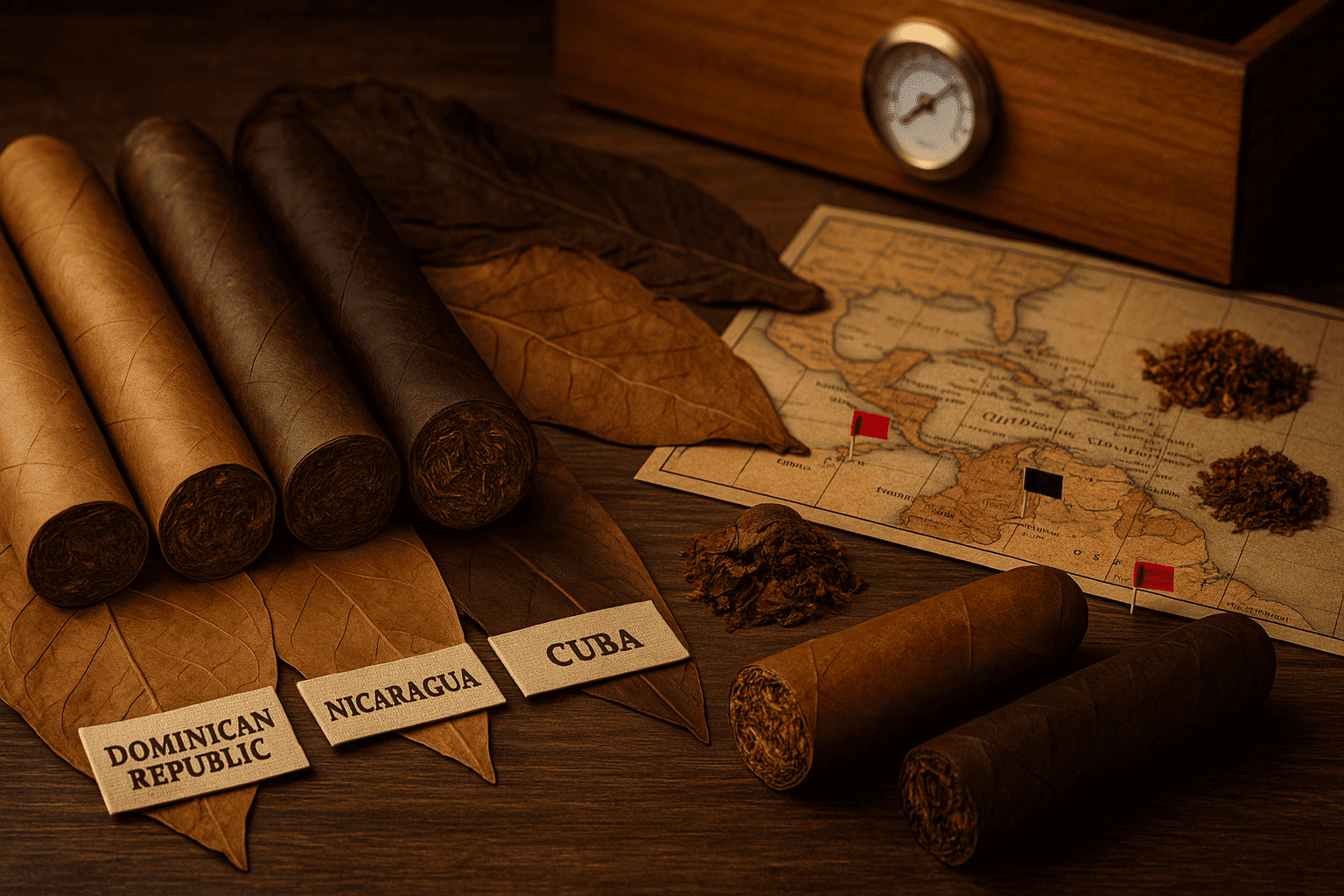
Tobacco is an agricultural product whose chemical profile is shaped by soil composition, rainfall regimes, altitude, and agricultural practice. The major regions associated with premium cigar tobacco are summarized below with their characteristic contributions.
Cuba (Vuelta Abajo and Surrounding Zones)
Cuban tobacco—particularly from Vuelta Abajo—has been a historical benchmark for wrapper and filler quality. Cuban growing areas produce leaves valued for complexity, natural sweetness, and a particular structural density that influences combustion and aroma. Although political and regulatory realities have influenced distribution, Cuban leaves remain central to the historical literature on cigar flavor archetypes.
Dominican Republic
A major producer of both filler and wrapper leaf, the Dominican Republic is known for well-balanced, smooth tobaccos used in wide-ranging blends. Its tobacco often yields mild to medium-bodied profiles and is versatile in combination with other regional tobaccos.
Nicaragua
Nicaragua has risen in prominence for fuller-bodied fillers, especially from regions such as Estelí and Condega. Soil with volcanic influence and higher elevation contribute to leaves with spicy character and robust structural elements. The region’s tobaccos are often used to add backbone and pepper to blends.
Honduras and Jamastrán
Honduran agricultural niches produce both wrapper and filler leaves; certain Honduran-grown Connecticut seed wrappers offer a thicker, more fermentable leaf that can support additional flavor development.
Ecuador
Ecuador’s volcanic soils are widely used for growing Connecticut-seed wrappers (Ecuadoran Connecticut) and other leaves that produce even, neutral-toned wrappers with predictable burn and sheen. This regional advantage is logistical as well as agronomic; cloud cover simulates shade conditions without the tenting infrastructure used in Connecticut. (Cigar Aficionado — Secrets of Connecticut Shade).
Brazil
Brazilian tobacco provides varieties used for dark wrappers (broadleaf types) and specific filler profiles; its climatic and soil features support fermentation regimes that create sweet and toasty profiles.
Mexico (San Andrés)
The San Andrés Valley of Mexico is known for producing dark, toothy wrappers that are often used as maduro or near-maduro coverings. These wrappers typically contribute deep cocoa and earthy tones.
Collectively, regional profiles are not binary; they form a spectrum. Blenders select among these elements to achieve targeted aroma, body, and combustion characteristics.
The Chemistry of Curing and Fermentation
Processing transforms field tobacco into cigar-grade leaf. Two main stages are involved: curing and fermentation.
- Curing removes moisture and initiates changes in leaf chemistry to stabilize sugars and reduce green vegetal notes. Methods include air-curing (commonly for cigar leaf) and flue-curing (more typical for cigarette tobacco).
- Fermentation is a controlled biochemical and microbiological process that modifies alkaloid distribution, reduces harshness, and develops aromatic precursors. Recent scientific work shows fermentation involves enzymatic reactions and microbial community dynamics, with Maillard and redox processes contributing to new flavor molecules. These processes are typically staged, can use stacked leaf piles, and are controlled for temperature and humidity to avoid spoilage. (PMC — Microbial community and metabolic function).
Fermentation is not a single recipe but a set of controlled transformations: longer, hotter fermentation tends to darken leaf color and draw out sugar-derived aromatics (a common method in producing Maduro wrappers), while shorter, milder fermentation preserves volatile delicate notes (used for lighter wrappers like many Connecticut types).
Filler and Binder: Structural and Flavor Roles
A cigar’s internal architecture—filler and binder—serves both mechanical and organoleptic functions. The binder secures the filler and contributes mid-palate attributes, while filler leaves (a mixture of ligero, seco, ligero-substitutive primings) generate strength, nicotine, and layered flavor.
- Ligero (top leaves) contributes nicotine and power; it burns more slowly and tends to appear in the filler to give body.
- Seco and Viso (middle and lower primings) are used to adjust burn rate and aromatic nuance.
- Binder is selected for elasticity and combustion behavior; it can add a subtle, persistent aroma.
Blending requires an understanding of combustion behavior: a poorly balanced filler can lead to canoeing, uneven burn, or unwanted harshness. The wrapper’s permeability interacts with filler composition to determine draw resistance and smoke density.
Blending: Strategy, Objectives, and Reproducibility
Blending is a deliberate process: the blender selects wrapper, binder, and filler to achieve a target profile that considers body, intensity, aromatic family, and combustion behavior. Blends commonly aim for one of the following profiles:
- Mild and complex — often wrapper-forward in profile (Connecticut), with binder and filler chosen to provide layered nuance without aggressive spice.
- Medium-bodied balance — distributed contribution from filler and wrapper; seeks to walk a middle line between sweetness and spice.
- Full-bodied — heavier use of ligero and spicy wrappers (e.g., Habano or Maduro), with thicker binders to handle heat.
A blender employs sensory iteration: micro-batches are made, smoked, and adjusted. Good blending practice includes documenting each permutation and controlling storage conditions for both experiment and final production to ensure reproducibility.
Sensory Mapping: How Wrapper and Origin Show Up in the Smoke
The trained taster observes how wrappers influence the sensory phases of a cigar:
- Topnote (initial impression): The wrapper, being the most direct source of aroma on the surface, frequently sets the first impression—oiliness, sweetness, and surface spice. A Connecticut Shade wrapper typically introduces cream and light almond; a Maduro will often give cocoa or molasses.
- Middle palate: Binder and filler assume prominence as the fire draws volatiles from the interior. Here the interplay of regional fillers (e.g., Nicaraguan ligero) and binder choice becomes audible in the smoke: leather, espresso, or black pepper might be perceived.
- Finish and retrohale: The wrapper may reassert itself in finish due to the surface oils and wrapper-capped volatile components; retrohaling can expose delicate spice or floral compounds not readily perceived via oral exhalation.
A disciplined taster records these phases and correlates them to construction, wrapper sheen, ash layering, and burn line straightness. Each observation reduces uncertainty when attributing a sensation to wrapper, filler, or fermentation.
Case Studies: Wrapper Choices in Commercial Practice
Two practical cases illustrate how wrapper and origin shape a product.
Case 1 — Connecticut Wrapper, Ecuador Origin
Manufacturers increasingly use Connecticut-seed wrappers grown in Ecuador rather than U.S.-grown Connecticut Shade. The Ecuadoran leaf is similar in look but differs chemically due to volcanic soils and climate; it often requires less aging and yields a thinner, more neutral profile that allows filler complexity to appear without aggressive wrapper influence. As one industry source stated, Ecuadoran Connecticut has a “very oily, shiny appearance” but “the taste is fairly neutral, so the manufacturers can do what they want in terms of blending.” (Cigar Aficionado — Secrets of Connecticut Shade).
Case 2 — Maduro Wrappers from Mexico (San Andrés)
San Andrés wrappers are used to produce maduros that provide smoky, cocoa-rich finishes. The extended fermentation that creates dark color is also a decisive production step, and blenders use these leaves to create contrasts with brighter fillers (for instance, Dominican or Nicaraguan ligero) to achieve a balanced overall profile.
These case studies show that identical seed lines can produce different outcomes in different geographies; the blender’s decision is therefore an exercise in selecting both genetic and environmental variables.
Practical Guidance for Selection and Tasting
A connoisseur’s approach to selecting wrappers and blends should be methodical.
- Document metadata: Record wrapper type, origin, seed (if known), storage conditions, and date of tasting.
- Control for storage and conditioning: A wrapper’s oils and the cigar’s moisture content can alter initial impressions. If possible, allow a purchased cigar to equilibrate in a properly controlled humidor before tasting. Manufacturer guidance on humidor seasoning and two-way humidity packs is explicit: for example, one producer advises, “Don’t open the humidor for 14 days—no matter what your hygrometer readings are.” (Boveda — How to Season Your Humidor).
- Sample across a set: Taste diagrammed sets (same filler but different wrappers; same wrapper with different fillers) to isolate the wrapper’s influence.
- Use the three-phase note structure: initial, middle, and final phases with retrohale notes and construction observations.
These practices convert subjective impression into reproducible sensory data.
Market Scale and Public-Health Context
A technical understanding of wrappers and blends should be situated in larger economic and public-health contexts. Market analyses report that the global cigar and cigarillos market was estimated at USD 54.79 billion in 2024 and is projected to grow further. Such figures indicate the scale at which wrapper demand, seed breeding, and regional agriculture operate. For context on prevalence, the Centers for Disease Control and Prevention notes that “In 2021, an estimated 8.6 million adults aged 18 and older currently smoked cigars.” These data points illuminate the social and economic framework within which producers and custodians operate. (Grand View Research — Cigar & Cigarillos Market), (CDC — Tobacco Product Use Among Adults, 2021).
Readers should interpret such market statistics as background rather than as prescriptive for personal practice; the technical aspects of wrapper selection remain independent of market size, even as supply dynamics influence availability and price.
The Science of Flavor: Microbial, Enzymatic, and Maillard Contributions
Flavor formation in tobacco during processing is a chemically active sequence. Fermentation reduces undesirable volatile amines and ammonia and promotes polymerization and Maillard-type reactions that create complex aroma compounds. Recent metabolomics and microbiome studies document that microbial communities and enzymatic activity affect both sensory outcomes and processing efficiency. Those scientific observations justify why producers control temperature and humidity during fermentation and why different regions adopt distinct fermentation schedules to reach target flavor profiles. (PMC — Microbial community and metabolic function).
Awareness of these processes helps the practitioner understand why certain wrappers develop cocoa-like notes (due to prolonged Maillard and caramelization reactions) while others retain floral and green sugar notes (due to milder fermentation and earlier use).
Economic and Agronomic Constraints
Wrapper quality is shaped by agronomic realities. High-grade Connecticut Shade requires shading infrastructure and is sensitive to weather and plant disease; yields can fluctuate and require attentive soil management. Ecuador’s climatic advantage (natural cloud shade) and lower production costs have made Ecuadoran Connecticut wrapper commercially attractive. These supply dynamics are significant for collectors and blenders who must factor availability, price, and quality variance into purchasing and production decisions. (Cigar Aficionado — Secrets of Connecticut Shade).
Practical Notes for Collectors and Blenders
- Storage: wrapper oils and fermentation state can change with time; maintain stable humidity and temperature to preserve intended wrapper character. Manufacturer advice on humidor conditioning and maintenance is precise; follow manufacturer guidance to avoid wrapper and filler degradation. (Boveda — How to Season Your Humidor).
- Rotation: when storing multiple boxes or varied wrappers, rotate stock to avoid undue aging gradients and to sample for product drift.
- Batch testing: sample three to five sticks from each box before committing to extended aging or large purchases.
- Documentation: maintain a tasting ledger that records wrapper seed, origin, and perceived contribution.
These steps reduce uncertainty when making purchasing or blending decisions.
A Short Methodology for Comparative Tasting
To empirically assess wrapper impact in a reproducible way, the connoisseur may follow a simple experimental design:
- Obtain three cigars with identical filler and binder but different wrappers (or identical wrapper with different fillers).
- Standardize storage: hold all cigars in the same humidor and climate for at least two weeks prior to tasting.
- Use the three-phase template: record initial, middle, and final phases, including retrohale at the middle phase.
- Control puff cadence: maintain roughly one puff every 45–60 seconds to minimize heat bias.
- Compare notes: isolate consistent descriptors across the set and map them to wrapper features.
Applying a simple experimental approach converts preference into evidence.
Closing Observations on Craft and Reproducibility
Wrapper leaves, their regional origins, and the blending strategies that incorporate them form a tightly interdependent system. Each selection—seed, soil, curing regimen, fermentation schedule, and wrapper finishing—affects combustion, aroma delivery, and mouthfeel. The disciplined practitioner mitigates uncertainty through controlled storage, methodical tasting protocols, and careful documentation.
Where expert commentary is used, it should be quoted and linked precisely. For example, the industry reference for wrapper definition and the production realities discussed above is provided by Cigar Aficionado: “A high-quality tobacco leaf wrapped around the finished bunch and binder of a handmade, premium cigar. Wrapper leaves need to be coddled and treated with the utmost care to avoid blemishes and tears. Wrappers, when purchased, are the most expensive type of tobacco.” (Cigar Aficionado — Wrapper).
The scientific and agronomic literature on fermentation and metabolomics provides a mechanistic basis for why different wrappers and fermentation regimes produce distinct sensory outcomes. That literature supports the practical practices advocated here: measured fermentation, controlled aging, and experimental tasting should be standard operating procedures for conscientious blenders and collectors. (PMC — Microbial community and metabolic function).
Final Considerations
The wrapper is not merely ornamental. It is a carefully selected agricultural product whose properties interact with binder, filler, and processing to produce the cigar’s sensory identity. Choosing between light Connecticut, oily Ecuadoran Connecticut, peppery Habano, dark Maduro, or toothy Cameroon is a controlled decision that shapes aroma, mouthfeel, and finish.
Actionable items for the careful practitioner:
- Record wrapper origin, seed (if known), and fermentation notes when purchasing or sampling.
- Allow purchased cigars time to equilibrate in stable storage conditions before tasting. Manufacturer guidance on humidor seasoning and pack use should be followed to reduce confounding storage effects. (Boveda — How to Season Your Humidor).
- Use the three-phase tasting template and a consistent cadence to compare wrappers and blends empirically.
- When evaluating blends, isolate variables (wrapper, binder, filler) through controlled sampling to attribute sensory effects properly.
This methodical approach allows a practitioner to progress from subjective preference to evidence-based assessment, producing clearer mappings between region, seed, processing, and sensory outcome. Market-scale data and public-health statistics frame the broader environment but do not alter the procedural best practices for blending and tasting. The careful connoisseur will employ both sensory training and controlled experimentation to understand how wrappers and regional origins contribute to the cigar’s final expression.
Selected links cited in text (click to view): (https://www.etymonline.com/word/cigar), (https://www.cigaraficionado.com/glossary/wrapper), (https://www.cigaraficionado.com/article/secrets-of-connecticut-shade-16347), (https://bovedainc.com/season-wood-humidor-one-step-boveda/), (https://www.grandviewresearch.com/industry-analysis/cigar-cigarillos-market), (https://www.cdc.gov/mmwr/volumes/72/wr/mm7218a1.htm), (https://www.ncbi.nlm.nih.gov/pmc/articles/PMC8483401/).