
An 80 ring gauge cigar is an object of proportion and engineering. Its circumference—80/64 of an inch—places it in a class of thick cigars that change heat dynamics, draw characteristics, and the relative balance of wrapper versus filler. The piece examines manufacturing logic, sensory trajectory, selection criteria, and practical trade-offs for consumers seeking 80 ring gauge cigars for sale, combining measured technical detail with sensory description and actionable purchasing guidance.
What the Number Means and Why It Matters
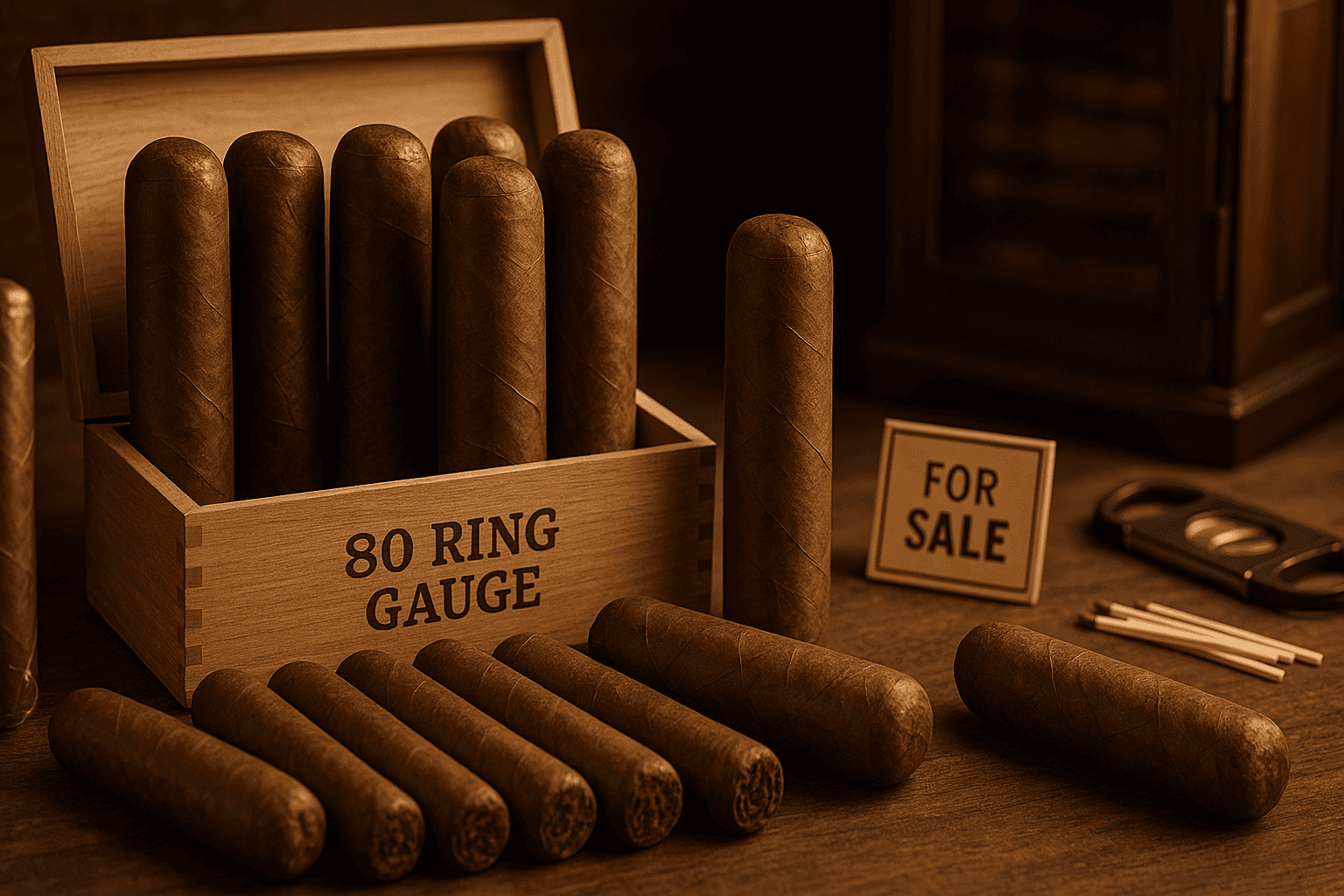
A cigar’s ring gauge expresses diameter in sixty-fourths of an inch; a ring gauge of 80 therefore equals 80/64 in diameter. This method of measurement is standard in trade references and size charts. Vitola and size references (Wikipedia) The physical consequence is straightforward: increasing circumference increases the volume of filler relative to wrapper surface area, modifies thermal mass, and typically slows the rate of temperature rise in the core of the cigar. Readers who wish to convert ring gauge into metric dimensions may use the standard formula: diameter (mm) = (ring gauge / 64) × 25.4. Cigar ring gauge explanation (Davidoff)
A larger ring gauge changes perceived intensity. Because wrapper leaf contributes strongly to top-note aromatics, a broad ring tends to dilute the wrapper’s immediate dominance and emphasize filler layers unless the blend is crafted to prioritize wrapper impact. This mechanical relationship is central to any cigar format flavor map that a buyer uses to predict behavior across formats. Practical buyers benefit from seeing ring gauge as a variable that alters extraction speed, nicotine delivery profile per puff, and the persistence of structural tannins.
Market Context and Availability
Large ring gauge cigars have been visible in mainstream offerings for more than a decade and are available from both mass-market and boutique producers. Retail collections and specialty lists name specific 80-ring examples—both boutique blends and mainstream novelty releases—indicating that the format has established a commercial presence. Retail and hobbyist lists compiling 80-ring offerings provide concrete product names and price-level references. Retail listings and product searches
At a macro level, the cigar and cigarillos market scale contributes to manufacturers’ willingness to offer extreme formats. One industry estimate placed the global cigar and cigarillos market at USD 54.79 billion in 2024, a figure that underscores why brands invest in variant sizes and packaging strategies. Grand View Research: cigar & cigarillos market report
Notable 80-Ring Examples and Typical Price Positioning
Several brand models have drawn attention for their very large ring gauges. Historically cited items include oversized vitolas that reach 80 ring gauges and beyond; product reviews have referenced 6×80 and 8×80 sizes explicitly in trade coverage. Product reviews and trade coverage (Cigar Aficionado) Retailers report stock of 80–89 ring gauge SKUs across brands that target novelty and value segments. Listings and curated “best of” pages catalog specific 80-ring releases for consumers seeking immediate purchase options.
A practical note on pricing: extreme ring gauge cigars are offered across a wide retail range. Some boutique or limited releases command premium marks; many mass-market 80-gauge releases are priced competitively, reflecting economies of scale in machine-made or high-volume handmade production. Retail listings are the best immediate guide to current availability and price.
Construction and Blend Considerations
Large-circumference cigars require deliberate construction choices:
- Filler architecture: To avoid excessive draw or loose combustion, blenders usually layer multiple filler leaves with attention to density and binder selection. Long-filler construction improves ash cohesion and burn stability in larger gauges. How cigars are made (Cigar Aficionado)
- Wrapper choice: Thicker wrappers such as Connecticut Broadleaf, Habano, or Maduro varietals resist splitting on wide gauges. Retail care guides often advise choosing robust wrappers when handling or aging big-ring cigars.
- Binder strength and cap work: Proper cap formation and binder tension prevent unraveling under the increased mass of filler. A poorly tensioned binder on a large ring will invite tunneling and uneven burn.
When shopping for 80 ring gauge cigars for sale, prioritize construction signs: firm but slightly springy packing, seamless wrapper application, and even coloration. Sellers often include construction notes in product descriptions; buyers who can inspect stock should palpate gently along the length for soft spots.
Sensory Trajectory: How an 80 Ring Cigar Evolves
The sensory profile of a very wide cigar can be mapped into condensed phases, with dynamics affected by ring gauge, length, and shape. The following framework offers a replicable tasting protocol:
- Opening phase (first quarter): Because of larger filler mass, the opening often produces broad, muted wrapper notes and immediate filler complexity—earth, leather, cocoa, toasted grain—without wrapper dominance on the first draws. Thermal mass moderates heat transfer, producing cooler puffs relative to narrow-gauge counterparts.
- Middle phase: The blend’s architecture—ligero, seco, volado distribution—becomes apparent. In well-designed 80-ring blends, spice and secondary notes (baking spice, dried fruit, cedar) surface gradually rather than immediately. If the binder or filler includes a high proportion of ligero, intensity will increase in this segment.
- Closing phase: The last third concentrates residual oils and tannins. Due to the volume of tobacco, the finish can remain cool if the smoker paces draws; excessive frequency of draws raises temperature and can produce harshness. Judicious pacing preserves complexity into the finish.
Objective metrics are useful: measure draw resistance on a 1–5 scale, ash cohesion in millimeters before flaking, and finish duration in seconds after the final puff. These measures create an evidence-friendly set of tasting notes that are repeatable across sessions.
Shapes, Cut, and the Role of Vitola
Shape choices influence how an 80-ring cigar behaves. The broad categories parejo vs figurado shapes remain relevant: parejos (straight-sided forms) stabilize draw and burn; figurados (tapered or irregular forms) can modulate airflow and local heat transfer. Parejo and Figurado definitions (Cigar Aficionado glossary)
A few shape-related considerations:
- What is a torpedo cigar: a tapered head design that narrows the smoke channel and increases wrapper influence per puff; the combination with a very large ring gauge can create pronounced dynamics in the initial draws.
- Perfecto shape characteristics: tapers at both ends with a mid-body swell; on a wide gauge, a perfecto forces notable shifts in draw resistance as construction changes along the length.
- Lancero smoking profile: the lancero smoking profile emphasizes wrapper oils due to its narrow bore; its behavioral contrast with an 80-ring cigar clarifies how ring gauge alters perceived balance.
Choice of cutter is practical: a straight guillotine or a punch suited to the broad head is recommended, and frequent testers suggest a V-cutter for large gauges to reduce airflow and temperature when desired.
Buying Strategy: Where to Look and What to Inspect
When searching for 80 ring gauge cigars for sale, buyers may consult three channels:
- Specialty retailers and humidor shops: These sources often carry premium 80-gauge handmade releases and permit tactile inspection. Retailers and specialist lists catalog available models and notes on construction. Specialty retailers and listings
- Online marketplaces and large-scale vendors: These platforms list novelty and mass-market 80-gauge lines, often with price comparison and user reviews. Product pages frequently include measurements and blend descriptions.
- Auction and collector communities: Limited-run tins and commemorative releases can appear in secondary markets; condition and provenance matter for collectibility.
Inspect product listings for clear ring gauge and length information; the standard notation (e.g., 6 × 80) communicates exact dimensions. When possible, query the seller about filler composition (long vs short filler), wrapper varietal, and typical draw characteristics.
Pairings, Time Management, and Format Choice
An 80-ring cigar is a commitment: wide circumference often indicates a longer session or larger tobacco mass to carry flavor development. For pairing and time planning:
- Use a cigar format flavor map that matches ring gauge to beverage intensity: full-bodied spirits pair with full-bodied wide cigars; lighter teas or espressos pair better with mid-range ring sizes.
- If time is limited, consult a short smoke cigars guide: select smaller formats (robusto, petit corona) where flavor extraction occurs on a compressed timeline. The opposite choice—long smoke cigar picks such as Churchills or full-length gordos—fits leisure hours and relaxed pacing.
- Choosing cigar size for occasion should account for company, meal pairing, and tolerance to nicotine exposure.
Practical Handling and Storage
Large ring gauges are more sensitive to handling and require slightly higher humidity targets to maintain wrapper elasticity—retail advice often recommends maintaining humidor conditions around 65–67% relative humidity for big-ring stock. A V-cutter is commonly suggested as the preferred cutter for extra-wide cigars to reduce heat and control smoke volume. Practical handling guides and cutter recommendations
Final Considerations
An 80 ring gauge cigar is a design choice with measurable mechanical and sensory consequences. It shifts the balance of wrapper influence, increases thermal mass, and demands careful construction to maintain consistent burn and draw. Availability spans novelty releases, mass-market lines, and handcrafted limited editions; market-scale factors explain why many producers list wide gauges in their portfolios. Market context and analysis
Buyers seeking 80 ring gauge cigars for sale should prioritize verified construction quality, readable product specifications, and informed storage. When assessed with deliberate metrics and paced smoking, large ring gauges provide a distinctive, layered experience that rewards attention to blend intent and sensible pairing choices.